
A food-manufacturing plant is planning to install a new 2,000-gallon aboveground tank for edible soybean oil adjacent to an existing 1,200-gallon diesel fuel tank on a site that drains to a nearby creek. The plant engineer assumes the soybean oil tank is exempt from federal Spill Prevention, Control, and Countermeasure (SPCC) planning because it is a food-grade vegetable oil rather than petroleum. How should the EHS manager classify the soybean oil tank when determining SPCC applicability under 40 CFR Part 112?
Select an answer to reveal the explanation.
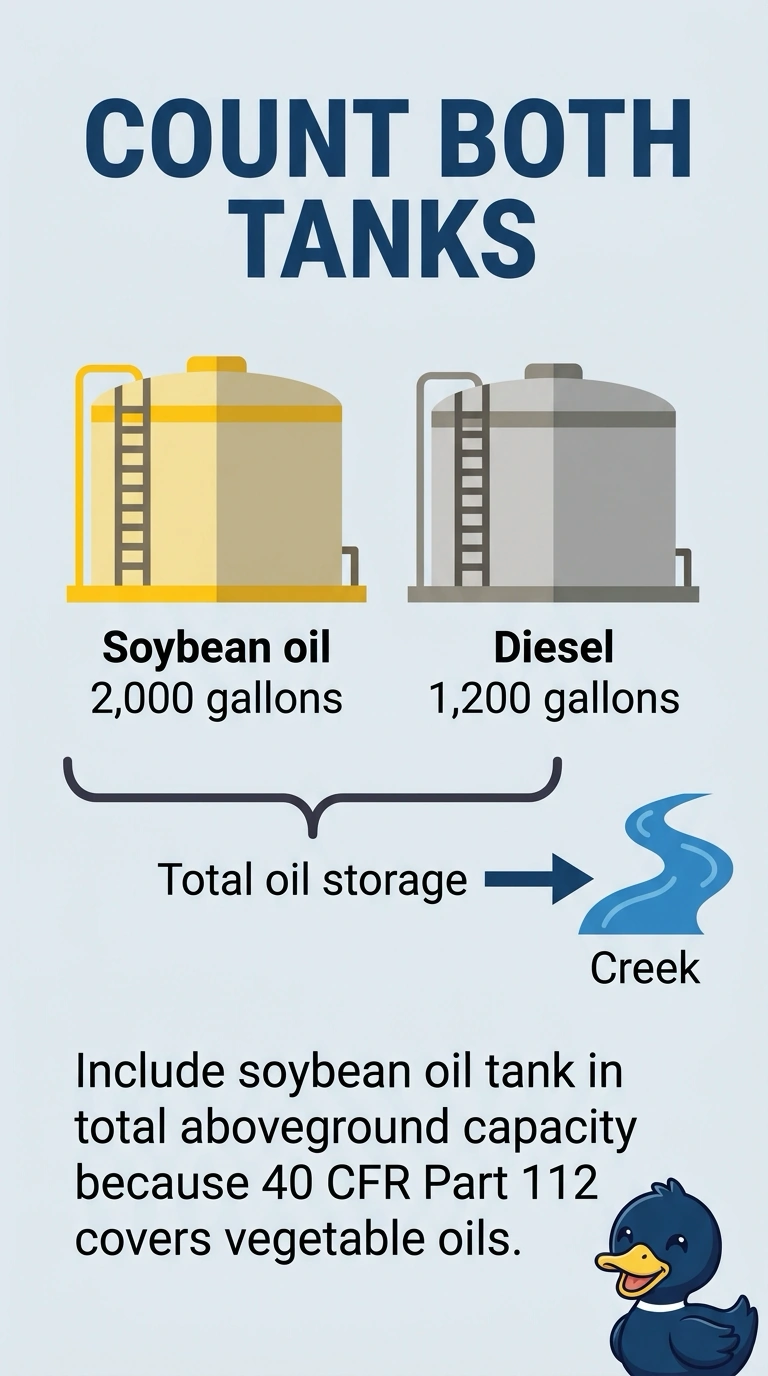
Short Explanation
Don't let the word "edible" fool you when you calculate oil storage thresholds! The classic trap is assuming SPCC rules only care about petroleum fuels, when in reality vegetable oils can suffocate aquatic life just as fast. You must include the soybean oil tank in your total aboveground oil storage capacity under 40 CFR Part 112.
Full Explanation
Under EPA Spill Prevention, Control, and Countermeasure regulations in 40 CFR 112.2, oil is defined broadly to include petroleum, fuel oil, synthetic oils, animal fats, and vegetable oils such as soybean oil. Therefore, the facility must Include the soybean oil tank in total aboveground oil storage capacity because 40 CFR Part 112 covers vegetable oils. Excluding it pushes the plant below or misstates its regulatory applicability when evaluating whether total aboveground oil storage exceeds 1,320 gallons. The choice to Exclude the soybean oil tank from aggregate capacity because food-grade oils are non-toxic fails because even food-grade oils can coat waterways, deplete dissolved oxygen, and harm aquatic life. The choice to Count the soybean oil tank only if it is stored in the same containment dike as diesel is incorrect because SPCC capacity thresholds aggregate all qualifying oil containers across the facility, regardless of separate dikes. The choice to Regulate the soybean oil tank solely under RCRA Subtitle C hazardous waste storage rules fails because virgin soybean oil stored as a raw material is a product, not a discarded hazardous waste. Keep in mind the caveat that only containers of 55 gallons or more count toward the 1,320-gallon aggregate SPCC threshold. As an operational check, review your facility oil inventory register to confirm every petroleum, synthetic, animal, and vegetable oil tank of 55 gallons or more is included in your SPCC Plan.
Prefer to study offline? Printable PDF study book + test engine ($7.50, unofficial). These questions stay free here.