
During a pre-job briefing for a tank-entry task requiring tight-fitting half-mask air-purifying respirators, a supervisor notices an operator has a full beard covering the cheeks and chin. What must the supervisor require under OSHA 29 CFR 1910.134?
Select an answer to reveal the explanation.
Short Explanation
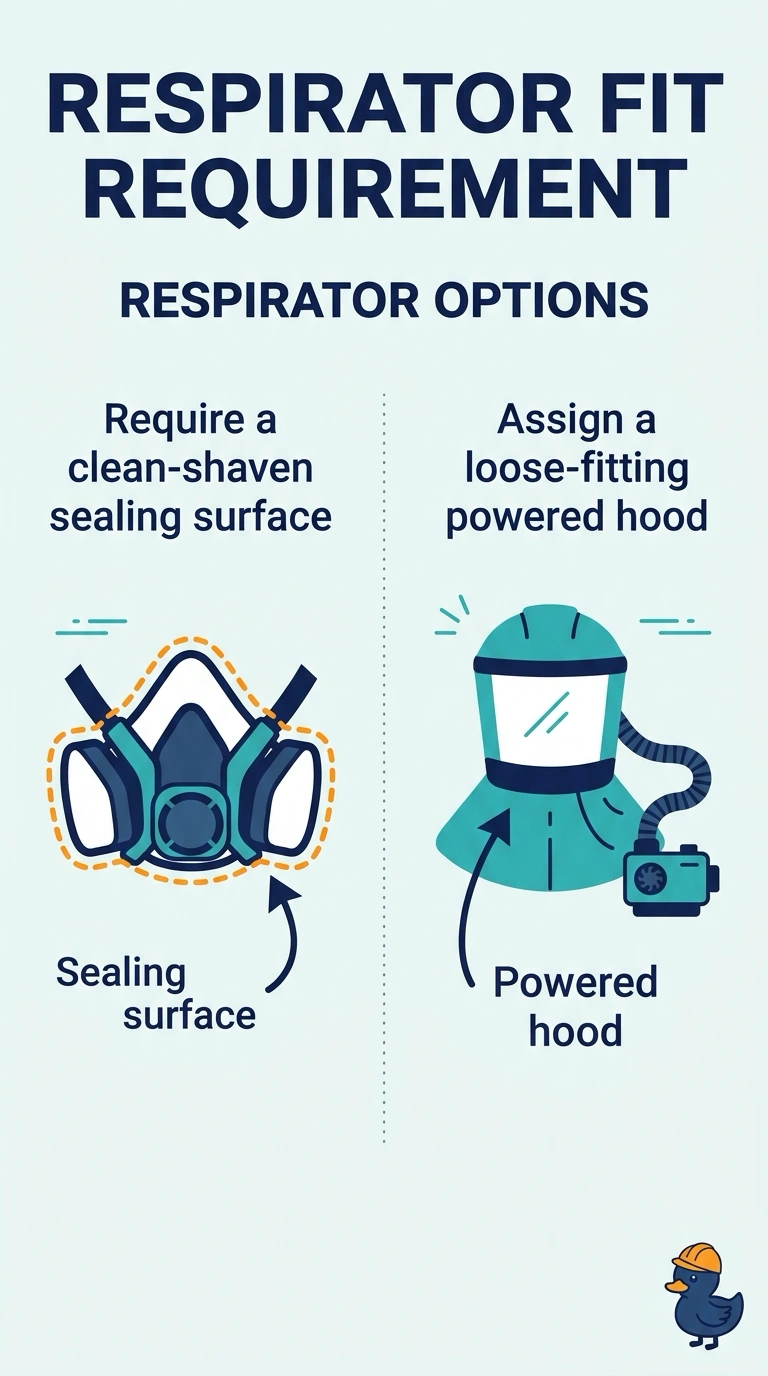
Even microscopic facial hair breaks the rubber-to-skin seal on a tight-fitting respirator, letting contaminants bypass the filter. Don't fall for the trap of tightening straps or switching sizes to force a fit over a beard. For your crew, the only compliant paths are a clean-shaven sealing surface or a loose-fitting hooded unit.
Full Explanation
OSHA Respiratory Protection at 29 CFR 1910.134 prohibits tight-fitting respirators from being worn by employees with facial hair that comes between the facepiece sealing surface and the face or interferes with valve function. Choosing to Require a clean-shaven sealing surface or assign a loose-fitting powered hood protects the worker either by restoring an intact seal or by using positive-pressure hooded equipment that does not rely on a tight facepiece seal. Choosing to Increase the respirator strap tension until the rubber seal compresses the beard fails because hair fibers still create leak channels and overtightening causes discomfort and seal distortion. Choosing to Apply petroleum jelly along the sealing edge to block vapor leakage around hair fails because lubricants degrade elastomeric facepieces, trap contaminants, and are prohibited by OSHA and manufacturers. Choosing to Switch to a smaller tight-fitting half-mask size without repeating a fit test fails both because facial hair still prevents a seal and because any change in respirator model or size requires a new fit test. Exam caveat: mustaches or goatees are only permitted if they stay completely clear of the sealing surface and exhalation valve. Operational check: perform a pre-use seal inspection and positive/negative user seal check before entering any contaminated zone.
Prefer to study offline? Printable PDF study book + test engine ($7.50, unofficial). These questions stay free here.