
Personal air-monitoring results for a paint-booth operator show simultaneous 8-hour time-weighted average exposures to two organic solvents that both act as central nervous system depressants, with each individual solvent measuring at 60 percent of its OSHA Permissible Exposure Limit. How must the industrial hygienist evaluate compliance under 29 CFR 1910.1000?
Select an answer to reveal the explanation.
Short Explanation
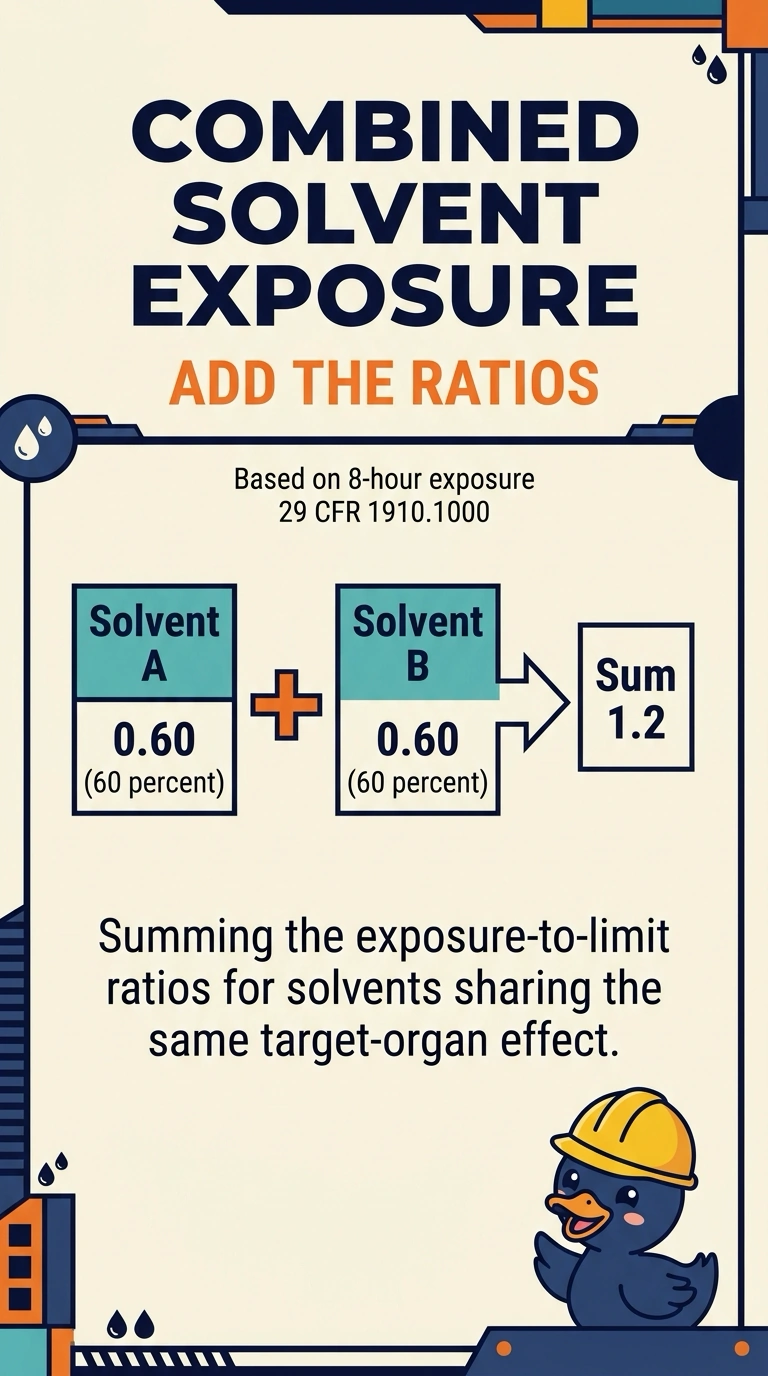
When you monitor two solvents that depress the same target organ, their effects can add up. Summing their exposure-to-limit ratios gives 1.2, above the compliance threshold of 1.0; checking each solvent alone would miss the combined overload.
Full Explanation
When you assess simultaneous exposure to contaminants with additive effects on the same organ system, OSHA 29 CFR 1910.1000 requires evaluating the combined mixture rather than each chemical in isolation. Summing the exposure-to-limit ratios for the two solvents that both depress the central nervous system gives 0.60 + 0.60 = 1.20, exceeding unity (1.0) and indicating an overexposure that requires engineering or respiratory controls. Comparing only the single highest solvent concentration with its individual exposure limit ignores the additive burden of the second solvent on the central nervous system. Averaging the two airborne concentrations before comparing the result with the higher limit is mathematically invalid because different chemicals can have different toxic potencies and exposure limits. Evaluating each vapor independently because both are below their odor thresholds is unreliable: odor thresholds vary widely among people and may exceed safe exposure limits. One exam caveat is that ratios for chemicals acting independently on entirely different target organs without additive effects are not combined unless toxicological data show an interaction. As a practical check, review Safety Data Sheet Section 11 for target-organ information before calculating mixture compliance.
Prefer to study offline? Printable PDF study book + test engine ($7.50, unofficial). These questions stay free here.