
During a tank-cleaning operation, personal air monitoring measures an airborne organic solvent vapor concentration of 1,200 ppm, which is below the substance's IDLH level of 2,000 ppm but well above its 100 ppm OSHA Permissible Exposure Limit. Half-mask air-purifying respirators carry an Assigned Protection Factor (APF) of 10, while full-facepiece air-purifying respirators carry an APF of 50. Which respirator selection complies with OSHA 29 CFR 1910.134(d)(3)(i)?
Select an answer to reveal the explanation.
Short Explanation
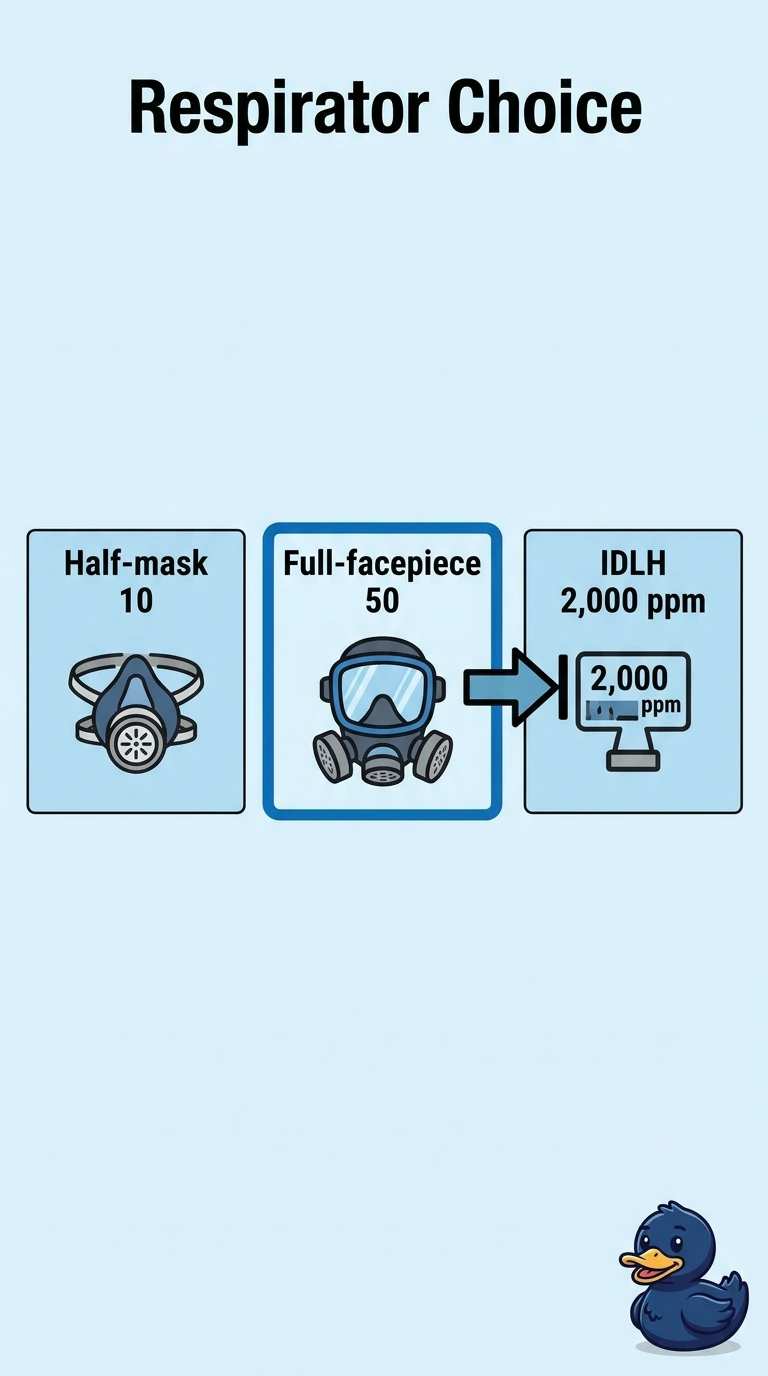
You find your protection by multiplying APF by the PEL, then capping at IDLH if that math exceeds it. For you at 1,200 ppm, a full-facepiece calculates to 5,000 ppm but is capped at the 2,000 ppm IDLH, so you are still protected, while a half-mask maxes at 1,000 ppm and leaves you exposed.
Full Explanation
Under OSHA 29 CFR 1910.134(d)(3)(i), Maximum Use Concentration equals Assigned Protection Factor multiplied by the exposure limit, but when that calculation exceeds IDLH the employer must cap MUC at IDLH. Choosing "A full-facepiece air-purifying respirator, with the maximum use concentration capped at the 2,000 ppm IDLH" complies because 50 x 100 ppm PEL = 5,000 ppm capped at 2,000 ppm IDLH, which exceeds the measured 1,200 ppm while remaining below IDLH where air-purifying use is still allowed. Choosing "A half-mask air-purifying respirator paired with double organic vapor cartridges" fails because 10 x 100 ppm = 1,000 ppm MUC, below 1,200 ppm, and added cartridges do not change face-seal leakage that sets APF. Using "A loose-fitting filtering facepiece respirator fitted with an organic vapor cartridge" fails because loose-fitting design provides no face seal and no assigned vapor protection to achieve the required MUC at 1,200 ppm. Relying on "A half-mask air-purifying respirator paired with a documented four-hour cartridge change-out" fails because a change schedule prevents sorbent breakthrough but does not raise APF or MUC above 1,000 ppm.
Prefer to study offline? Printable PDF study book + test engine ($7.50, unofficial). These questions stay free here.