
Personal air-sampling results for a solvent-coating operator show an 8-hour time-weighted average exposure of 35 ppm, which is below the OSHA Permissible Exposure Limit (PEL) of 50 ppm but above the ACGIH Threshold Limit Value (TLV) of 20 ppm. How should the EHS manager interpret these results when advising plant leadership?
Select an answer to reveal the explanation.
Short Explanation
OSHA PELs set the legal floor, while ACGIH TLVs reflect newer health science. The trap is treating them as interchangeable—either thinking the TLV brings an OSHA fine or ignoring a lower consensus limit that could protect your workers.
Full Explanation
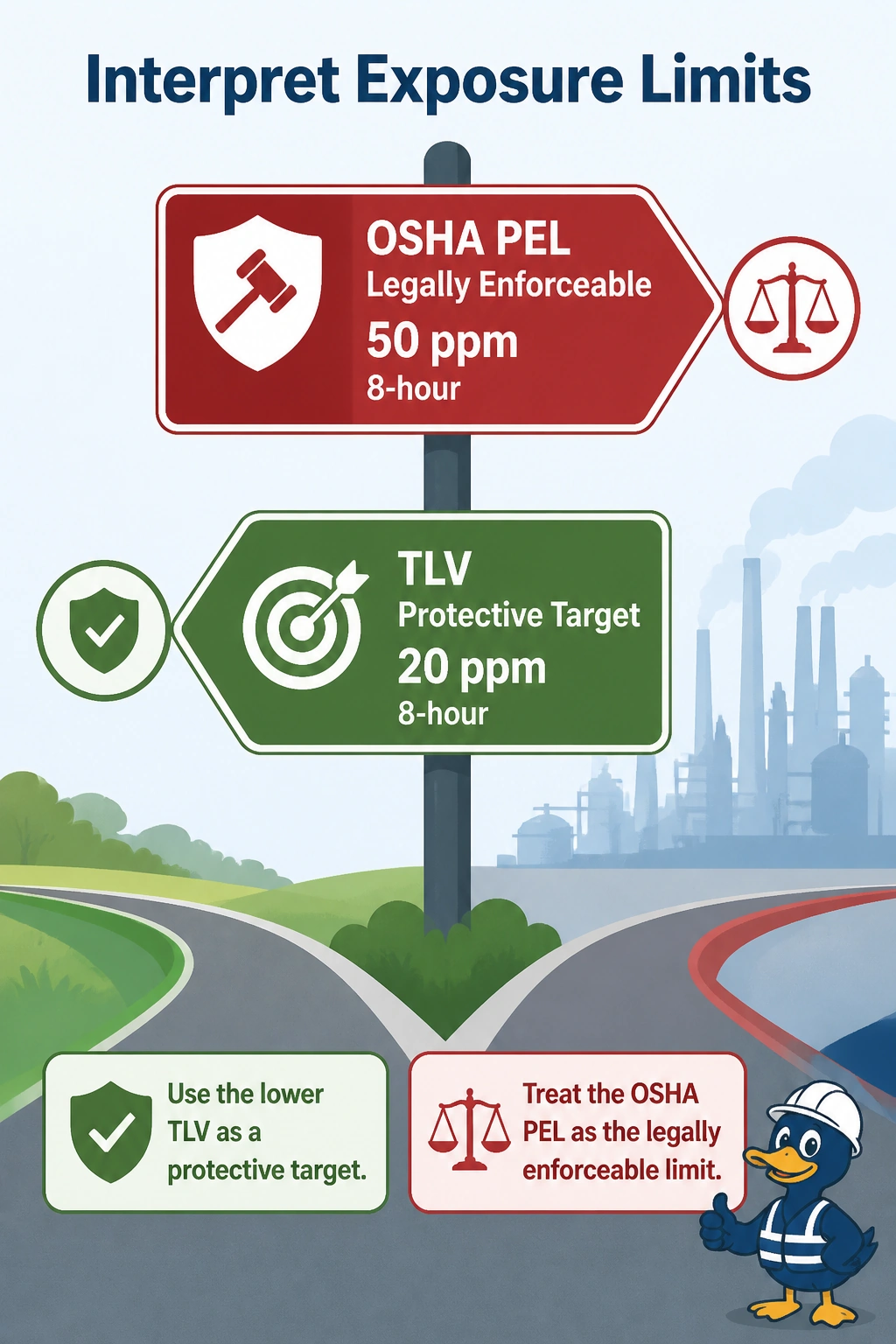
In US industrial hygiene practice, you should treat the OSHA PEL as the legally enforceable limit while using the lower TLV as a protective target when evaluating worker exposure. OSHA PELs in 29 CFR 1910.1000 are binding federal standards, whereas ACGIH TLVs are peer-reviewed health-based recommendations that are frequently updated and more stringent. Choosing to ignore the ACGIH TLV completely because consensus guidelines cannot inform workplace exposure controls overlooks valuable toxicological guidance and best-practice risk reduction. Choosing to treat the ACGIH TLV as a federal citation threshold enforced directly by OSHA compliance officers misstates regulatory authority, as OSHA enforces its own PELs (though consensus standards can inform General Duty Clause evaluations in specific circumstances). Choosing to average the eight-hour sample over a forty-hour workweek to compare against the OSHA Ceiling limit is scientifically and legally wrong because a Ceiling limit is an instantaneous maximum that must never be exceeded at any point. As a caveat, always check whether a specific substance has a newer substance-specific OSHA standard or state-plan PEL that is stricter than federal Table Z limits. Operationally, evaluate engineering controls such as local exhaust ventilation to bring exposures below the 20 ppm TLV and document the rationale in your industrial hygiene program.
Prefer to study offline? Printable PDF study book + test engine ($7.50, unofficial). These questions stay free here.