
A maintenance contractor needs to weld a pipe support bracket onto a structural beam directly above a covered process line containing flammable hydrocarbons at a facility regulated under OSHA Process Safety Management (29 CFR 1910.119). What must the facility require before any arc welding begins?
Select an answer to reveal the explanation.
Short Explanation
Sparks and flammable vapors only need one second together to turn routine maintenance into a major incident. The trap is treating welding near covered process piping like ordinary shop work when you must secure a formal Hot Work Permit first.
Full Explanation
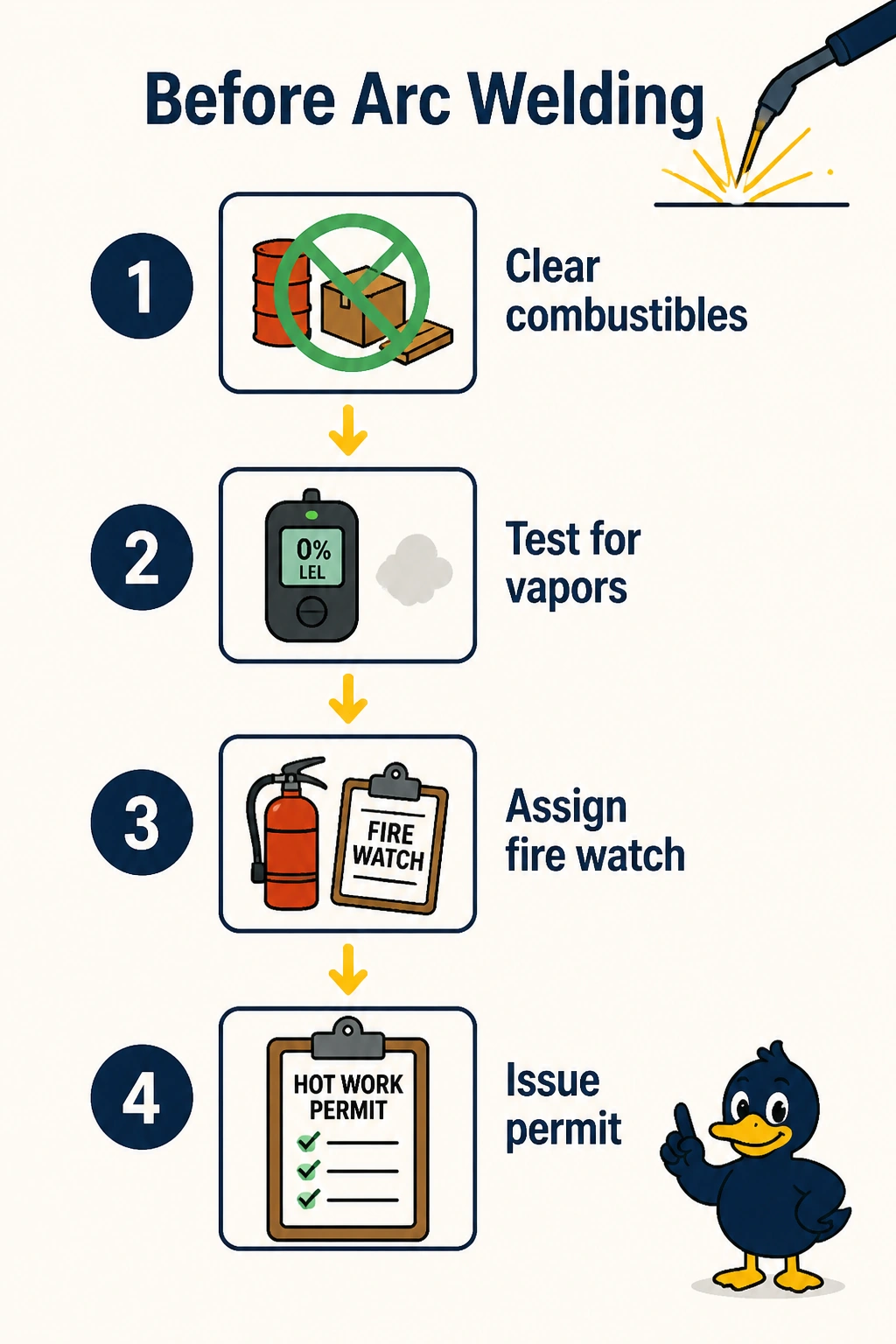
Under OSHA Process Safety Management in 29 CFR 1910.119 and 29 CFR 1910.252, the facility must issue a Hot Work Permit after clearing combustibles, testing for flammable vapors, and assigning a fire watch before any welding begins on or near a covered process. The written permit documents that fire prevention and protection precautions have been verified and authorizes work for a defined time and location. Choosing to proceed with welding once the area supervisor gives verbal approval at shift start bypasses mandatory written authorization and hazard verification. Choosing to rely on the building sprinkler system alone without performing atmospheric gas testing ignores the risk of igniting an explosive vapor cloud before sprinklers can even activate. Choosing to apply Lockout/Tagout to the welder power cord while leaving nearby solvent vents open misunderstands energy isolation and leaves an active vapor source next to ignition sparks. A critical caveat is that atmospheric monitoring must continue or be repeated whenever conditions can change, and the fire watch must remain posted after welding stops to catch smoldering embers. Operationally, verify calibrated LEL meter readings of zero percent before signing the permit and keep a charged extinguisher within arm's reach.
Prefer to study offline? Printable PDF study book + test engine ($7.50, unofficial). These questions stay free here.