
Why does model risk practice under SR 26-2 (which superseded SR 11-7 in April 2026) value challenger or benchmark models?
Select an answer to reveal the explanation.
Short Explanation
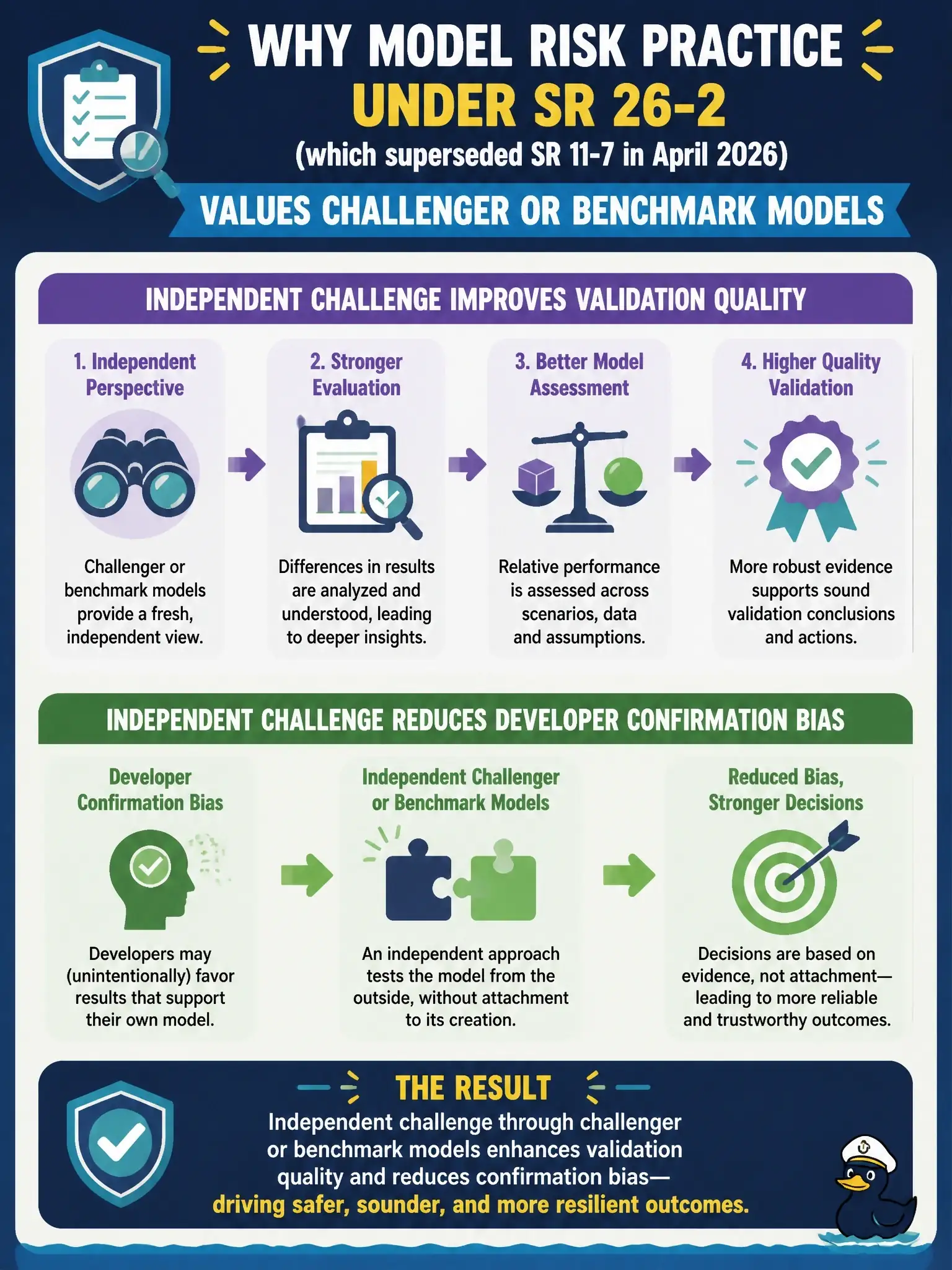
A challenger model is the friend who asks, 'Are you sure about that?' before you commit. Benchmarking against one gives you the effective challenge SR 26-2 talks about and keeps developers from only seeing what they expect to see.
Full Explanation
SR 26-2, issued by the Federal Reserve, OCC and FDIC in April 2026 to supersede SR 11-7, keeps effective challenge at the center of model risk management: critical analysis by objective experts with the expertise, sufficient independence and organizational standing to effect change. Challenger and benchmark models are a practical way to deliver it. For development, the guidance describes testing that compares alternative assumptions and methodologies, and for conceptual soundness it notes that benchmarking to other models may be more practical than theoretical review for some model types. A challenger built on different methods or data exposes where the champion's results hinge on one particular choice, which counters the confirmation bias of a team reviewing its own work. The idea that one model should never be questioned is the opposite of effective challenge. The claim that challengers are forbidden in banking is false; comparing alternatives is standard practice. Letting challengers replace production without controls confuses challenge with deployment; a challenger that outperforms still goes through validation and change control before promotion. Exam caveat: SR 26-2 is non-binding and scales rigor to materiality, so challengers are most justified for material models. In practice, record champion-versus-challenger results in the validation report alongside the decision they supported.