
An alternative data team at a real estate investment trust (REIT) wants to generate alpha by predicting same-store NOI growth before it is reported. They have access to high-cadence satellite imagery, mobile foot traffic data, and building permit filings. Which data integration strategy is MOST likely to produce statistically significant alpha, and why?
Select an answer to reveal the explanation.
Short Explanation and Infographic
Imagine trying to judge a restaurant's health by looking only at the menu — but if you also watched the parking lot filling up, tracked how many people's phones pinged the location, and saw that a new competing restaurant just got a permit next door, you'd have a complete picture. Multi-modal fusion is the difference between a single clue and a working investigation.
Full explanation below image
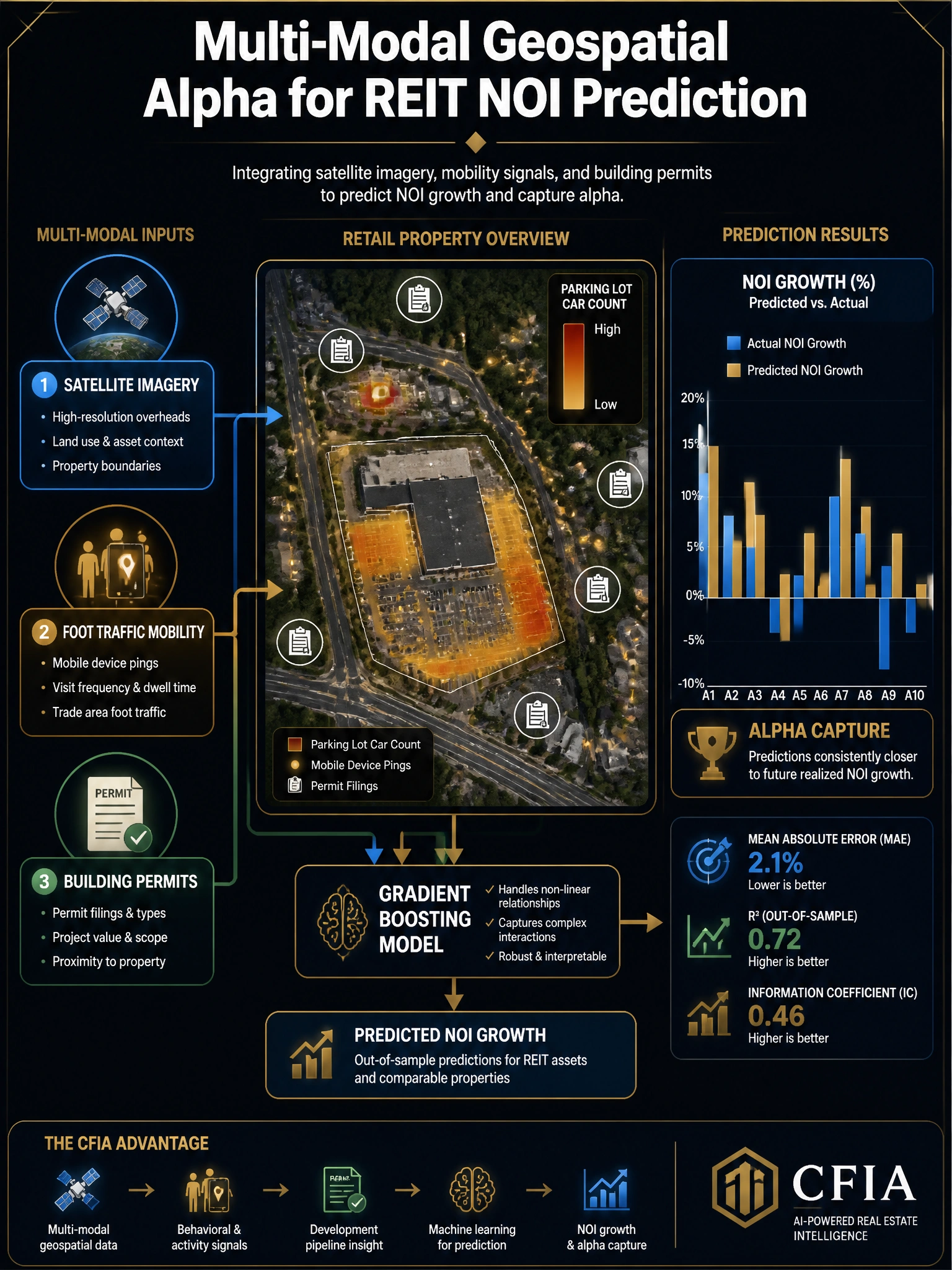
Full Explanation
Option C is correct because geospatial alpha generation in real estate reaches its highest predictive power when complementary data streams capture different aspects of property performance at different time horizons. Satellite imagery processed with computer vision (car counting in parking lots, roof HVAC unit monitoring, loading dock activity) provides a persistent, high-frequency proxy for occupancy and tenant health. Mobile foot traffic (from anonymized SDK panel data) captures consumer visitation with latency measured in days. Building permit filings — for both the subject property and competing developments within a defined trade area — provide forward-looking supply pressure signals.
Gradient boosting models (XGBoost, LightGBM) are particularly well-suited to this type of structured heterogeneous feature set because they handle missing data gracefully, model non-linear interactions between features, and provide feature importance scores that allow analysts to understand which signals are driving predictions — critical for investment committee presentations.
The property-level granularity point is important: REITs report same-store NOI at the portfolio level, but the predictive signal is richest when modeled at the individual asset level, then aggregated. This allows the model to identify which specific properties are outperforming or underperforming the portfolio mean — information that is valuable for both position sizing in REIT securities and for direct real estate investors doing asset-level underwriting.
Option A (permit filings alone) provides only one dimension — supply pipeline — and misses demand-side signals entirely. Government data quality is high, but single-source models underperform in real estate because supply and demand are jointly determined. Option B (foot traffic alone) ignores competitive dynamics and physical property conditions. Option D (reweighted sell-side estimates) is not alpha generation — it is information recycling, and consensus estimates are already reflected in market prices by the time they are published.