
A mid-sized systematic macro fund is evaluating how to source real-time equity and FX market data for its algorithmic trading strategies. The infrastructure team is debating between subscribing to a commercial financial data API (e.g., Bloomberg B-PIPE, Refinitiv Elektron) and establishing direct exchange data feeds through a co-location provider. Both options have dramatically different cost, latency, and operational profiles. Which factors should primarily drive the architecture decision between these two approaches?
Select an answer to reveal the explanation.
Short Explanation
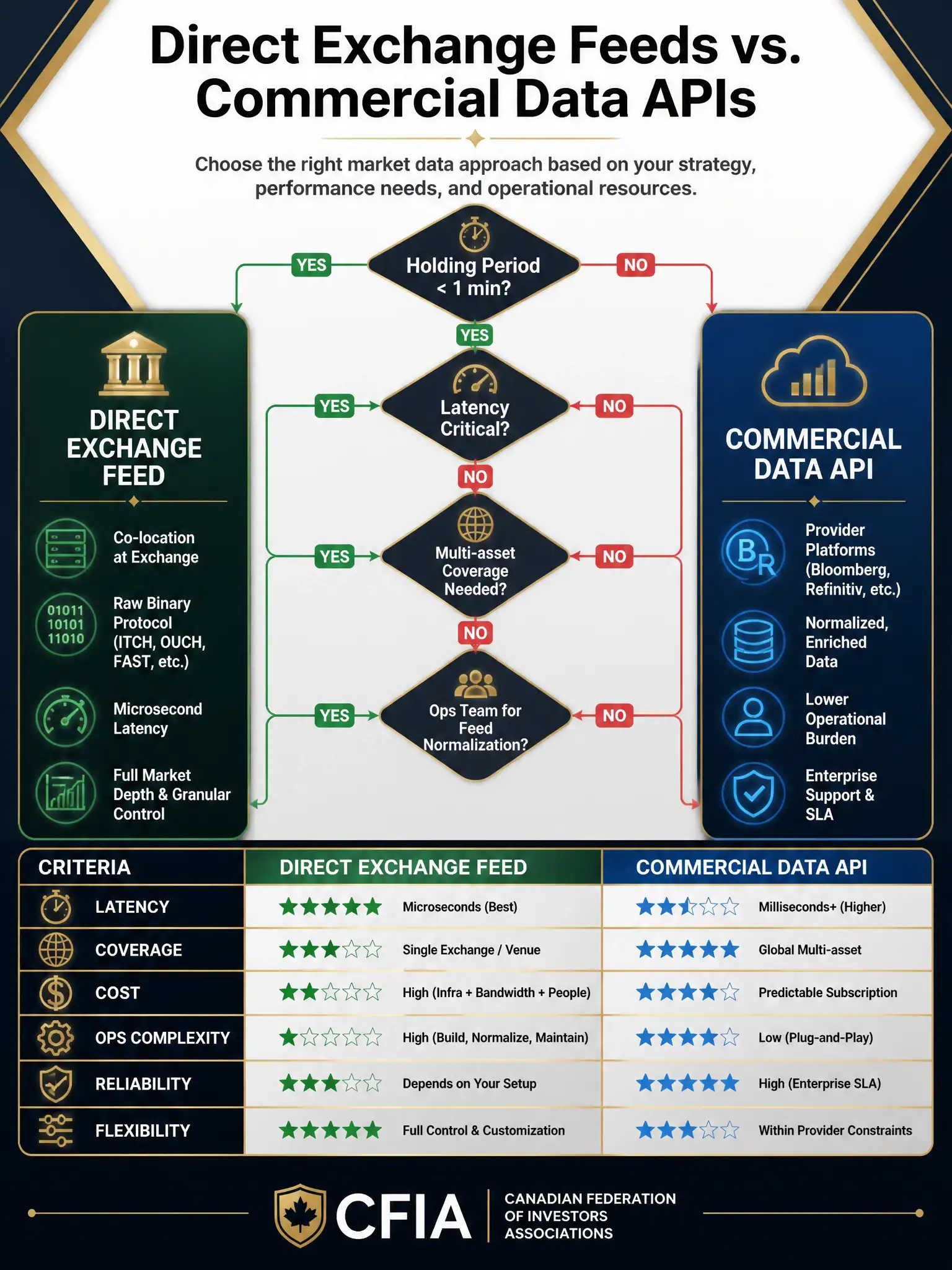
Choosing between a direct exchange feed and a commercial API is like choosing between a private jet and a first-class ticket — it depends where you're going and how fast you need to get there. You should base the architecture on latency needs, holding period, coverage breadth, your team's ability to manage a raw feed, and the cold hard math of cost versus alpha.
Full Explanation
The choice between direct exchange data feeds and commercial data APIs is one of the most consequential and frequently misunderstood infrastructure decisions in systematic investment management. Neither option is universally superior; the optimal choice depends on a constellation of firm-specific factors. The correct framing is that the decision should be driven by the firm's minimum latency requirements, strategy holding period, data coverage breadth needs, operational capacity to manage feed normalization, and total cost of ownership relative to the alpha being generated. Latency requirements and strategy holding period are the primary filters. High-frequency and ultra-low-latency strategies, with holding periods measured in milliseconds to seconds, require direct exchange feeds with co-location to achieve the microsecond latency profiles necessary for competitive execution. Systematic macro strategies with daily or weekly holding periods gain no meaningful alpha from microsecond latency and would be wasting significant capital on co-location infrastructure. Data coverage breadth favors commercial providers for firms trading across many asset classes, geographies, and data types. Bloomberg B-PIPE and Refinitiv Elektron normalize data from thousands of sources, handle corporate actions, provide reference data, and include alternative datasets. Replicating this coverage with direct feeds would require exchange memberships, connectivity agreements, and normalization pipelines across dozens of venues — a substantial engineering burden. Operational capacity is underweighted in vendor evaluations. Direct exchange feeds deliver raw binary market data in exchange-specific protocols such as ITCH, PITCH, and FAST, which require dedicated engineers to decode, normalize, validate, and monitor. Commercial APIs abstract this complexity but introduce vendor dependency risk. The claim that direct exchange feeds are always superior whenever the firm's assets under management exceed $500 million is a heuristic that does not exist in practice. A $500 million macro fund with daily holding periods has no use case for co-location, while a $100 million high-frequency trading firm does. The claim that commercial data APIs should always be preferred because they normalize data across exchanges and reduce operational complexity ignores the legitimate latency advantages of direct feeds for strategies that require them. The claim that the firm should implement both options in parallel — direct feeds for equities and APIs for FX — because exchange feeds do not cover FX markets and FX operates exclusively through OTC broker networks contains a factual error. FX markets have direct feed options through platforms such as EBS, Reuters Matching, and CME FX Link, in addition to OTC ECN connectivity. The claim that FX operates exclusively through OTC broker networks is incorrect.