
A global asset manager running equities, fixed income, commodities, and alternatives has centralized all market and portfolio data into a single data warehouse managed by a central data engineering team. Business users in each asset class report months-long delays for new data products, and data quality issues in one asset class frequently impact others. The CIO tasks the data architecture team with restructuring the data platform. Which architectural approach best addresses these organizational and technical pain points at enterprise scale?
Select an answer to reveal the explanation.
Short Explanation and Infographic
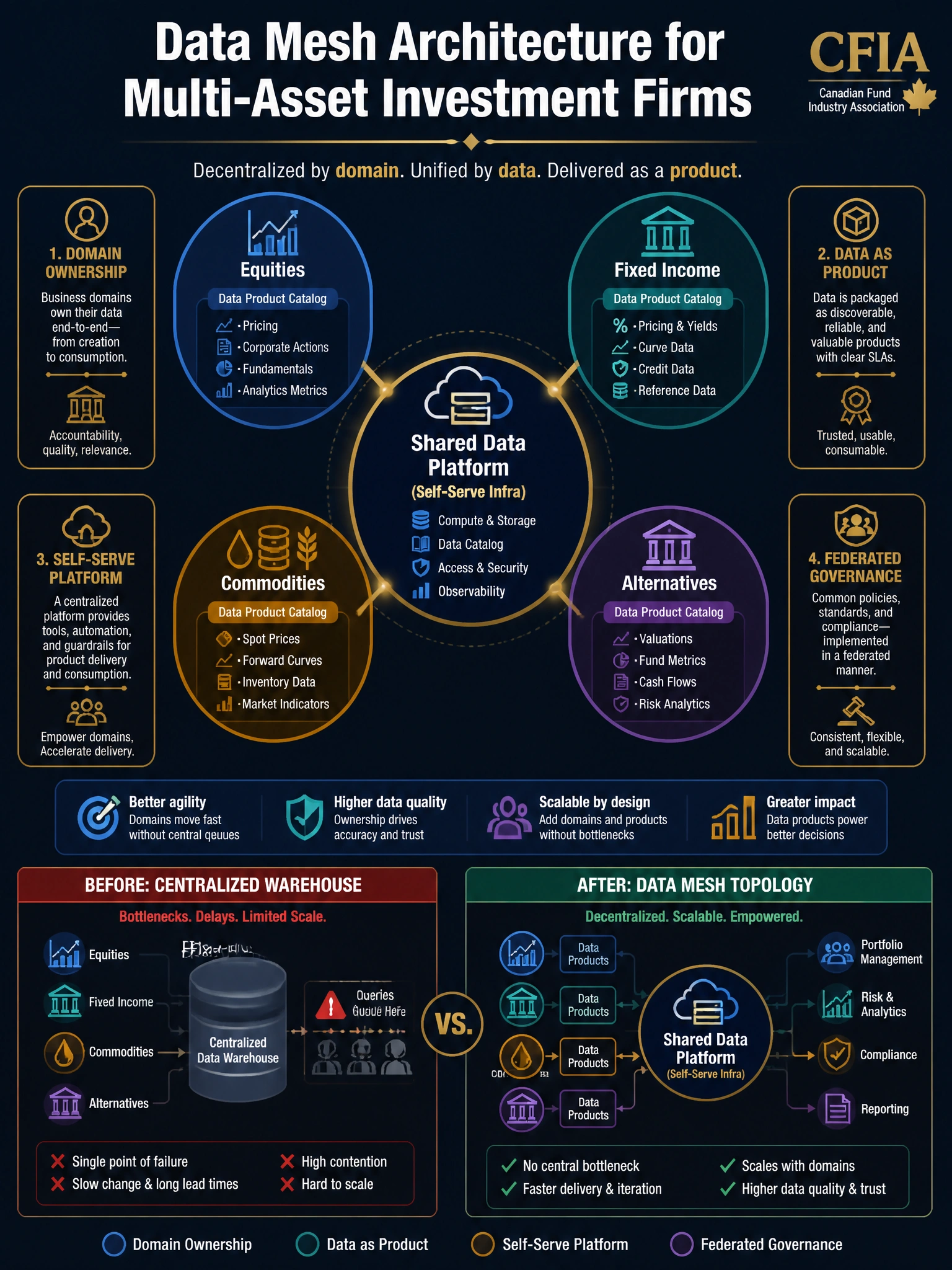
Todd Lammle: Imagine if the equities desk had to file a ticket every time they needed a new price series — and wait six months in a queue behind the rates desk. That's the centralized data warehouse trap. A data mesh flips the model: each asset class team owns their data like a product, with API-style contracts and federated governance. Option B is right because it solves the organizational bottleneck, not just the technical one — the two are inseparable in a multi-asset firm.
Full explanation below image
Full Explanation
The data mesh paradigm, articulated by Zhamak Dehghani and increasingly adopted in financial services, addresses a fundamental organizational failure mode: treating data as a technical artifact owned by a central infrastructure team rather than as a product owned by domain experts. In a multi-asset firm, equities, fixed income, commodities, and alternatives have fundamentally different data models, quality requirements, update frequencies, and regulatory obligations. Centralizing all of this under a single engineering team creates a bottleneck that no amount of additional headcount or hardware acceleration can sustainably resolve.
Option A (faster database + more engineers) is a common but ineffective response. It treats a sociotechnical problem as a purely technical one. Columnar engines like Snowflake or BigQuery improve query performance but do not address the governance model that routes all data requests through a single team. The backlog grows with the organization.
Option C (medallion lake architecture managed centrally) improves data quality tier management but preserves the central ownership model. Cross-asset quality contamination persists because the governance boundary is still organizational — one team is responsible for data correctness across all asset classes it doesn't deeply understand.
Option D (data virtualization) reduces physical data movement but introduces a federation of query complexity and performance unpredictability. It also does not solve ownership: when a fixed income yield curve calculation is wrong, who is responsible for debugging the virtualized view?
Option B — data mesh — assigns ownership to domain teams (equities, fixed income, alternatives) who publish their data as versioned, discoverable, quality-guaranteed products via a shared infrastructure platform. Federated governance establishes enterprise-wide standards (schemas, SLAs, lineage requirements) while allowing domain autonomy. This pattern has been adopted by firms including Goldman Sachs and JPMorgan for exactly this multi-asset coordination problem, and it aligns with the CFIA Data Infrastructure domain's emphasis on organizational data architecture.