
A quantitative investment firm is deploying a large language model to automate end-of-day portfolio rebalancing workflows. The system must retrieve current holdings from the OMS, calculate drift from target weights, execute trade orders via a broker API, and log all actions to a compliance ledger — all without human intervention. Which architectural approach best enables the LLM to orchestrate these heterogeneous backend actions reliably and in a structured, auditable manner?
Select an answer to reveal the explanation.
Short Explanation and Infographic
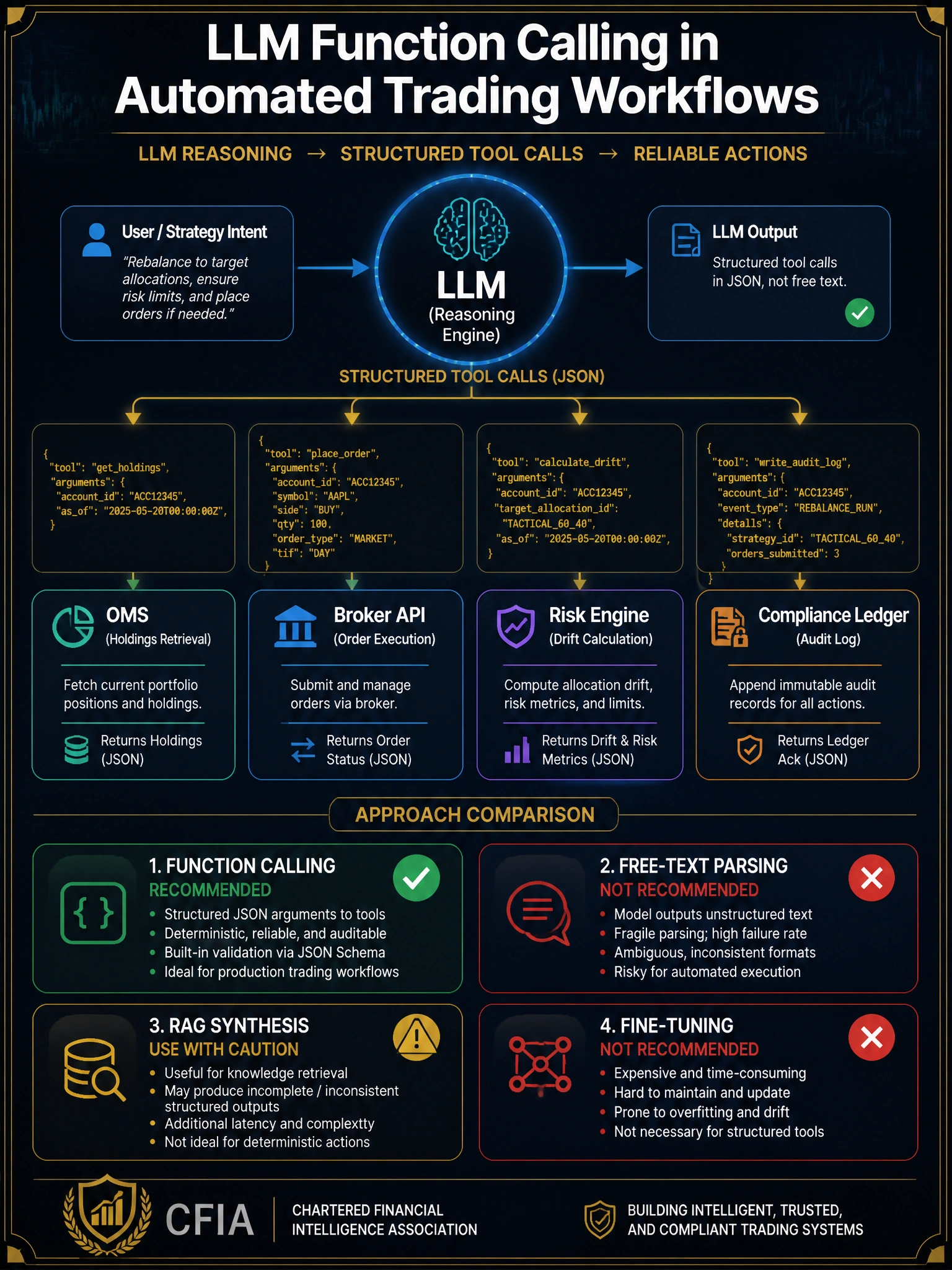
Todd Lammle: Think of function calling like a well-organized toolbox — each tool is labeled, sized for a specific job, and documented. When your LLM needs to rebalance a portfolio, it reaches for the exact right tool with the exact right inputs rather than improvising with a hammer. Structured function calling gives the model typed schemas, so every action is validated before it touches a live system — that's the difference between a reliable quant desk and a compliance disaster. Option B is the clear winner because it combines LLM reasoning power with deterministic, schema-enforced execution.
Full explanation below image
Full Explanation
Function calling (also called tool use) is the canonical architectural pattern for integrating large language models into operational financial workflows that require interaction with external systems. By defining each backend capability — OMS read, broker order submission, compliance ledger write — as a typed JSON schema tool, the LLM reasons about what to do and emits structured function invocation requests. The execution environment then validates parameters, calls the actual API, and returns results for the model to continue reasoning. This creates a deterministic and auditable action trail critical for regulatory compliance under frameworks such as SEC Rule 17a-4 and MiFID II.
Option A (free-form text parsed by a downstream system) introduces brittleness: natural language is ambiguous, the parser becomes a single point of failure, and the action chain is not natively structured for audit logging. Small phrasing variations in model output can silently produce incorrect API calls — unacceptable in live trading contexts.
Option C (RAG for API documentation synthesis) confuses retrieval with execution. RAG is valuable for grounding the model in system documentation, but generating curl commands embedded in prose still requires fragile text extraction before any action is taken. It adds latency and failure modes without providing schema validation.
Option D (fine-tuning on historical trade logs) mistakes memorization for reliability. Fine-tuned models can hallucinate API parameters not present in their training data, and they cannot adapt to schema changes in live systems without retraining. Function definitions exposed at inference time are dynamically updatable and version-controlled — a far more maintainable architecture.
The correct pattern aligns with OpenAI function calling, Anthropic tool use, and the broader agent-action paradigm described in the CFIA body of knowledge. For financial workflows specifically, typed tool schemas enable parameter validation, rate-limit enforcement, permissioning (e.g., order size caps), and complete observability — all non-negotiable requirements in a regulated trading environment.