
An equity research team wants to deploy a large language model to assist analysts in synthesizing earnings call transcripts, 10-K filings, and sell-side research notes into comprehensive company summaries. A data scientist recommends retrieval-augmented generation (RAG) rather than fine-tuning a base model. What is the primary advantage of RAG in this earnings research context?
Select an answer to reveal the explanation.
Short Explanation and Infographic
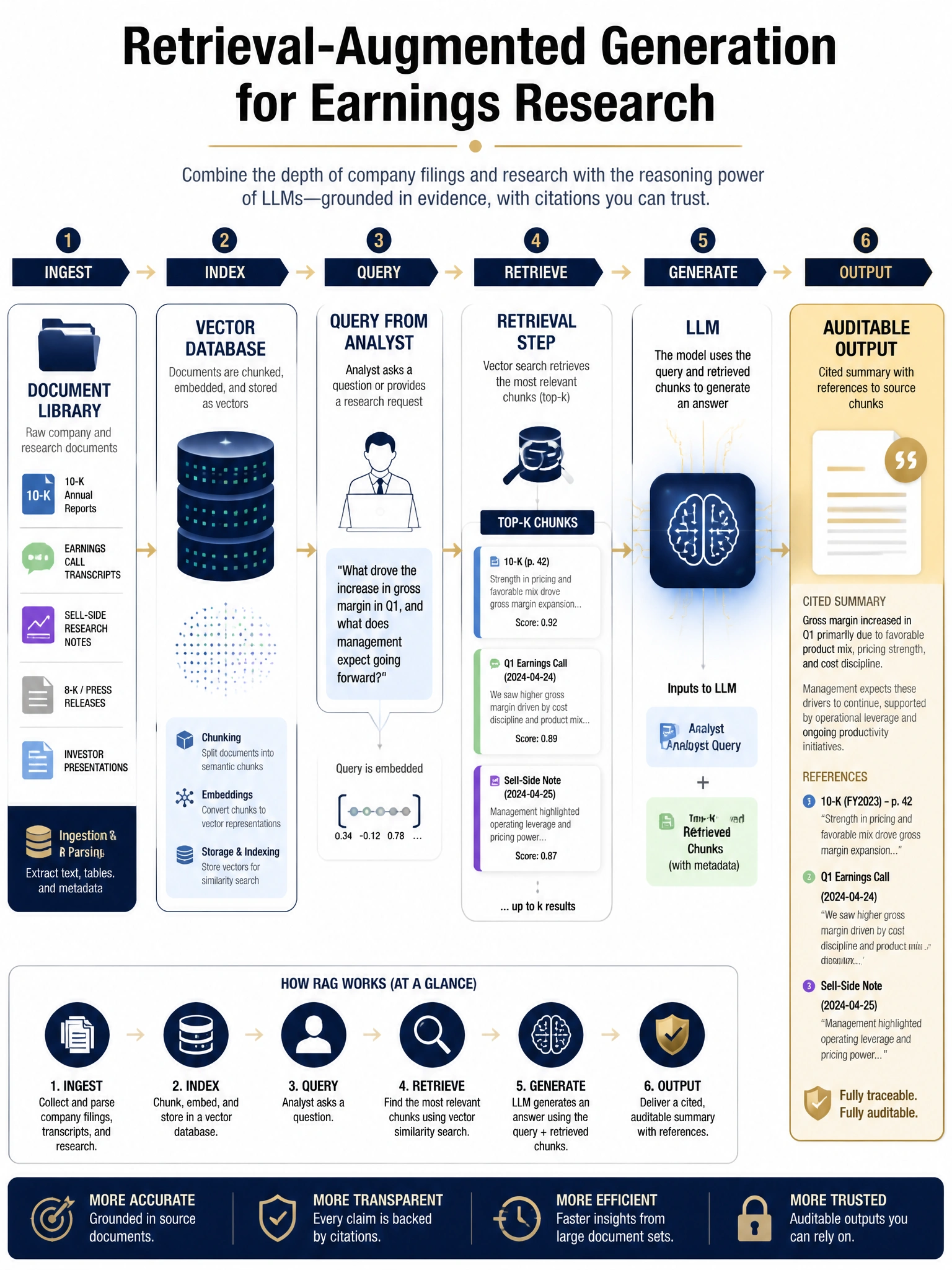
RAG is like giving the analyst a library card instead of memorizing every book. Instead of baking documents into model weights through fine-tuning, RAG retrieves the relevant filings at query time and hands them to the model as live context — so summaries stay current, citable, and auditable as new earnings drop.
Full explanation below image
Full Explanation
Retrieval-augmented generation (RAG) addresses the fundamental limitation of static pre-trained language models in time-sensitive financial research: knowledge cutoff. A base LLM trained on data through a certain date cannot incorporate the Q3 earnings call that was published yesterday, the 8-K filed last week, or the revised sell-side consensus note from this morning. Fine-tuning could update model knowledge, but retraining on every new document is computationally prohibitive and introduces the risk of catastrophic forgetting — where new training degrades performance on previous knowledge.
RAG solves this by separating retrieval from generation. A vector database indexes all relevant financial documents — earnings transcripts, 10-K/10-Q filings, 8-Ks, sell-side notes — as embedding vectors. At query time, the analyst's question is embedded and used to retrieve the most semantically relevant document chunks, which are then injected into the model's context window alongside the query. The model generates its response grounded in those specific retrieved passages, which can be cited by document, page, and paragraph. This citation trail is essential in investment contexts where analysts and compliance teams need to audit the basis for any claim in a company summary.
Additionally, RAG enables selective retrieval across firm-proprietary document repositories that should never be included in model training data due to confidentiality or regulatory restrictions — documents can be queried without being exposed to external model vendors through fine-tuning pipelines. Option A misunderstands RAG: retrieved documents constrain hallucination significantly but do not eliminate it — models can still misinterpret or selectively emphasize retrieved passages, so human review remains mandatory. Option C confuses RAG with fine-tuning; retrieved documents live in an external index, not in model weights, and are fully accessible to administrators. Option D is incorrect: prose fluency is a function of the base model, not the retrieval mechanism.