
A global asset manager operates two historically siloed teams: a quantitative strategies group that runs systematic factor models, and a fundamental research team that generates long-horizon theses on individual companies. The CIO is evaluating how AI can bridge these two teams to create integrated investment insights. Which integration model is most effective?
Select an answer to reveal the explanation.
Short Explanation
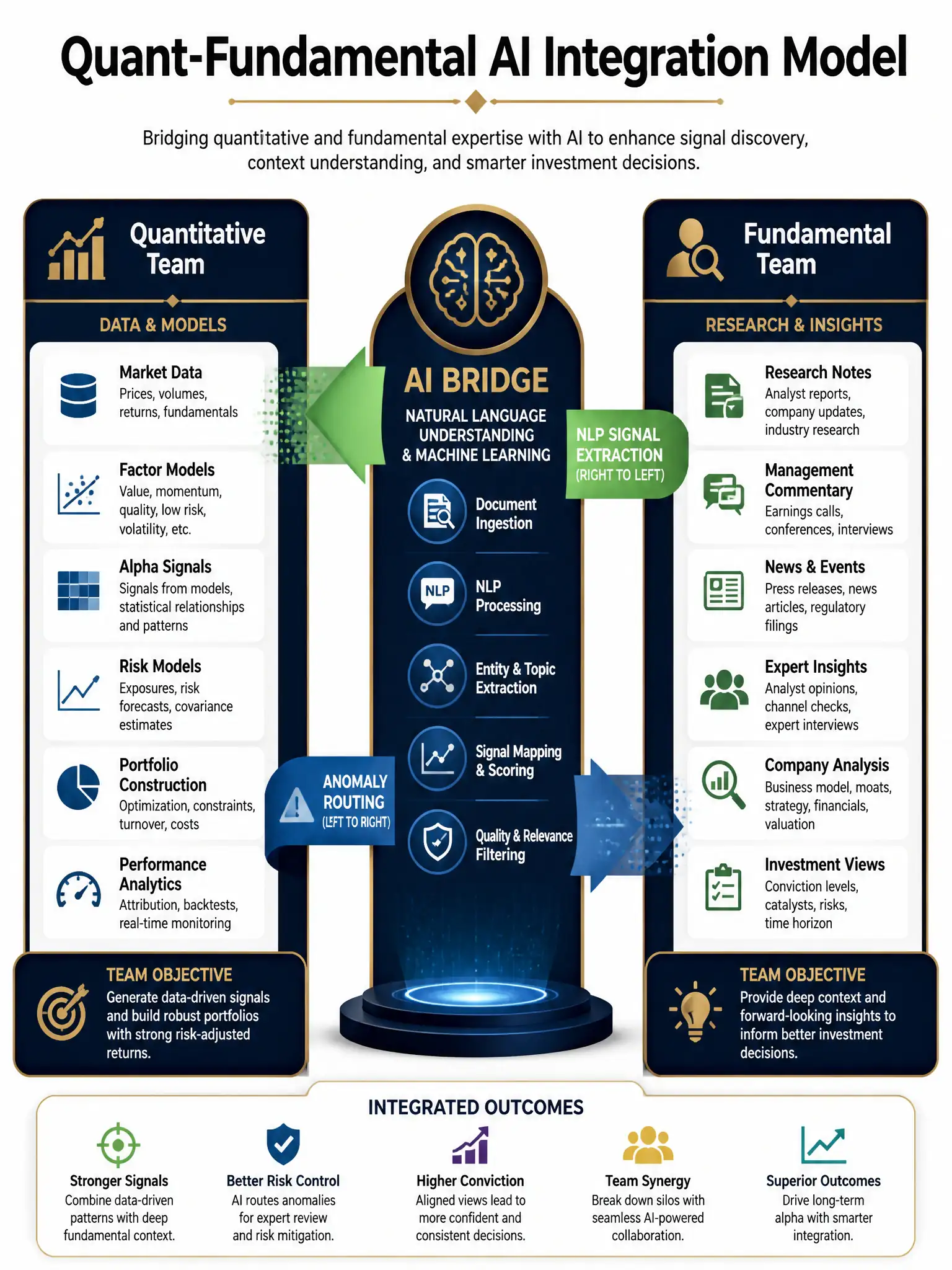
Picture a two-way bridge over a river: the technology carries quant signals upstream to analysts and analyst judgments downstream to models. You get the best integration when fundamental insights become structured signals and statistical anomalies get routed for qualitative investigation. You don't want one-way plumbing that starves either side.
Full Explanation
The persistent silo between quantitative and fundamental teams represents one of the largest untapped sources of alpha in traditional asset management. Quant models excel at processing structured data at scale but often miss the qualitative context that makes a signal durable — management quality, competitive moat, regulatory risk, or industry disruption dynamics. Fundamental analysts capture those qualitative dimensions but are constrained in breadth and speed. The technology serves as the translation layer between these two disciplines. On the fundamental-to-quant pathway, natural language processing models can extract structured factors from analyst research notes — sentiment intensity, conviction language, specific catalysts, and target-price revisions — and convert them into quantitative inputs for systematic models. This enriches factor libraries with 'soft' signals that pure quant teams cannot generate on their own. On the quant-to-fundamental pathway, the technology can flag statistical anomalies — unusual short interest spikes, option flow divergences, earnings revision patterns — and route them to the relevant sector analyst as a prompt for qualitative investigation. The model that uses the technology to translate fundamental analyst insights into structured signals that feed the quant models, while simultaneously surfacing quant anomalies to fundamental analysts for qualitative investigation, is most effective because it creates a bidirectional feedback loop. It preserves the distinct strengths of each team while making their knowledge usable by the other. The Bridgewater, Point72, and Man Group models all demonstrate that the highest-performing hybrid firms maintain distinct but deeply interconnected quant and fundamental capabilities. The model that merges the two teams into a single quantitative division and retrains all fundamental analysts as data scientists, eliminating discretionary research entirely, is organizationally destructive: discretionary research produces insights that cannot be fully systematized, and the talent loss from forcing analysts into data science roles would degrade both output streams. The model that has the quant team build separate artificial intelligence models that operate independently of the fundamental team, and combine outputs only at the final portfolio construction step via an allocation optimizer, delays integration to the portfolio construction stage, forfeiting the richer signal combination that occurs when insights are shared earlier in the process. The model that requires fundamental analysts to publish all research in a structured database before it is reviewed, then allows the quant team to use only statistically significant findings, imposes a one-directional, filtered, and delayed information flow that fails to leverage the real-time feedback loops that make technology-mediated integration valuable.