
A mid-sized active equity manager with a 25-year track record is redesigning its investment process to become AI-native. The CIO wants to preserve the firm's fundamental research edge while embedding AI throughout the workflow. Which approach best describes a successful AI-native investment process redesign?
Select an answer to reveal the explanation.
Short Explanation and Infographic
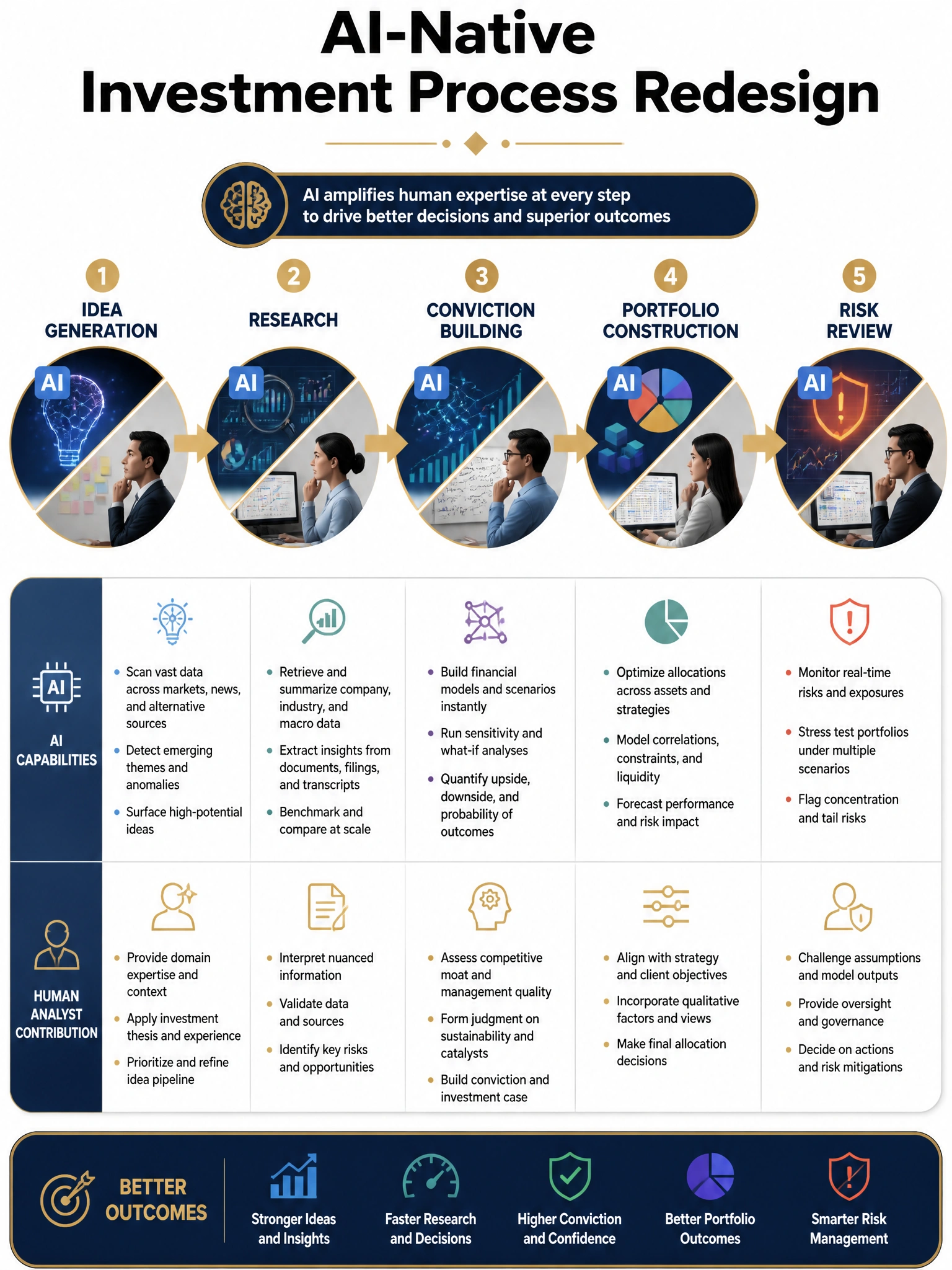
Think of it like upgrading a cockpit — you don't remove the pilot, you give them better instruments. The winning approach redesigns every stage of the investment pipeline so AI and human judgment work together at each node, amplifying the firm's existing edge rather than erasing it.
Full explanation below image
Full Explanation
An AI-native investment process redesign is not a binary switch from human to machine — it is a systematic reimagining of every stage in the alpha-generation pipeline. At the idea-generation stage, AI can surface non-consensus signals from alternative data, earnings call transcripts, and supply-chain datasets that analysts would never have time to review manually. At the research stage, AI accelerates financial modeling, document synthesis, and competitor benchmarking, freeing analysts to focus on higher-order qualitative judgments. At conviction building, AI can stress-test theses across thousands of historical analogs, helping PMs identify where their logic is most vulnerable. Portfolio construction and risk review benefit from AI-driven factor exposure monitoring, liquidity analytics, and scenario simulation running in near-real time.
Option A — full automation — discards the firm's accumulated human capital and exposes it to model failure and regulatory scrutiny without a human override layer. Option C overestimates the current reliability of any single LLM for high-stakes, irreversible financial decisions; LLMs hallucinate and lack the fiduciary accountability framework required for investment committee governance. Option D is a missed opportunity: constraining AI to the back office leaves most of the addressable value untouched and cedes competitive ground to firms that embed AI deeper in alpha generation.
The McKinsey framework for 'human-in-the-loop' AI transformation and the CFA Institute's 2024 guidance on AI in investment management both emphasize modular adoption: integrate AI at each decision node, measure its marginal contribution to process quality, and progressively expand autonomy only where confidence and auditability are established. A successful redesign treats AI as an analyst multiplier, not an analyst replacement, preserving the interpretability and accountability that institutional clients and regulators require.