
A long/short equity fund generates 340 bps of annual alpha, of which the PM team attributes 120 bps to an AI signal ensemble. An institutional consultant reviewing the fund questions this attribution, noting that the AI signals are correlated with known systematic risk factors. Which alpha attribution methodology best isolates genuine AI-generated alpha from factor-embedded alpha?
Select an answer to reveal the explanation.
Short Explanation and Infographic
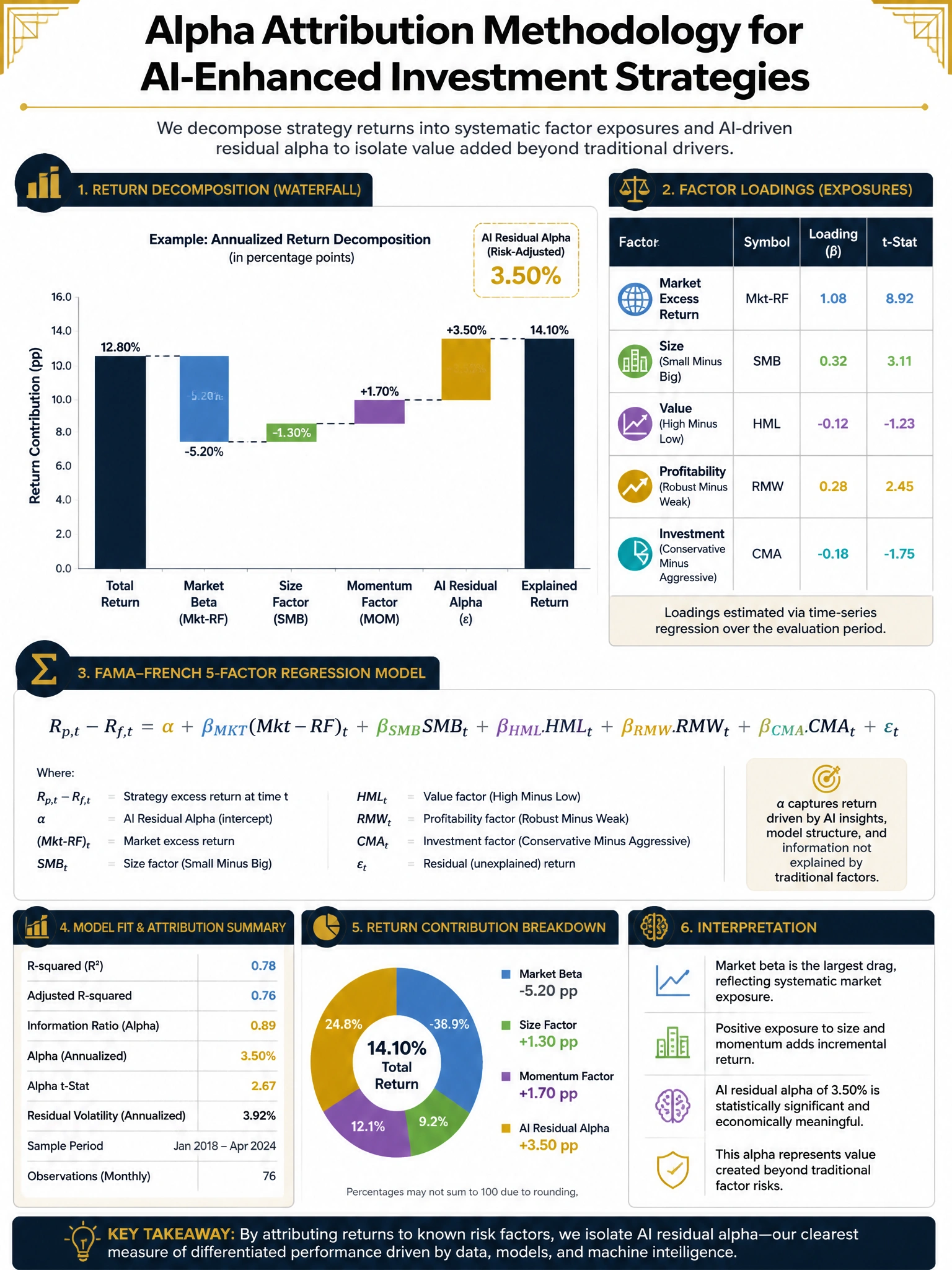
Todd Lammle: Alpha attribution is like figuring out who actually scored the goal versus who was just standing on a rising tide. If the AI signal is long momentum stocks in a momentum bull market, that's factor exposure — not alpha. Option B strips out the known factors via a multi-factor regression and whatever is left, the residual, is the real AI contribution.
Full explanation below image
Full Explanation
Accurate alpha attribution when AI signals are involved requires rigorous decomposition of returns into systematic factor components and idiosyncratic residuals. The standard methodology applies multi-factor regression — most commonly the Fama-French 5-factor model (market, size, value, profitability, investment) or the Carhart 4-factor extension (adding momentum) — to the subset of positions driven by the AI signal ensemble. The intercept of this regression (Jensen's alpha) represents the return that cannot be explained by exposure to priced systematic risk factors, which is the most defensible definition of AI-generated alpha.
This methodology matters both for investor communication and for internal resource allocation. If the 120 bps attributed to AI is substantially explained by uncompensated factor loading (e.g., persistent small-cap growth tilt during a period of small-cap outperformance), the fund's risk-adjusted economics are materially different from what is being represented.
Option A (isolated signal Sharpe) measures efficiency of the signal as a trading strategy in isolation, but does not account for the portfolio-level factor context in which those positions are expressed. A high standalone Sharpe can coexist with zero net alpha if the signal simply harvests a cheap factor premium.
Option C (activity-matched attribution) is a form of confirmation bias hardwired into the methodology. Attributing gains to AI and losses to macro conditions produces systematically inflated AI attribution estimates that will not survive institutional due diligence.
Option D (qualitative survey) has no place in quantitative attribution frameworks for an institutional fund. PM team intuition is an input to strategy development, not to performance measurement.
CFIA candidates should be comfortable constructing and interpreting multi-factor attribution models, and should know the difference between information ratio, Jensen's alpha, and factor-adjusted alpha.