
A proprietary trading firm operates an AI-driven high-frequency trading system that executes up to 40,000 orders per second. During a stress simulation, risk managers identified that human operators could not react fast enough to manually halt the system before it could breach position limits in an adverse scenario. Under MiFID II RTS 6 algorithmic trading requirements, what is the firm's primary obligation regarding this finding?
Select an answer to reveal the explanation.
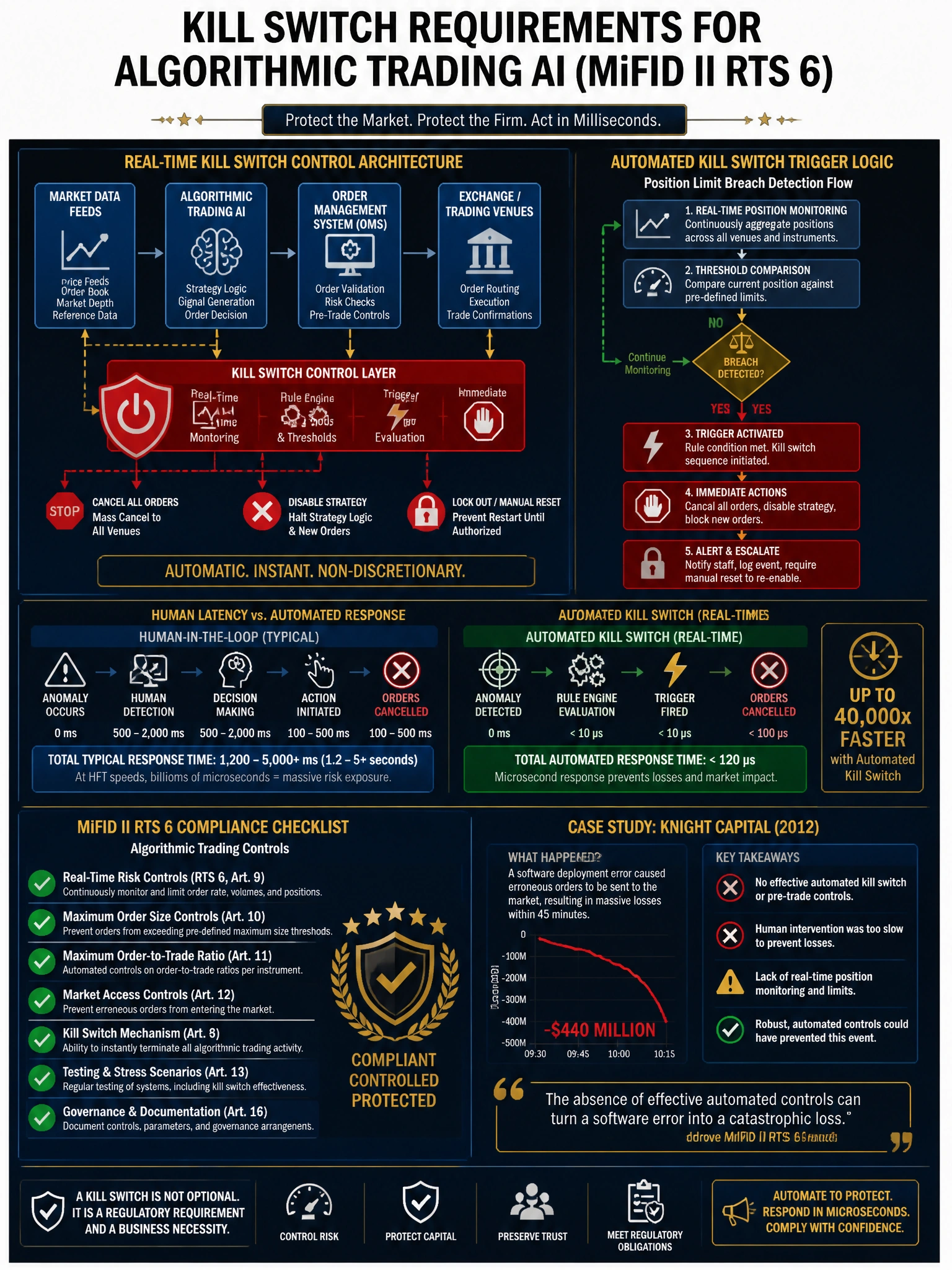
Short Explanation and Infographic
MiFID II RTS 6 is very direct about this: if you run an algorithmic trading system, you must have the ability to cancel outstanding orders and halt trading — and the speed of modern HFT systems means that 'ability' has to be automated, not human-dependent. If your own stress test shows humans can't stop the machine in time, you've documented a compliance gap that requires an engineering fix, not a training program or a regulator's permission slip.
Full explanation below image
Full Explanation
MiFID II's Regulatory Technical Standard 6 (Commission Delegated Regulation 2017/589) sets out organizational requirements for firms engaged in algorithmic trading. Article 12 explicitly requires that algorithmic trading systems include kill switch functionality capable of canceling all or part of outstanding orders and halting trading activity immediately. The standard further requires that this capability be tested regularly and that it be capable of operating without dependency on manual human reaction time.
The stress simulation finding is significant precisely because it demonstrates a design gap: the kill switch, if it exists in only manual form, is ineffective at the speed the system operates. RTS 6 compliance requires that the kill switch be automated — capable of triggering based on predefined risk parameters (position limits, loss thresholds, order rate anomalies) without waiting for human initiation, and that it be tested under realistic trading conditions, not just documented.
The specification for kill switch systems under RTS 6 and related ESMA guidelines includes: (1) automated triggering based on quantitative risk thresholds; (2) ability to operate at the latency of the trading system itself; (3) cancellation of open orders across all venues simultaneously; (4) audit logging of all activations; and (5) regular testing in a simulated production environment.
Option A (training and risk register documentation) does not address the control gap — the problem is architectural, not operational. Option C (rate reduction) may be a complementary measure but does not fulfill the kill switch requirement and would fundamentally alter the firm's trading strategy. Option D (notify NCA and await guidance) inverts the regulatory obligation — the firm is responsible for maintaining compliant controls at all times, and awaiting permission to fix a known gap during which the system remains deployed would compound the violation.
The Knight Capital incident of 2012 — where a software deployment error caused an algorithmic system to generate $440 million in losses in 45 minutes — remains the defining case study for why automated kill switches with human-speed-independent operation are non-negotiable in HFT environments.