
A quantitative portfolio manager presents a new AI alpha signal that achieved a Sharpe ratio of 3.2 in backtesting across 15 years of historical data. The model was developed through 200 iterations of feature engineering and parameter tuning on this same dataset. From a model risk management perspective, which concern should the risk committee prioritize before approving live deployment?
Select an answer to reveal the explanation.
Short Explanation and Infographic
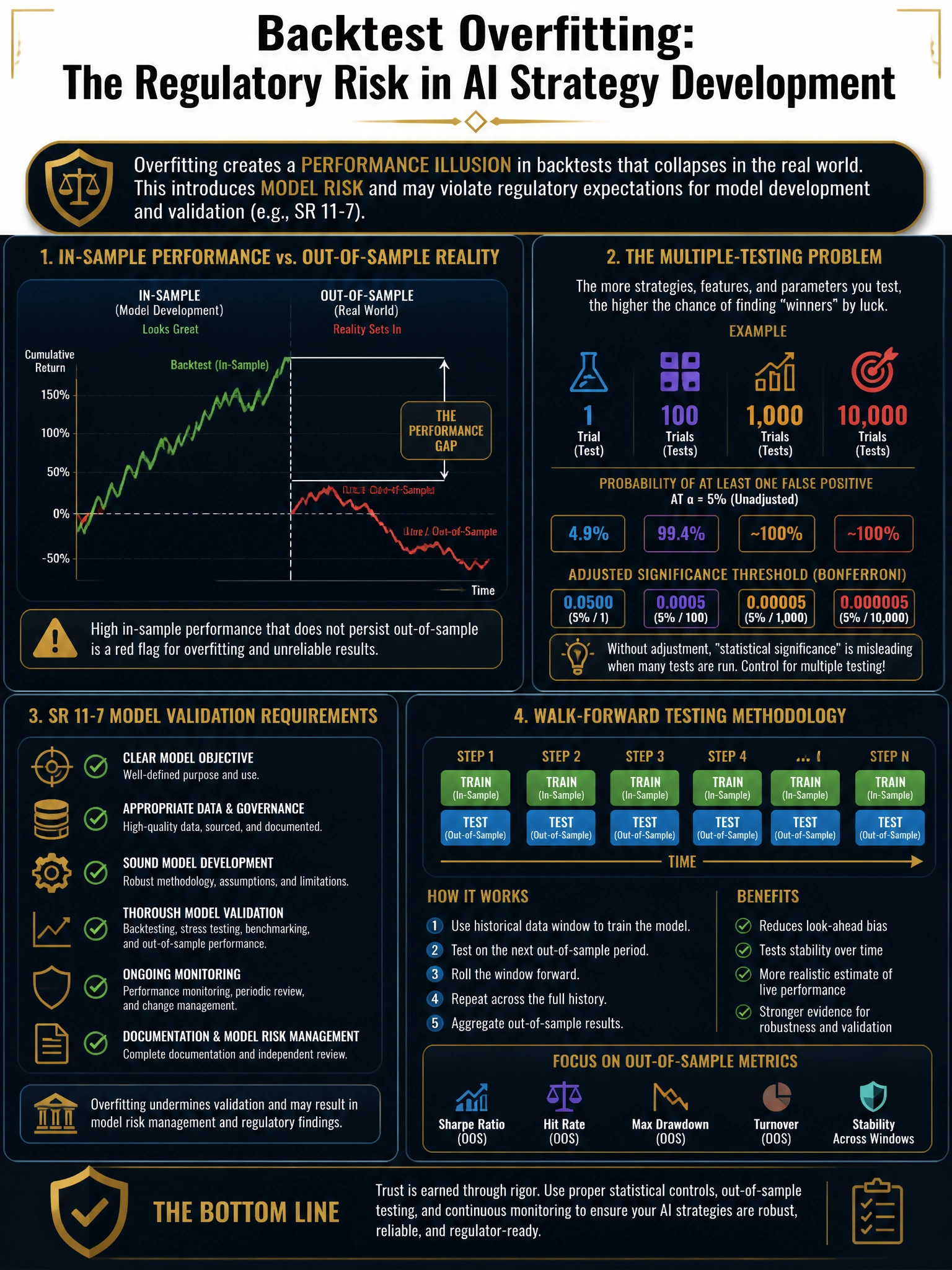
Two hundred iterations of tuning on the same 15 years of data is a textbook recipe for backtest overfitting — sometimes called 'data snooping bias.' After enough trials, you can fit almost any pattern into historical noise by accident. A Sharpe of 3.2 under these conditions is more likely a perfectly memorized exam than a genuine edge. Regulators and SR 11-7 both require out-of-sample validation precisely to catch this before client capital is at risk.
Full explanation below image
Full Explanation
Backtest overfitting — also called data snooping, multiple hypothesis testing bias, or in-sample overfitting — is one of the most serious model risks in quantitative investment management. It occurs when a model is developed through repeated iteration on the same historical dataset, effectively learning the idiosyncratic noise of that sample as if it were signal. The result is inflated in-sample performance metrics that do not generalize to new data.
The statistical relationship here is well-established: Harvey, Liu, and Zhu (2016) demonstrated that for strategies tested on financial data, the minimum acceptable t-statistic for a claimed factor should be at least 3.0, accounting for the number of tests performed. With 200 iterations of feature engineering and tuning on the same dataset, the effective p-value threshold has been drastically eroded — a Sharpe of 3.2 achieved through this process provides very weak statistical evidence of genuine alpha.
From a regulatory standpoint, the OCC/Federal Reserve SR 11-7 model risk management guidance explicitly identifies backtesting overfitting as a validation concern. Proper model validation requires: (1) a true hold-out test set that was never touched during development; (2) walk-forward out-of-sample testing; (3) transaction cost modeling; and (4) sensitivity analysis across market regimes. The absence of any out-of-sample validation is a material gap.
Option C raises a valid secondary concern about stress testing coverage, but it is a refinement issue rather than the foundational validity problem. Option A (Sharpe calculation methodology) is a disclosure question, not a model integrity question. Option D (non-public information) would be a serious legal issue but is not the risk indicated by the described development process.
The risk committee should require the development team to conduct genuine out-of-sample evaluation on data that was fully sequestered before development began, and apply statistical adjustment methods (such as the Bailey-López de Prado minimum backtest length formula) to set appropriate performance thresholds given the number of trials conducted.