
A robo-advisory platform uses a deep neural network to generate personalized portfolio recommendations for retail investors. The compliance team is designing the investor-facing disclosure. Which explainability approach best satisfies both regulatory expectations under MiFID II suitability rules and practical retail investor comprehension?
Select an answer to reveal the explanation.
Short Explanation and Infographic
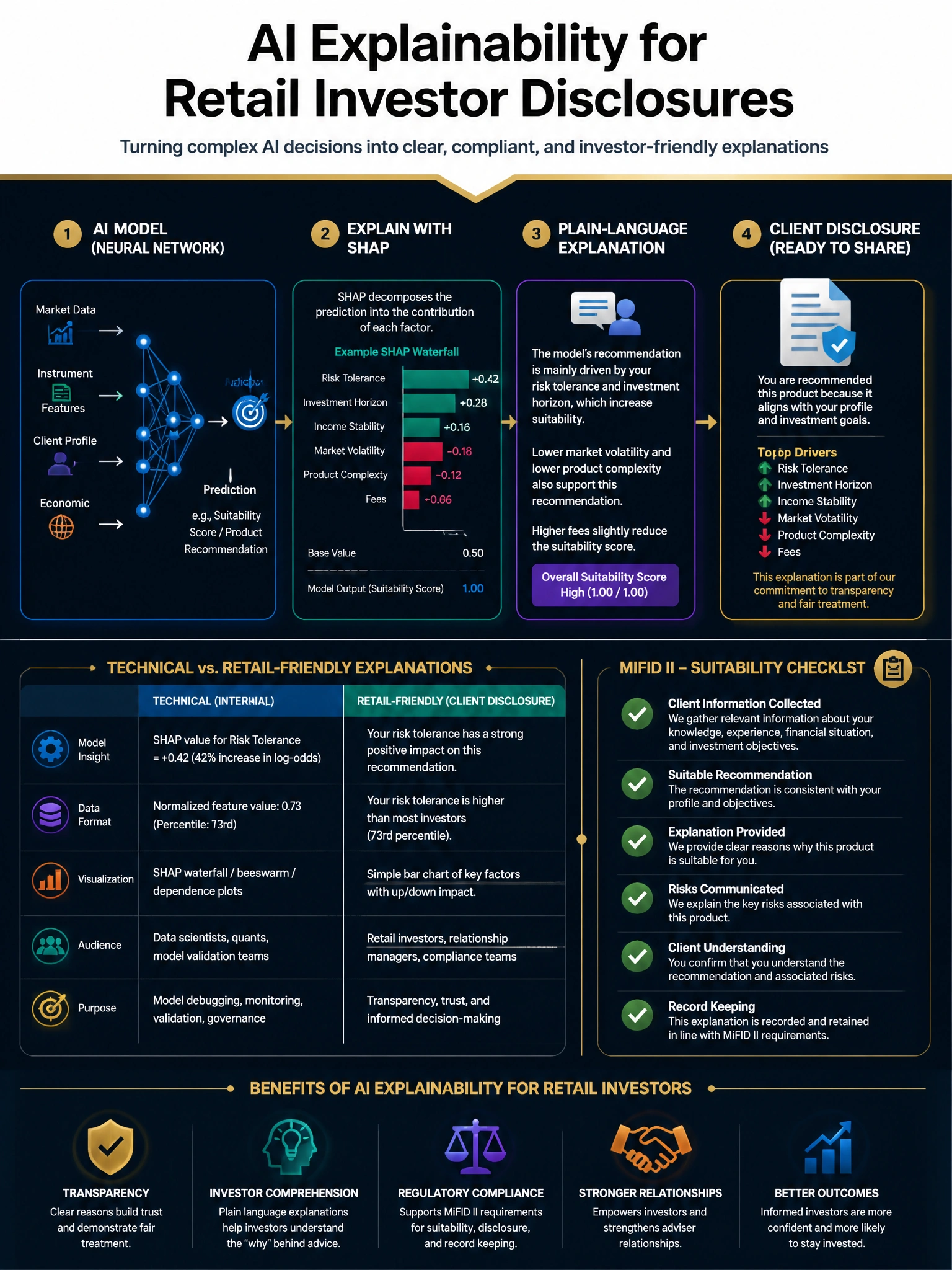
SHAP (SHapley Additive exPlanations) is the bridge between 'black box' and 'client-friendly.' It tells you which inputs — say, your risk tolerance and investment horizon — drove the output the most, and you can translate that into 'We recommended growth equities primarily because you indicated a 15-year horizon and high loss tolerance.' That's what MiFID II's suitability obligation is really asking for: a reason the client can evaluate, not a math lecture.
Full explanation below image
Full Explanation
MiFID II Article 25 and the associated ESMA suitability guidelines require investment firms to explain why a recommendation is suitable for the specific client, referencing the client's financial situation, investment objectives, and risk tolerance. The obligation is substantive — a generic disclosure that 'an algorithm was used' does not satisfy the requirement to explain the basis for suitability.
For neural networks and other non-interpretable models, post-hoc explainability methods like SHAP (SHapley Additive exPlanations), LIME (Local Interpretable Model-Agnostic Explanations), or integrated gradients produce local feature attributions: quantified estimates of how much each input feature contributed to a specific output for a specific client. These outputs can be ranked and translated into natural language — for example, 'Your recommendation for a balanced fund was primarily driven by your moderate risk score (40%), followed by your 10-year investment horizon (35%) and existing cash holdings (25%).'
Option A, publishing model weights, is both technically meaningless to retail investors and potentially a proprietary information disclosure issue. It inverts the purpose of explainability — transparency to the client, not technical reproducibility for experts. Option C (directing to a model risk policy) fails the retail comprehension standard; ESMA guidance explicitly requires explanations that are understandable to the target client segment. Option D omits AI disclosure entirely, which increasingly conflicts with both MiFID II suitability rules and emerging AI-specific disclosure frameworks including the EU AI Act's transparency obligations for high-risk systems.
Architecturally, the best practice is a two-layer disclosure: a plain-language investor-facing summary (the SHAP-derived narrative) and a more detailed technical explanation available on request for more sophisticated clients. This layered approach satisfies regulatory expectations while respecting retail investors' actual information needs.