
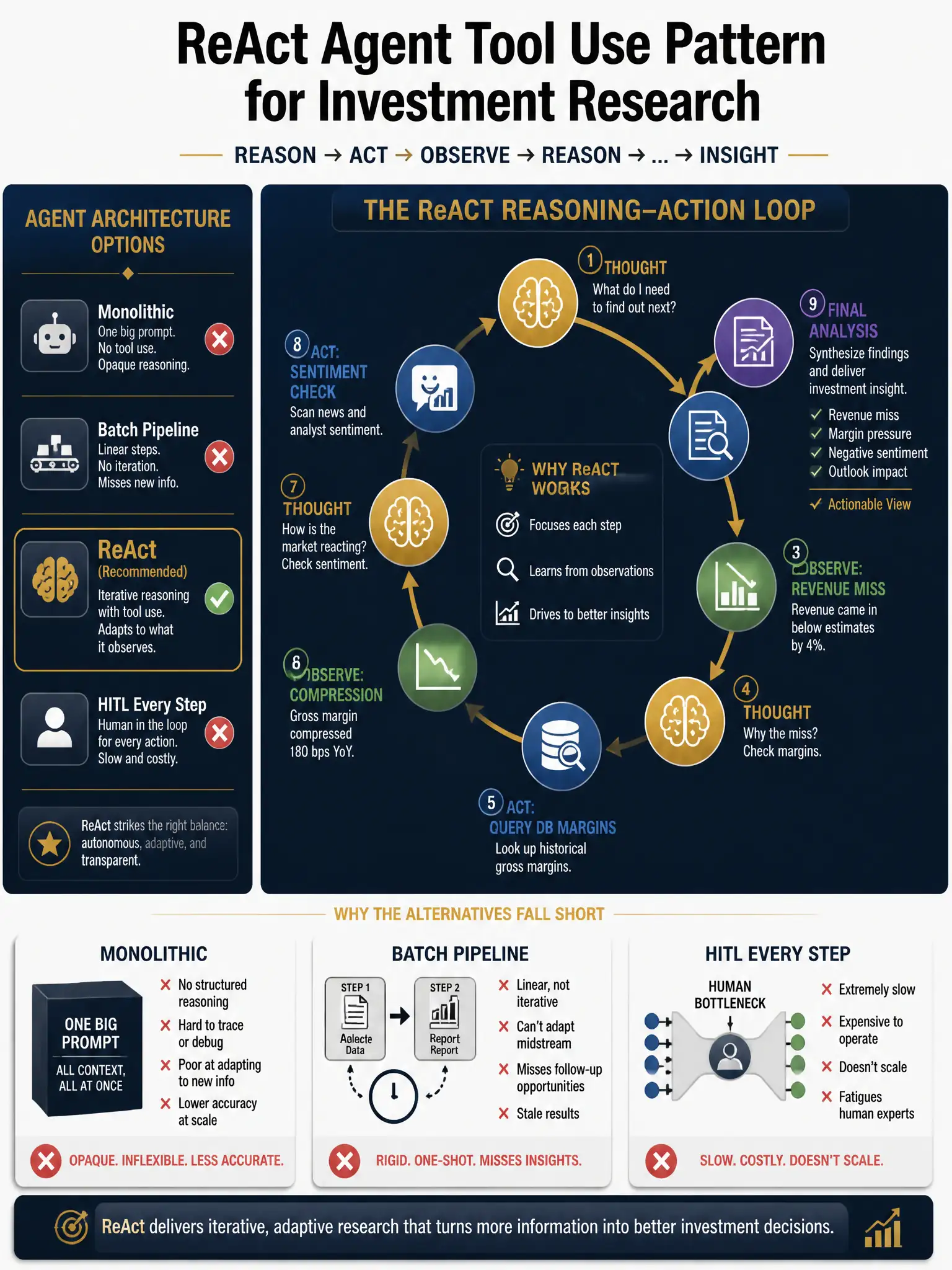
A buy-side equity research team wants to deploy an AI agent that can autonomously gather earnings call transcripts, query financial databases, and cross-reference with news sentiment. The agent must adapt its next action based on what each prior tool call returns — for example, discovering a revenue miss in a transcript and then immediately querying the database for historical margin trends before checking sentiment. Which tool use architecture pattern best supports this dynamic, multi-source investment research workflow?
Select an answer to reveal the explanation.
Short Explanation
Think of a great detective: you don't read every file before leaving Baker Street—you follow one clue to the next. The ReAct pattern works that way: you reason about a revenue miss, query margin history, reason again, then check sentiment. That chain of thought plus tool use is what makes it the right call here.
Full Explanation
The ReAct (Reasoning + Acting) pattern, introduced by Yao et al. (2022), interleaves chain-of-thought reasoning traces with concrete tool-use actions in a tight loop. For investment research, this architecture is particularly valuable because the analytical path is rarely known in advance: discovering a revenue miss in an earnings transcript may trigger a margin trend query, which in turn may surface a supply-chain note worth sentiment-checking. Each reasoning step informs the next tool invocation, allowing the agent to navigate complex, non-linear research workflows that a static pipeline cannot anticipate.
The single monolithic API call pattern forces all context to be pre-fetched before inference begins. This is efficient for simple, well-scoped tasks, but breaks down when the relevant context depends on what prior tool results reveal. For earnings research, you cannot know which database filters are meaningful until you have read the transcript; bundling everything upfront means either over-fetching irrelevant data or under-fetching the data that actually matters. Token costs and latency compound quickly at scale.
The batch offline processing pipeline is a strong pattern for nightly report generation and data warehouse refreshes, but it is fundamentally unsuitable for adaptive, session-level research queries. The pipeline that ran at 2:00 AM cannot react to an unexpected earnings announcement at 7:30 AM. Buy-side research advantages come from speed and analytical agility; the static batch job sacrifices both. In practice, batch pipelines and ReAct agents are complementary: the batch layer populates structured data stores that the ReAct agent queries dynamically.
The human-in-the-loop approval gate for every individual tool call conflates two distinct governance patterns. Human-in-the-loop oversight is appropriate at decision checkpoints (e.g., before a trade recommendation is surfaced to a portfolio manager), but inserting manual approval gates at the individual API-call level eliminates the efficiency benefit of agent automation entirely. Modern AI governance frameworks, including NIST AI RMF and internal risk controls at major asset managers, distinguish between oversight of consequential outputs and micro-management of intermediate reasoning steps. Gating every tool call is operationally unworkable and defeats the purpose of deploying an agent.
In practice, LangChain's AgentExecutor and Microsoft AutoGen both implement ReAct-style loops with configurable tool registries, making this pattern the industry-standard starting point for multi-tool financial research agents. The CFIA candidate should understand ReAct not as a niche research concept but as the foundational pattern underlying most production-grade agentic systems in financial services today.