
A quantitative investment firm deployed an AI-powered earnings call analysis tool 12 months ago. The CFO asks the CFIA-credentialed Head of AI Strategy to present a rigorous ROI measurement framework to the board. The tool has reduced analyst time per earnings call from 4 hours to 45 minutes, improved signal identification rate by 22%, but required $1.2M in annual infrastructure and licensing costs. Which ROI measurement framework BEST captures the full value and cost picture for this AI deployment?
Select an answer to reveal the explanation.
Short Explanation and Infographic
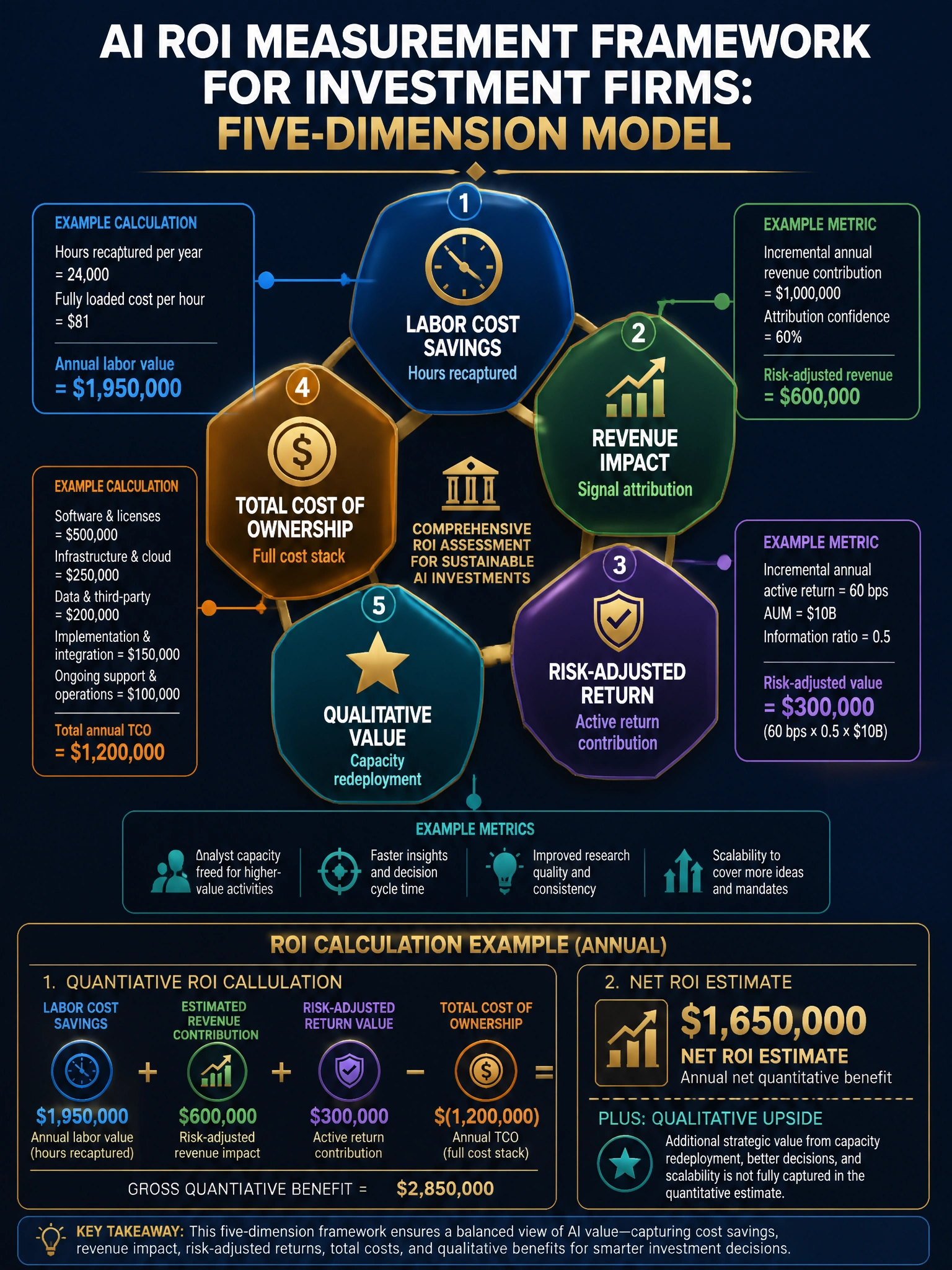
Measuring AI ROI in investment management is like evaluating a new analyst — you don't just count how fast they read; you measure what they found, what it was worth, and whether they freed up your senior team for higher-value work. Option B is correct because a complete ROI framework must capture labor savings, revenue impact, risk-adjusted return contribution, full costs, and qualitative strategic value — any single-dimension measure will systematically understate or misstate the true case.
Full explanation below image
Full Explanation
AI ROI measurement in investment management requires a framework that reflects the multi-layered value creation (and cost) mechanisms unique to financial intelligence tools. A single-metric approach — whether cost savings, model accuracy, or revenue attribution — will produce a misleading picture that either oversells or undersells the technology's contribution.
Direct labor cost savings are the most tangible starting point: if the tool reduces analyst time per earnings call from 4 hours to 45 minutes (a 3.25-hour saving per call), and the firm covers 500 earnings calls per quarter, that is 1,625 analyst hours per quarter freed — quantifiable at fully-loaded analyst compensation rates. For a senior analyst at $300/hour fully loaded, this is roughly $1.95M in annual labor value recaptured.
Revenue impact from improved signal quality requires attribution modeling. A 22% improvement in signal identification rate must be linked to portfolio outcomes — which positions sourced from AI-enhanced analysis outperformed? What was the contribution to active return? This requires integrating the AI system's signal provenance data with the portfolio management system's attribution outputs. Even a partial attribution (e.g., AI-sourced signals contributed 0.3% of 1.8% active return) creates a defensible revenue case.
Risk-adjusted return contribution adjusts the revenue impact for the incremental risk taken to achieve it. A higher signal identification rate that leads to higher-conviction positions may also reduce average holding period volatility — this should be measured using the firm's existing risk attribution framework (factor model, scenario analysis).
Total cost of ownership must capture not just infrastructure and licensing ($1.2M stated) but also: internal engineering time, data licensing fees specific to the AI use case, compliance review costs, and opportunity cost of capital deployed.
Qualitative metrics — analyst satisfaction, capacity redeployment to higher-value tasks, competitive differentiation in client pitches — complete the board-level narrative.
Option A captures only one cost dimension. Option C conflates model technical performance with business value. Option D is incorrect because 12 months of production data is sufficient to establish a credible ROI baseline; deferring measurement undermines governance accountability.