
A global investment bank is deploying an AI-powered deal screening tool that must integrate with its existing Bloomberg Terminal data feeds, an internal CRM system, a proprietary risk model engine, and a third-party document management platform. The AI architecture team is debating between three integration patterns: (1) REST API-based microservices, (2) embedded model within the risk engine, and (3) a hybrid approach using an orchestration layer. Which integration pattern provides the BEST balance of flexibility, data security, and operational maintainability for this multi-system environment?
Select an answer to reveal the explanation.
Short Explanation and Infographic
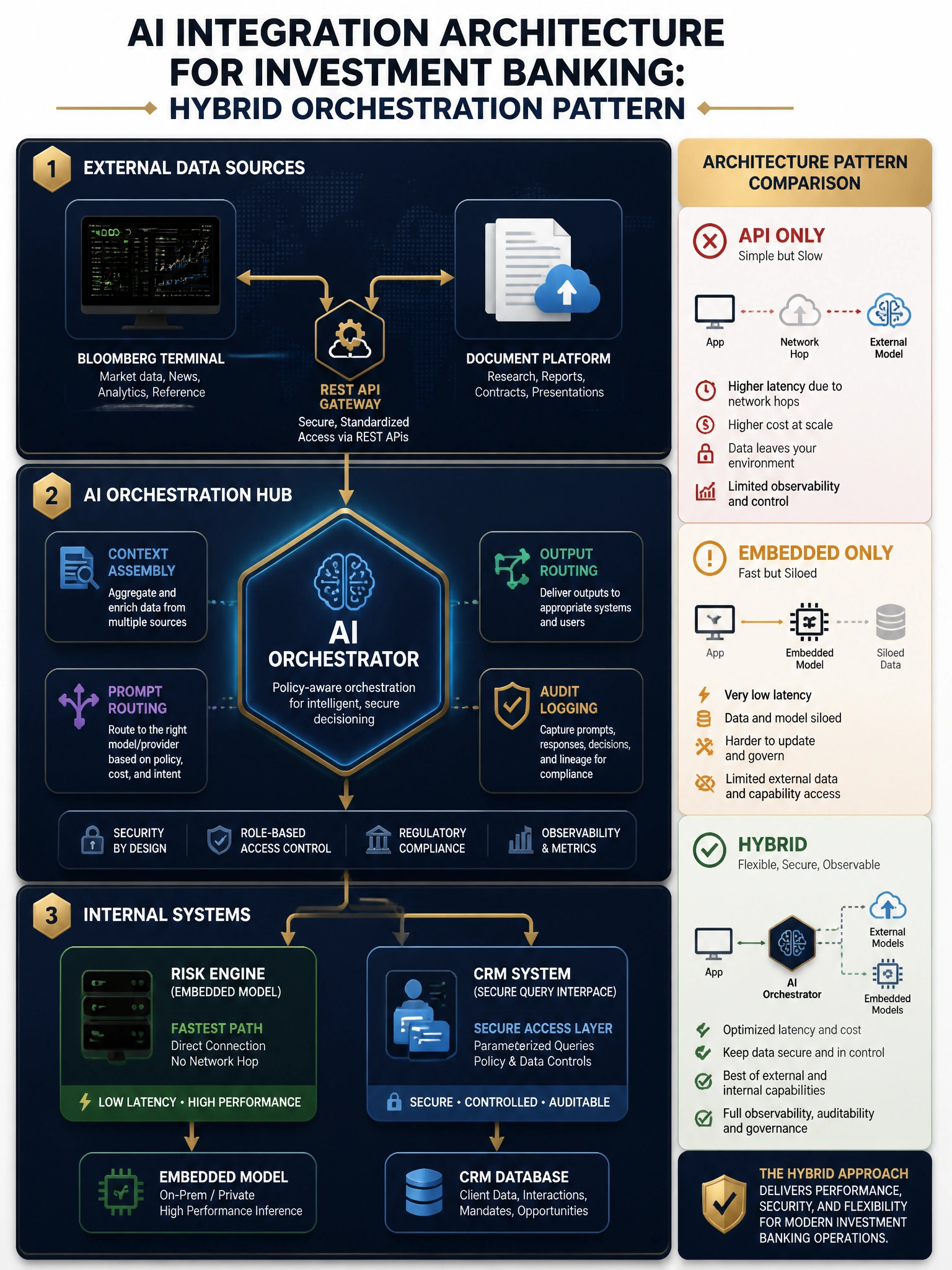
Multi-system AI integration in investment banking is like a trading floor where different desks need the same data but at different speeds and security levels — you need specialized lanes, not one highway. Option C is correct because the hybrid orchestration pattern matches each integration requirement to the best architectural pattern: APIs for external systems, embedded models for latency-sensitive calculations, and a central orchestration layer to tie it together coherently.
Full explanation below image
Full Explanation
Enterprise AI integration in financial services rarely fits a single architectural pattern because different source systems have fundamentally different requirements. Bloomberg Terminal data requires licensed API access with strict rate limits and data redistribution controls. Internal CRM data may contain client confidential information that requires access control enforcement at the integration layer. The proprietary risk model engine may demand sub-millisecond inference to avoid disrupting existing calculation workflows. A third-party document management platform adds another authentication domain and data residency consideration.
The REST API-based microservices pattern excels for external system integration because it provides clear authentication boundaries, versioning, rate limit management, and audit logging. It is the appropriate pattern for Bloomberg and the document platform, where the firm is a consumer of structured external data.
The embedded model pattern — where an LLM or ML model is compiled or containerized directly within the risk engine — minimizes network latency and eliminates a security boundary by keeping model inference in the same execution environment as the risk calculations. For time-sensitive risk screening where even 50ms of network round-trip affects workflow, this is the right pattern.
A central orchestration layer (built on frameworks like LangChain, LlamaIndex, or a custom agent framework) coordinates context assembly across all these sources, applies prompt engineering, manages conversation state, routes outputs to the appropriate downstream system, and provides a single point of observability and audit logging for AI decisions. Without this layer, each integration becomes a silo with no shared governance or monitoring.
Option A is incorrect because pure API microservices would introduce unacceptable latency for the risk engine integration. Option B is incorrect because embedding the model in the risk engine alone cannot handle the external data source integrations cleanly. Option D — a monolithic direct integration — violates separation of concerns, creates security anti-patterns (all systems potentially visible to all other systems), and is unmaintainable as the system evolves.