
A CIO at a mid-sized asset manager is evaluating two AI platform options: (A) a best-in-class third-party vendor platform offering pre-built models and API-based integration, and (B) an internally built platform developed by the firm's data science team. The firm currently manages $25 billion AUM and expects to double AUM within three years. Which scalability evaluation framework best guides this build-vs-buy decision?
Select an answer to reveal the explanation.
Short Explanation
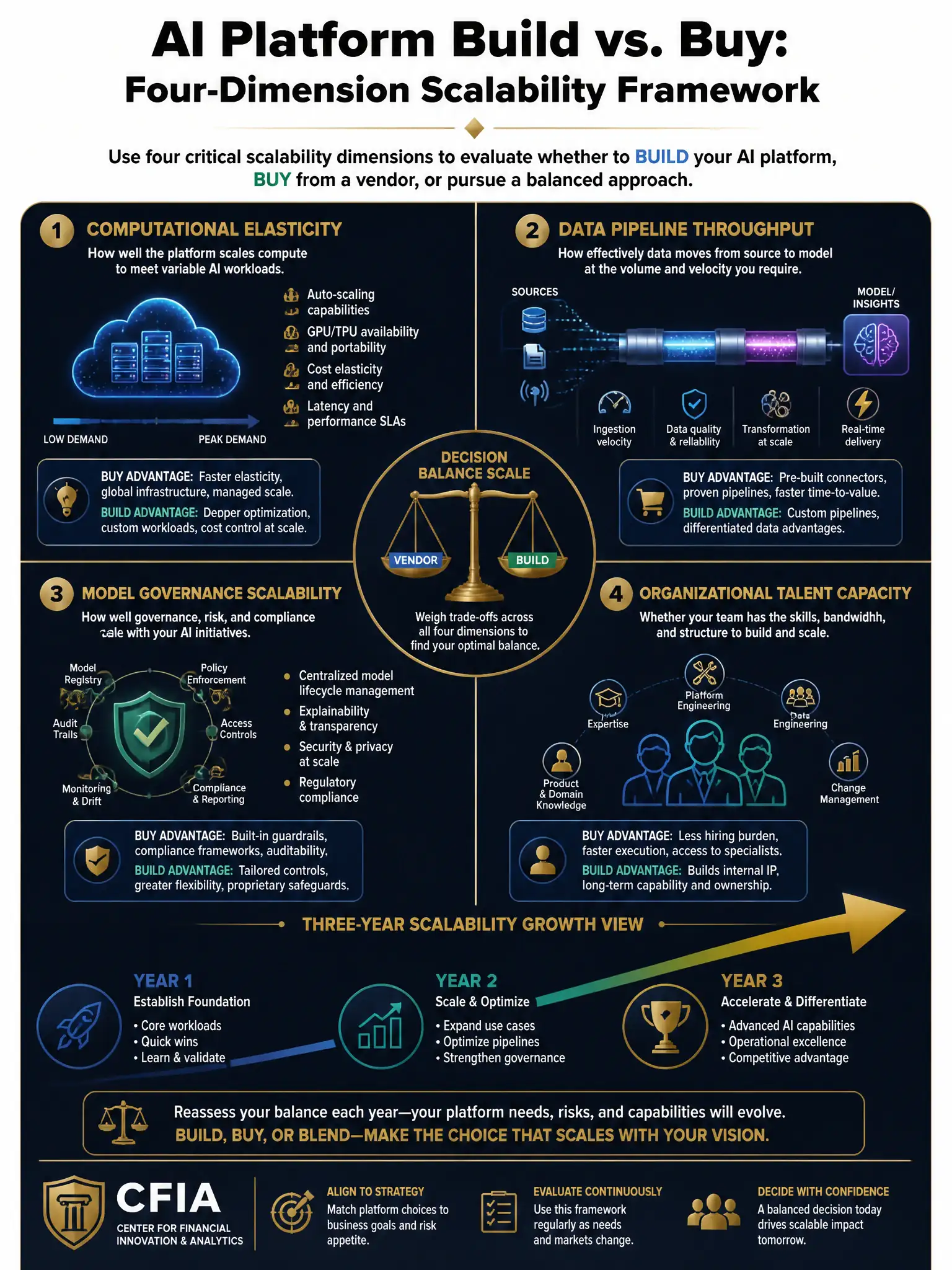
There is no universal answer to build versus buy — it is like asking whether you should rent or own a house without knowing your budget, how long you are staying, or whether you want to renovate. The right move is to evaluate computational elasticity, data pipeline throughput, model governance scalability, and organizational talent capacity against the firm's growth, risk tolerance, and differentiation goals.
Full Explanation
The build-versus-buy decision for artificial intelligence platforms in asset management is one of the highest-stakes technology strategy choices made by a chief information officer. Neither choice is universally superior — the right decision depends on a structured evaluation across multiple scalability dimensions specific to the firm's context, growth trajectory, and competitive strategy.
Computational elasticity refers to the platform's ability to scale inference and training workloads as assets under management and data volumes grow. Vendor cloud platforms typically offer elastic infrastructure that scales on demand; internally built systems may require significant capital expenditure in compute infrastructure to match this. For a firm doubling assets under management in three years, this dimension often favors vendor platforms unless the firm already has significant machine learning infrastructure.
Data pipeline throughput assesses whether the platform can ingest, process, and serve increasing volumes of market data, alternative data, and client data as the business grows. Internally built pipelines can be optimized for the firm's specific data assets, but require dedicated data engineering resources to maintain at scale.
Model governance scalability is frequently underestimated: as the number of models in production grows, can the platform support versioning, lineage tracking, monitoring, and documentation at institutional scale? Vendor platforms increasingly offer machine learning operations tooling; internal builds must replicate this. For regulated firms, model governance infrastructure is not optional.
Organizational talent capacity is the human factor: can the firm attract and retain the data scientists, machine learning engineers, and quantitative researchers needed to sustain an internally built platform competitive with a well-resourced vendor? This often shifts the calculus toward hybrid or vendor-led approaches for mid-sized firms without deep technology talent pipelines.
The evaluation framework that weighs computational elasticity, data pipeline throughput, model governance scalability, and organizational talent capacity against the firm's three-year growth trajectory, risk tolerance, and strategic differentiation goals is right because it applies a structured, multi-dimensional test to the firm's actual constraints and objectives.
The vendor-default position, which assumes third-party artificial intelligence platforms inherently scale better than internally built systems because of vendor infrastructure investment, is wrong because it treats vendor solutions as categorically superior without testing the four dimensions against the firm's growth, risk tolerance, and strategic differentiation goals. The internal-build default, which assumes proprietary systems eliminate vendor dependency risk and always deliver better long-term total cost of ownership for growing firms, is wrong because it treats internal systems as categorically superior while ignoring capital expenditure, governance burden, and talent constraints. The lowest-year-one-cost position, which claims artificial intelligence platforms in financial services typically reach feature parity within eighteen months regardless of initial architecture choices, is wrong because it uses a cost-minimization heuristic that ignores architectural lock-in, long-term total cost of ownership divergence, and the strategic value of proprietary capability. Exam candidates should apply a structured, multi-dimensional framework rather than relying on cost or vendor-dependency heuristics alone.