
Multiple institutional investors across the industry have adopted similar AI-powered factor models trained on common public datasets and using comparable feature engineering approaches. During a market stress event, these models simultaneously signal a reduction in equity exposure, triggering massive correlated selling. This scenario best illustrates which systemic risk concern?
Select an answer to reveal the explanation.
Short Explanation and Infographic
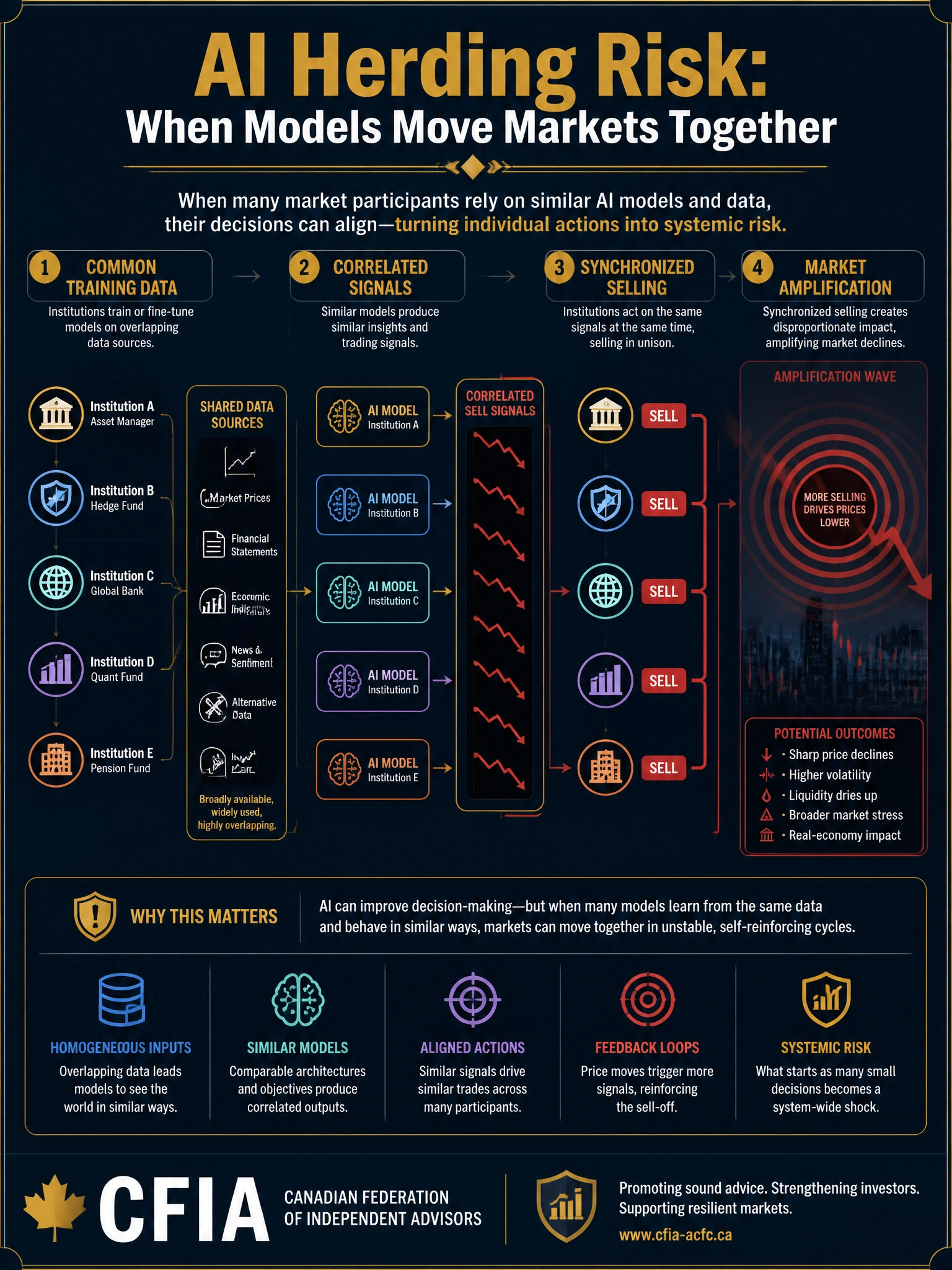
When everyone teaches their AI model from the same textbook and uses it the same way, you get financial flash mobs. AI herding turns individual models into a coordinated systemic amplifier — and that's exactly what Answer B describes.
Full explanation below image
Full Explanation
AI herding risk refers to the systemic danger that emerges when many market participants deploy AI models with sufficiently similar architectures, training data, features, or optimization objectives that their outputs are correlated — particularly under stress. Unlike the idiosyncratic risks of any single model, herding risk is an emergent, macro-prudential concern that regulators including the Financial Stability Board (FSB), BIS, and IOSCO have flagged as an AI-specific threat to market stability.
The mechanism is straightforward: if 50 large institutional investors all trained factor models on MSCI or Bloomberg data using similar momentum and quality signals, their models will tend to agree on market direction at the same time. During a drawdown, synchronized de-risking amplifies selling pressure, widens bid-ask spreads, and can trigger cascading margin calls — a dynamic observed during the August 2007 'quant quake' even before modern deep learning was prevalent.
Option A (overfitting) describes a model quality problem at the individual level, not the systemic correlation problem described. Option C conflates settlement concentration with the cause of the correlated trading — the counterparty credit concern is a downstream consequence, not the primary risk mechanism. Option D describes operational risk from coding errors, which requires a different root cause than shared training data and methodology.
For CFIA candidates, AI herding risk has risk management implications: portfolio diversification across model types and vendors, deliberate use of diversified signal sources, and internal limits on the proportion of a strategy driven by a single model architecture. At the regulatory level, FSB and IOSCO are developing macro-prudential monitoring frameworks specifically to track AI-driven correlated exposures across the financial system.