
A UK-based wealth manager is deploying an AI model to generate personalized investment recommendations for retail clients. The FCA's AI regulatory expectations, informed by its Discussion Paper DP5/22 and the Financial Services and Markets Act principles, would most likely require which of the following governance controls?
Select an answer to reveal the explanation.
Short Explanation and Infographic
The FCA isn't asking for a magic accuracy number — it cares whether clients can understand what they're getting and whether someone at the firm is accountable when AI goes wrong. Answer B captures the FCA's principles-based approach centered on explainability, human oversight, and Consumer Duty.
Full explanation below image
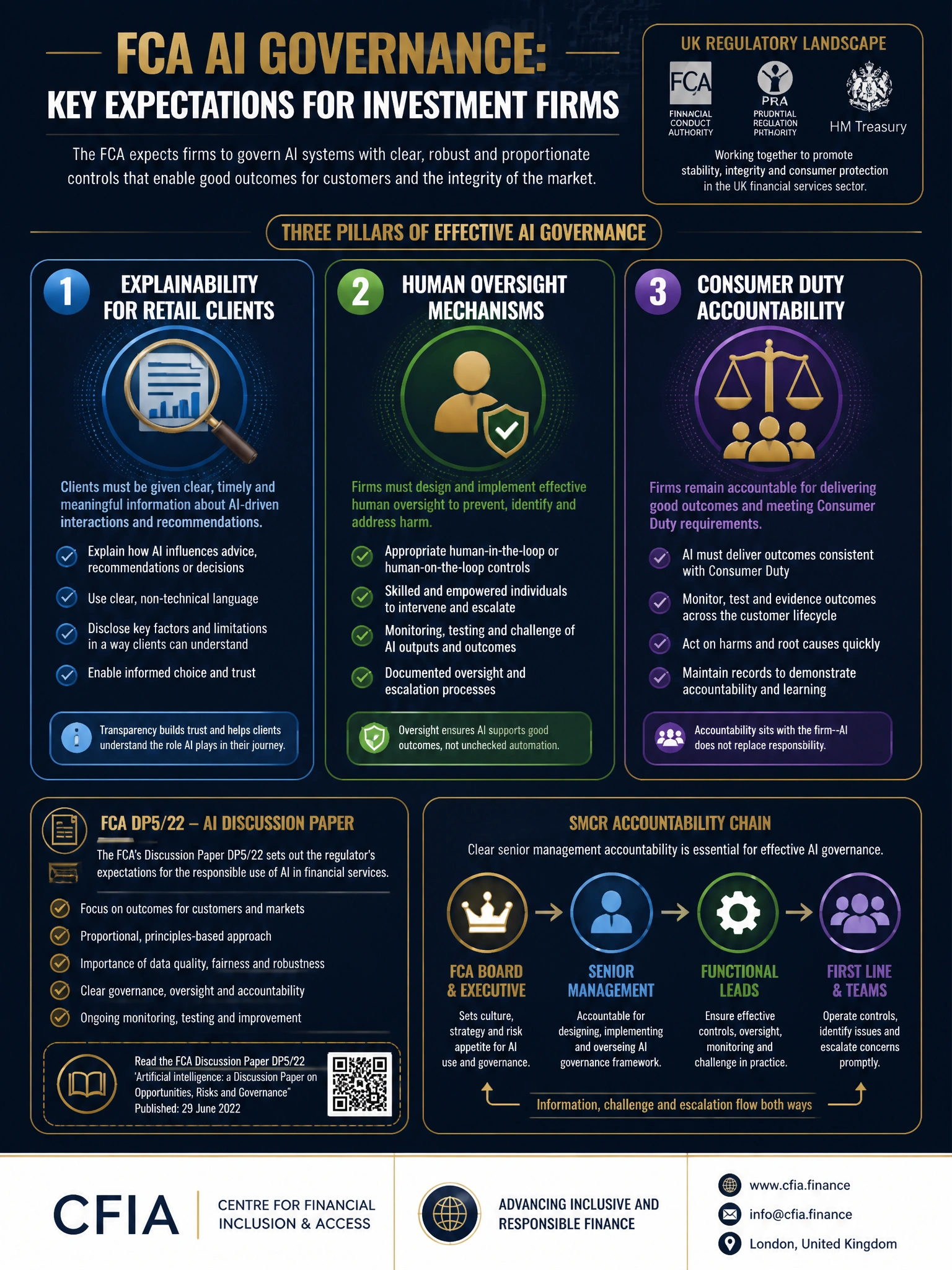
Full Explanation
The FCA's approach to AI governance is principles-based rather than prescriptive, rooted in existing frameworks including the Consumer Duty (PS22/9, effective July 2023), the FCA's Principles for Businesses, and guidance from DP5/22 ('Artificial Intelligence and Machine Learning'). The FCA has deliberately avoided creating a standalone AI rulebook, instead applying existing conduct and prudential obligations to AI-enabled activities.
For a retail-facing AI recommendation model, Consumer Duty is the primary lens. The Duty requires firms to deliver good outcomes for retail customers, including ensuring communications are understandable, products and services meet genuine needs, and customer support is adequate. Applied to AI, this means the firm must ensure: (1) clients receive meaningful explanations of AI-generated recommendations in plain language; (2) staff can identify and override AI recommendations that produce poor client outcomes; and (3) the board or senior management function retains clear accountability for AI-related consumer harm under the Senior Managers and Certification Regime (SMCR).
Option A is incorrect: as of the knowledge cutoff, the FCA has not established a mandatory AI model registry or pre-deployment audit requirement. Option C incorrectly scopes AI governance to banks and insurers — the FCA's principles apply across regulated sectors. Option D fabricates a numerical accuracy threshold that does not exist in FCA rules; such bright-line metrics would be inconsistent with the FCA's principles-based philosophy.
CFIA candidates should understand the UK's layered AI governance landscape: principles-based FCA rules, the cross-sector AI Safety requirements emerging from the DSIT framework, and the international context of the EU AI Act's potential extraterritorial effects on UK-EU serving firms.