
A CIO at a hedge fund uses an AI-powered factor model to size equity positions. During routine stress testing, the risk team discovers the model was trained exclusively on 2010–2023 market data — a period of predominantly low-volatility, low-interest-rate regimes. Which stress testing approach best addresses the model's historical data limitation?
Select an answer to reveal the explanation.
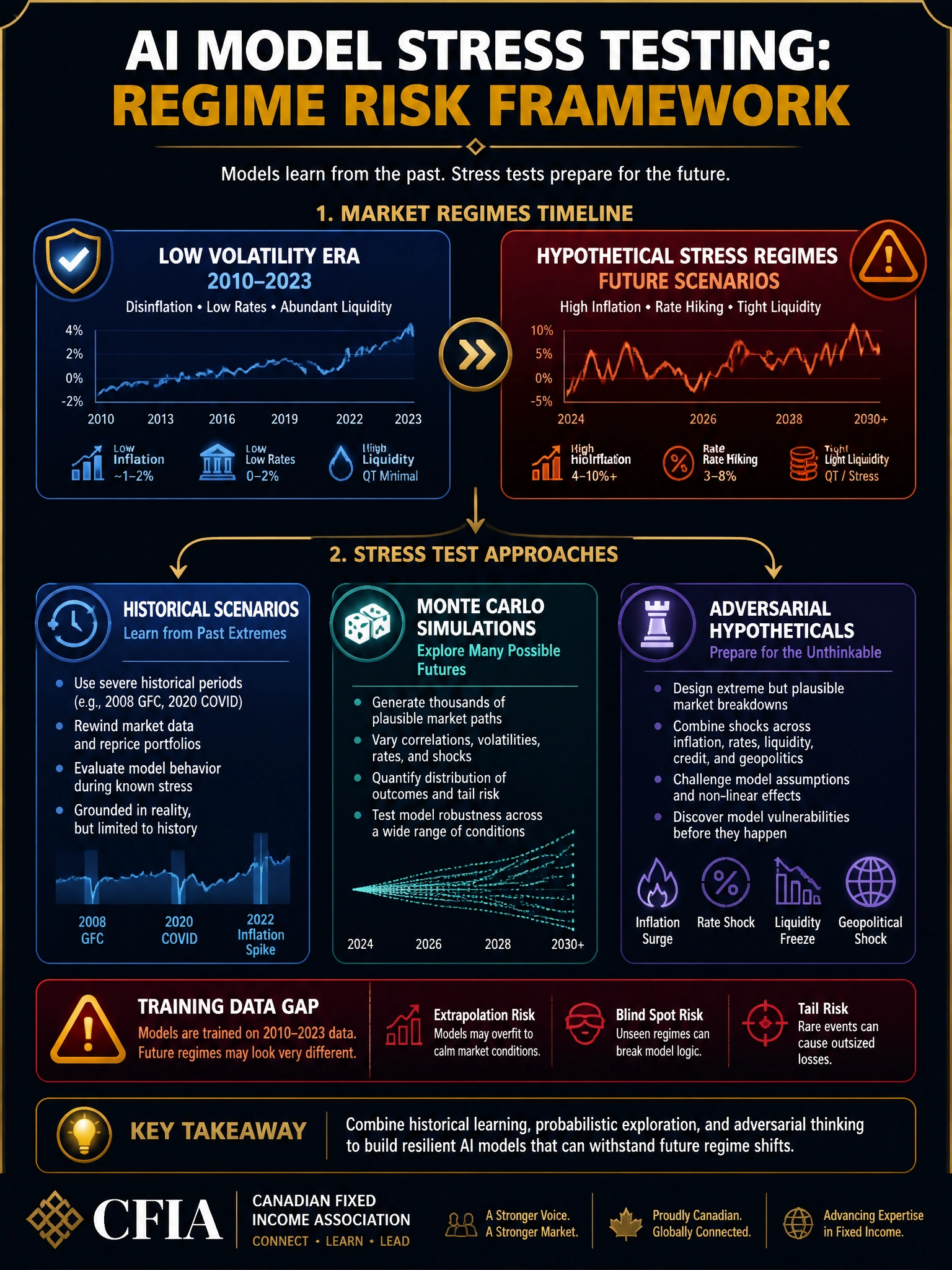
Short Explanation and Infographic
Training a model only on calm markets is like teaching someone to drive only in sunny weather — the first blizzard exposes every gap. Answer C correctly calls for adversarial and hypothetical scenarios that probe regimes the model has never seen.
Full explanation below image
Full Explanation
A fundamental limitation of machine learning models in finance is their susceptibility to regime risk: the model may learn statistical relationships that held during its training window but break down when the market enters a materially different state. A model trained exclusively on the 2010–2023 period has never experienced the input distributions of 1970s stagflation, the 1994 bond market collapse, or a sustained double-digit interest rate environment.
Historical scenario analysis (option B) is useful but insufficient when the training data already includes the historical period being tested — the model's embedded assumptions effectively overlap with the scenario data, limiting the diagnostic value. Monte Carlo simulation (option A) resamples from the same covariance structure the model learned, inheriting the same regime blind spots.
The best practice endorsed by the Basel Committee (Principles for Sound Stress Testing, 2009) and the SEC's model risk guidance is to combine historical scenarios with forward-looking hypothetical scenarios specifically designed to challenge model assumptions. For a factor model trained on low-rate data, this means constructing adversarial scenarios with sharply rising rates, factor crowding unwinding events, and liquidity crises to assess performance degradation.
Option D is operationally possible but not a substitute for ongoing stress testing — even a retrained model will have a cutoff date and will require stress testing beyond its training window. CFIA candidates should understand that stress testing AI models requires regime-aware scenario design, not just statistical bootstrapping of in-sample data.