
A global investment bank's trading desk discovers that risk reports and front-office systems are using conflicting GICS sector classifications for 340 securities, because three different data vendors assign sector codes differently for the same issuers. As a result, the firm's sector-neutral equity book is inadvertently 18% overweight Technology. Which reference data management practice most directly prevents this class of classification inconsistency?
Select an answer to reveal the explanation.
Short Explanation and Infographic
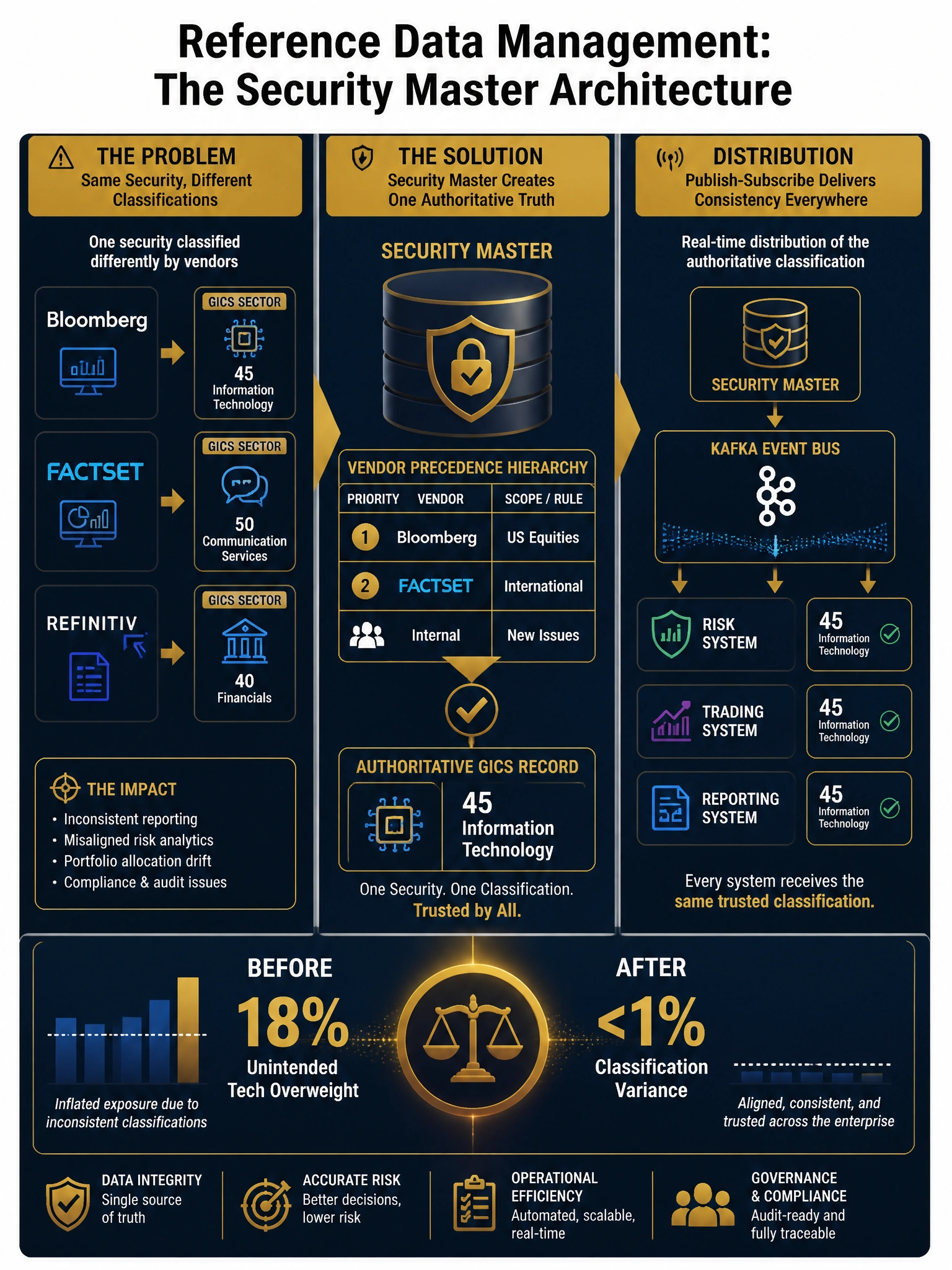
One restaurant, one menu — you can't run a professional kitchen if the servers are reading three different menus and voting on what the dish contains. The security master with an explicit vendor hierarchy is the single menu: it decides which vendor wins for each instrument type, produces one authoritative GICS record, and pushes it to all systems. Real-time API queries and majority voting don't establish canonical authority — they just spread the confusion faster or more elegantly.
Full explanation below image
Full Explanation
Reference data management — specifically the management of security master records including identifier mappings, sector classifications, instrument attributes, and corporate hierarchy data — is one of the highest-stakes data governance challenges in investment banking and asset management. Classification inconsistencies like the GICS sector conflict in this scenario have direct P&L and risk management consequences: a sector-neutral book that is inadvertently overweight Technology has unintended factor exposures that invalidate its risk model assumptions.
The root cause is the absence of a single authoritative source with explicit conflict-resolution rules. When three vendors assign different GICS codes and consuming systems choose independently (or default to whichever vendor's API was called first), the result is divergent classifications propagating through risk, trading, and reporting systems simultaneously. The security master solves this by establishing: (1) a canonical security record that is the firm's single authoritative version of every reference attribute for each instrument; (2) an explicit vendor precedence hierarchy — for example, Bloomberg is authoritative for sector classifications of US equities, FactSet is authoritative for international equities, and internal research overrides are authoritative for newly issued securities in the first 90 days; (3) a golden-copy distribution mechanism — typically a publish-subscribe event stream (Kafka is commonly used) that propagates classification changes to all subscribers within minutes of a master record update.
Subscribing to MSCI GICS directly (option A) would be an improvement over the current state but does not solve the problem if front-office and risk systems are still consuming sector codes from other sources and do not receive updates from the MSCI feed in a timely, consistent manner. The majority-vote algorithm (option C) has no principled basis for resolving legitimate classification disagreements — MSCI's GICS methodology may classify a diversified financial conglomerate differently from Bloomberg based on revenue segmentation rules, and two-out-of-three voting cannot determine which classification is correct for the firm's risk model purposes. Real-time API queries (option D) may improve consistency but introduce latency risk — risk systems querying reference data in real-time during end-of-day NAV calculation create a dependency on API availability and response time that is operationally unacceptable.
The ISDA Common Domain Model and the LEI (Legal Entity Identifier) system published by GLEIF provide the infrastructure for standardized security and entity identification that underpins modern security master implementations. GIPS standards and BCBS 239 both require firms to demonstrate that reference data classifications are consistent and authoritative across all reporting systems.