
A systematic equity fund ingests price data from six different vendors — Bloomberg, Refinitiv, FactSet, ICE, Quandl, and a proprietary exchange feed — each using different corporate action conventions, dividend adjustment methodologies, and ticker symbology. A quant analyst discovers that backtested returns diverge by as much as 340 basis points across vendor sources for the same strategy. What is the most operationally robust normalization approach to eliminate this cross-vendor drift?
Select an answer to reveal the explanation.
Short Explanation and Infographic
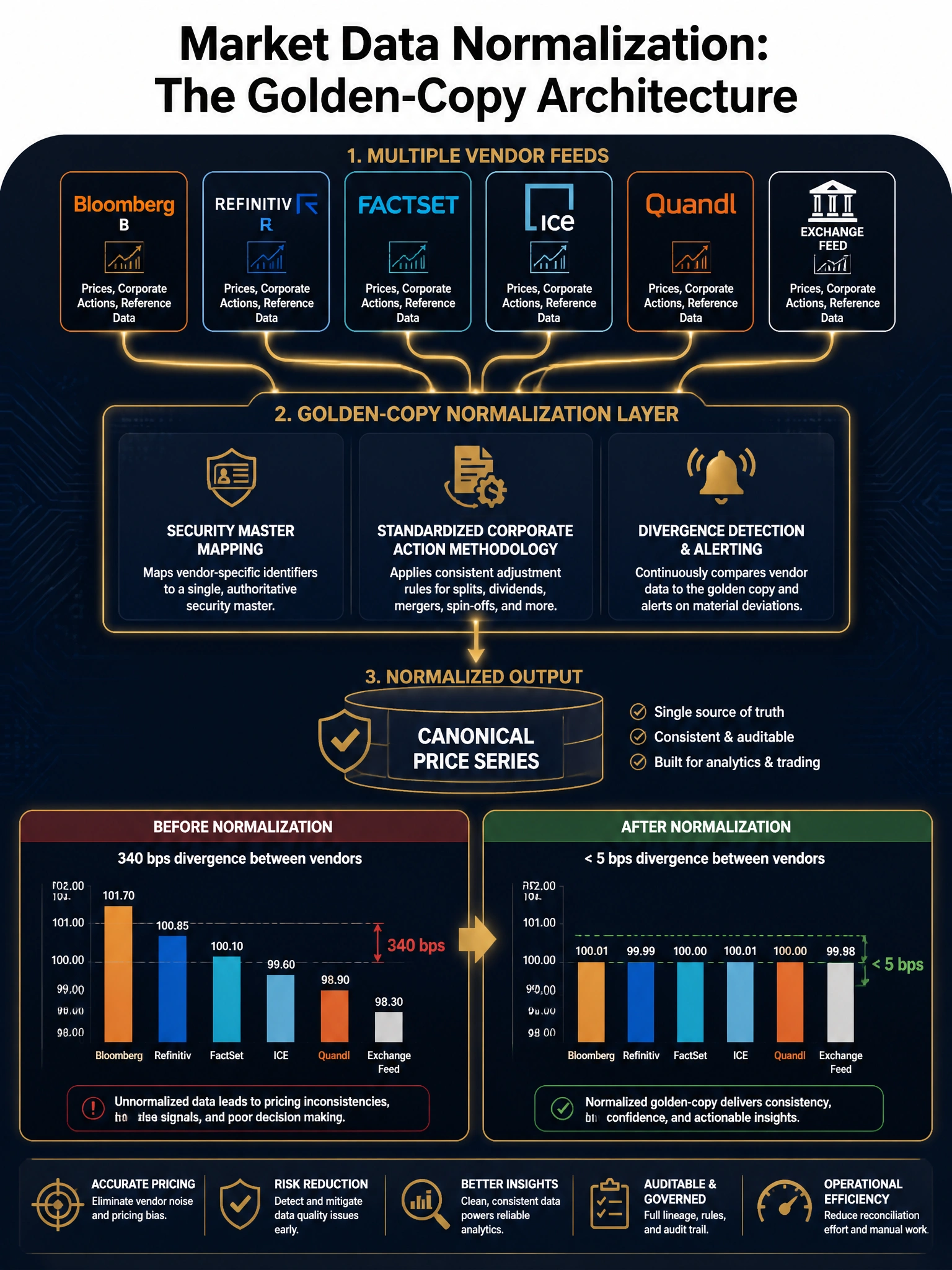
Imagine six watches showing slightly different times — picking one doesn't guarantee it's right, and averaging them just gives you a precisely wrong answer. The golden-copy layer is the master clock: it defines one standard methodology (like CRSP total-return adjustment), maps every ticker to one security master, and immediately surfaces discrepancies above your tolerance threshold so a human can investigate. That's how production quant shops eliminate 340-bps return drift.
Full explanation below image
Full Explanation
Cross-vendor price divergence in backtesting is not random noise — it reflects systematic differences in corporate action treatment, split adjustment timing, dividend reinvestment assumptions, and security identifier conventions. Bloomberg may apply ex-dividend adjustments on announcement date while Refinitiv uses ex-date; FactSet may include special dividends in its total-return series while ICE excludes them; ticker symbology may differ during merger transitions. Any of these differences, compounded over a multi-year backtest, produces the kind of 340-bps return divergence described in the scenario.
The golden-copy normalization architecture resolves this by establishing a single authoritative version of each price series within the firm's data infrastructure. The key components are: (1) a security master — a canonical mapping of all identifiers (ISIN, CUSIP, SEDOL, Bloomberg ticker, RIC) to a single internal security ID; (2) a standardized corporate action methodology consistently applied across all source feeds (the industry standard is CRSP-style factor-based total-return adjustment, which is also used by most benchmark providers); and (3) a divergence-detection system that continuously reconciles the normalized output against each raw vendor feed and escalates anomalies above a configurable threshold — for example, any adjusted close divergence above 10 bps on a liquid equity triggers a data operations review.
Relying on a single vendor (option A) eliminates normalization complexity but introduces concentration risk — vendor outages, data errors, and methodology changes are not caught because there is no cross-check. Averaging prices across vendors (option C) is statistically unsound: the average of six incorrectly adjusted series is not a correctly adjusted series; it simply distributes the error across sources. Applying a CPI deflator (option D) converts nominal to real returns but does nothing to reconcile the underlying adjustment methodology differences that caused the divergence.
The GIPS (Global Investment Performance Standards) and MSCI's security master best practices both emphasize the need for a single authoritative pricing and corporate action source for performance measurement. The golden-copy model is the institutionally accepted implementation of these standards in a multi-vendor data environment.