
A quantitative research team is deploying a large language model to automate earnings call summarization and generate preliminary analyst notes. Early outputs contain confident-sounding but factually incorrect revenue figures. Which prompt engineering pattern most directly mitigates hallucinated numerical data while preserving analytical depth?
Select an answer to reveal the explanation.
Short Explanation and Infographic
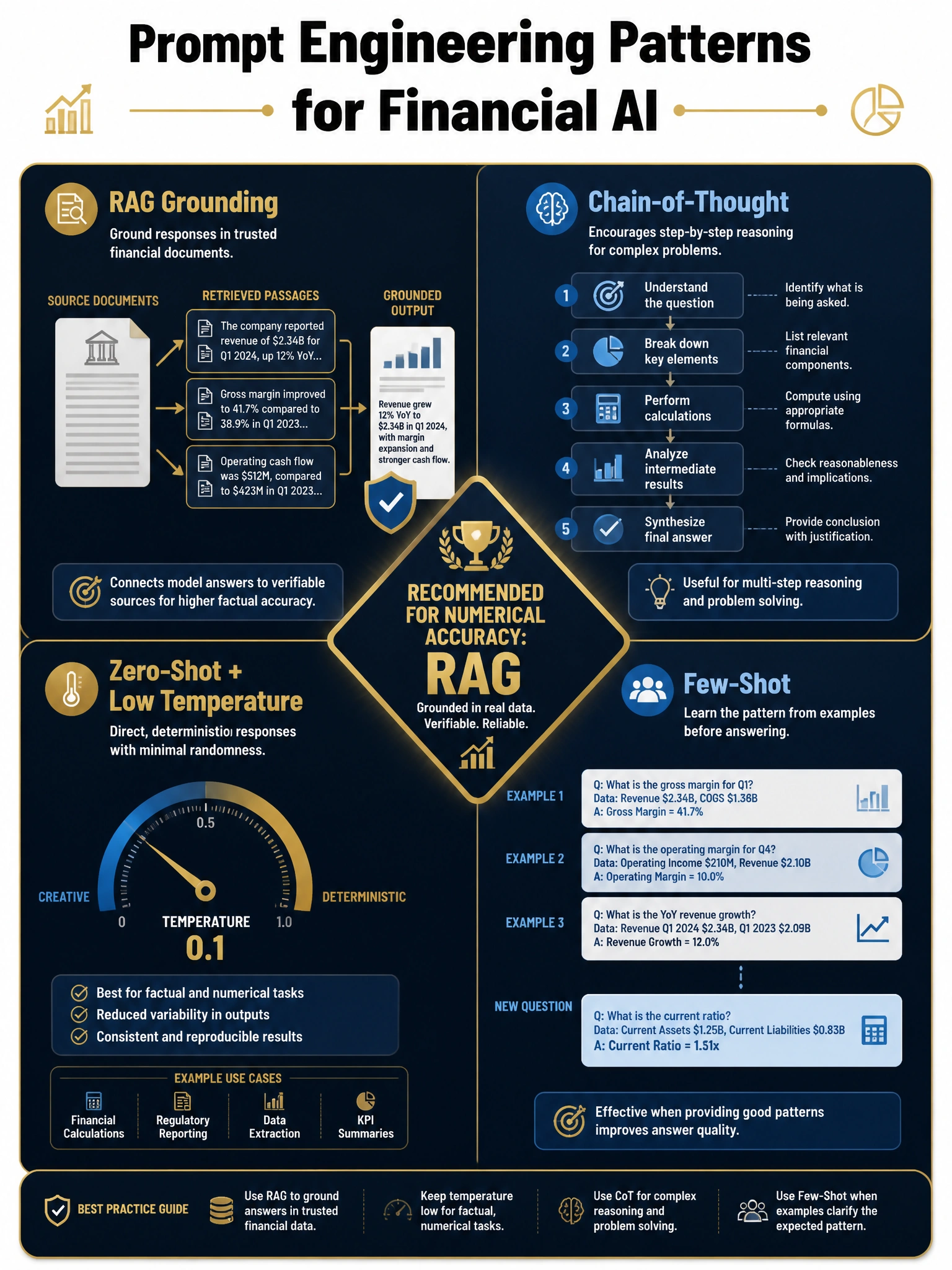
Think of it like a courtroom — a witness can't just say a number; they need to point to the document in evidence. RAG grounding forces the model to cite a source passage before stating any figure, which directly prevents it from confabulating revenue data. Temperature controls and chain-of-thought reasoning are useful, but they don't eliminate the root cause: the model generating numbers from parametric memory rather than retrieved facts.
Full explanation below image
Full Explanation
Large language models are probabilistic text predictors — they excel at pattern matching and prose generation but have no internal ledger of financial facts. When asked to summarize earnings calls from memory or from ungrounded prompts, they will generate plausible-sounding figures that reflect training-data patterns rather than the actual filing. This is the hallucination problem at its most dangerous in a financial context.
Retrieval-Augmented Generation (RAG) with grounding prompts addresses the root cause by restructuring the prompt pipeline: the model is forbidden from asserting numerical claims unless those claims are directly quoted or derived from a retrieved document chunk passed in context. A well-designed grounding prompt template might include a system instruction such as 'You may only state revenue, earnings-per-share, or margin figures that appear verbatim in the following SOURCE passages. If a figure is not in SOURCE, respond with [DATA NOT IN SOURCE].' This transforms the LLM from a memory recall engine into a structured reading comprehension engine.
Zero-shot prompting with temperature 0.0 reduces stochastic variation but does not eliminate hallucination — a deterministic hallucination is still a hallucination. Low temperature causes the model to produce its single most-likely output consistently, which is valuable for reproducibility but does nothing if the most-likely output is incorrect. Chain-of-thought prompting improves reasoning transparency and is excellent for multi-step analytical tasks such as ratio analysis or scenario modeling, but the reasoning chain can itself incorporate hallucinated premises, compounding rather than reducing errors when source documents are absent.
Few-shot prompting calibrates output style, tone, and structure — valuable for ensuring the summary follows a standardized analyst note format — but the in-context examples cannot supply the correct revenue figures for a new earnings call the model has not seen. The model will interpolate stylistically from examples while potentially hallucinating the substantive numbers.
Industry frameworks such as the NIST AI Risk Management Framework (AI RMF) and guidance from the FCA on AI in financial services both emphasize the need for AI outputs to be traceable to source data. RAG grounding directly satisfies this traceability requirement by design, making it the architecturally correct solution for numerical accuracy in financial AI applications.