
A credit research team wants to use an LLM with a 128,000-token context window to analyze complete 10-K annual reports. The average 10-K for their coverage universe is 95,000 words. The team's AI architect raises a concern about 'lost in the middle' degradation. After reviewing the literature, they conclude that raw context window size is insufficient to guarantee reliable extraction of material financial information from full filings. Which architectural or workflow mitigation best addresses the lost-in-the-middle phenomenon for long financial document analysis?
Select an answer to reveal the explanation.
Short Explanation
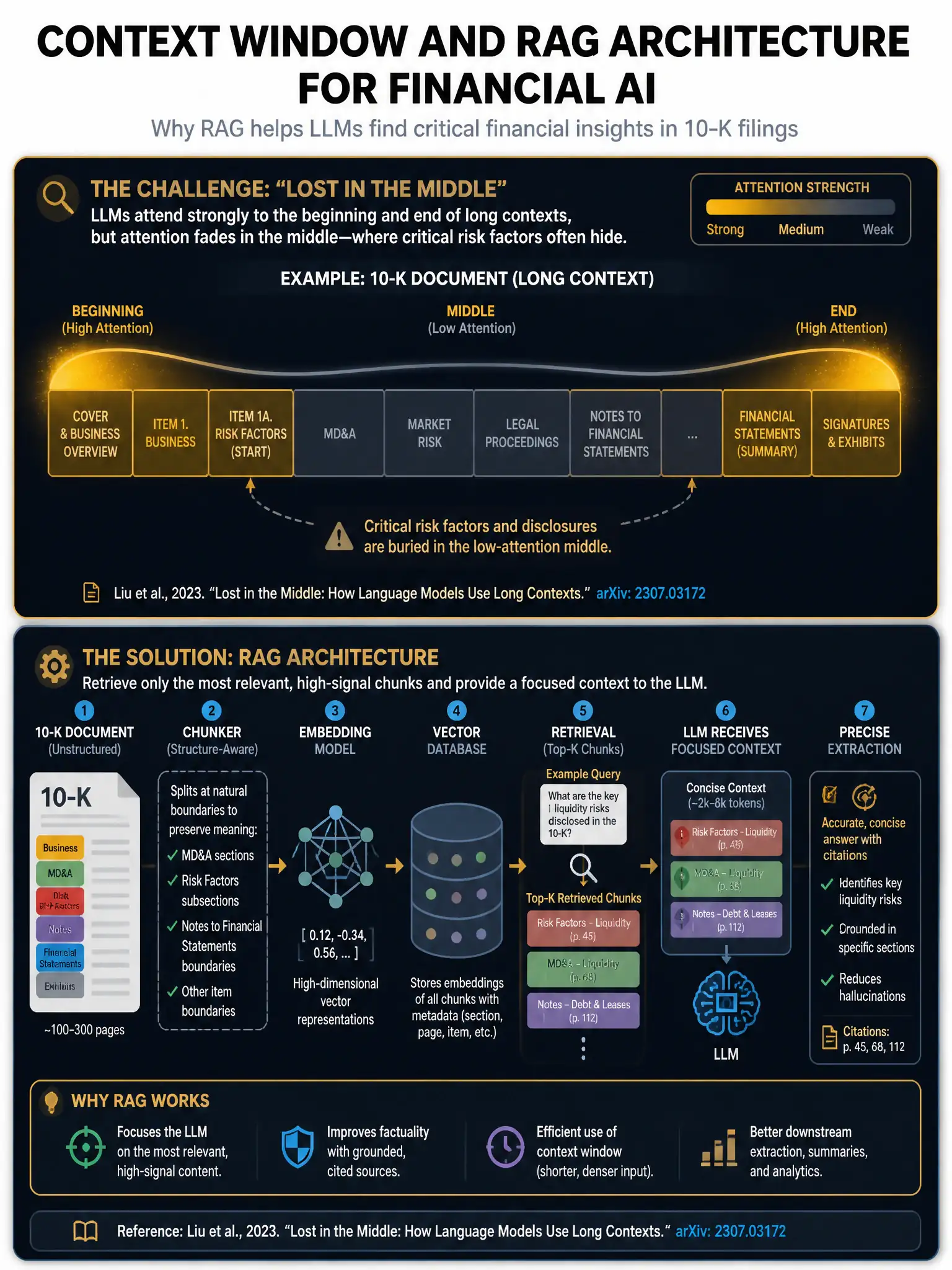
Context windows are like working memory — you can hold a lot, but you recall the beginning and end better than the middle. Lost-in-the-middle means the model can miss material facts buried in a full 10-K. RAG fixes it by pulling the relevant financial sections into a shorter prompt first, so the model sees what matters where it attends best.
Full Explanation
The 'lost in the middle' phenomenon was rigorously documented by Liu et al. (2023) in 'Lost in the Middle: How Language Models Use Long Contexts.' Their experiments showed that LLM performance on multi-document question answering degrades significantly when relevant information is placed in the middle of long contexts, even when the relevant information is technically within the model's context window. For 10-K analysis, this means that even a 128K token window — sufficient to hold a 95,000-word document — does not guarantee reliable extraction of material information buried in sections like the middle of the MD&A, deep in Note 14 of the financial statements, or in risk factor subsections 15-30 of 45.
The retrieval-augmented generation approach with financial domain-specific chunking and embeddings directly mitigates this by decomposing the problem: instead of passing the full document into context, a retrieval system (typically a dense embedding model with vector similarity search) identifies the top-ranked semantically relevant chunks to the query, and only those chunks are passed to the LLM. With domain-specific chunking (e.g., splitting 10-Ks at section boundaries — MD&A, Risk Factors, Notes — rather than arbitrary token counts) and financial embeddings (e.g., FinBERT-based embedding models), retrieval precision is high enough to bring the critical content into the LLM's primary attention focus at the beginning or end of a shorter context, where recall is strong.
The approach that increases batch size during inference addresses throughput parallelism in inference, not attention quality within a single long sequence — it has no effect on lost-in-the-middle degradation. The approach that splits each 10-K into two equal halves and runs two separate LLM inferences, then merges outputs, reduces but does not eliminate the problem: if material information straddles the split point, each half loses cross-section context, and merging outputs requires a second inference layer that introduces its own error propagation. The approach that increases model temperature during inference increases generation diversity and randomness but does not improve retrieval from long context — high temperature makes outputs less reliable, not more thorough. The RAG approach is additionally consistent with audit trail requirements, as the retrieved source chunks can be logged and verified.