
Orion Systematic Strategies is preparing to deploy an AI-driven credit risk scoring model that will influence lending decisions for its private credit business. The Chief AI Officer is designing the responsible AI framework for the deployment. Which combination of responsible AI principles is most critical to implement before go-live for a credit risk model with direct client impact?
Select an answer to reveal the explanation.
Short Explanation and Infographic
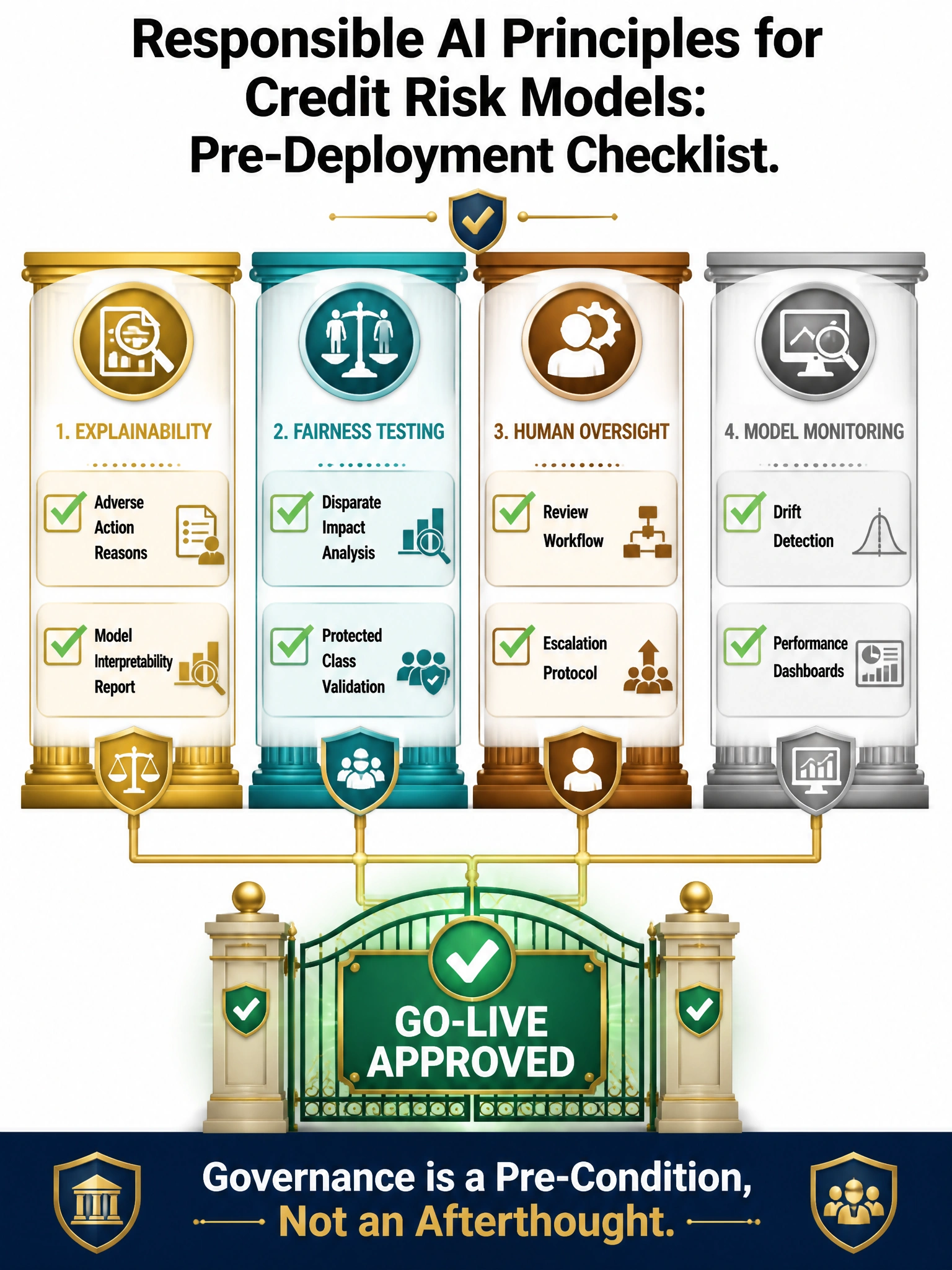
Credit decisions directly impact people's access to capital — that's about as consequential as AI gets. Think of responsible AI principles as the airbags in a car: you don't install them after the first crash, you build them in before you drive. For a credit model, explainability is your legal obligation (adverse action notices), fairness testing prevents discriminatory outcomes, human oversight creates the kill switch, and monitoring catches model drift before it causes harm.
Full explanation below image
Full Explanation
Credit risk AI models that influence lending decisions are among the highest-stakes AI deployments in financial services. They directly determine access to capital, which implicates equal credit opportunity laws (ECOA in the US, Consumer Credit Directive in the EU) and fiduciary obligations in private credit contexts. Responsible AI principles must be embedded pre-deployment, not bolted on afterward.
Explainability is legally mandated for credit decisions: US ECOA and Regulation B require that adverse credit decisions come with specific, articulable reasons. A black-box model that cannot generate adverse action reasons is non-compliant from day one. This alone makes explainability a pre-deployment prerequisite.
Fairness testing requires validating the model across protected demographic characteristics before it influences real decisions. Post-deployment discovery of disparate impact can result in class action litigation, CFPB enforcement action, and reputational damage that is far more expensive than pre-deployment testing.
Human oversight ensures that model outputs are reviewed by credentialed professionals before final credit decisions are made — satisfying both fiduciary standards and emerging AI Act requirements for high-risk AI systems that affect individuals' economic circumstances.
Model monitoring establishes baselines and drift detection so that model degradation — such as a shift in the economic environment that invalidates training data assumptions — triggers human review rather than silent performance deterioration.
Option A (deploy first, govern later) is the 'move fast and break things' approach applied to a context where the things being broken are credit access decisions affecting real borrowers. Regulators treat this as negligence, not innovation.
Option C mistakes transparency and encryption for comprehensive responsible AI. Telling clients AI is involved and encrypting outputs addresses two narrow concerns while leaving explainability, fairness, and monitoring unaddressed.
Option D places accuracy above governance and defers critical risk controls to an annual cycle. Credit model accuracy benchmarked on historical data says nothing about fairness, explainability, or resilience to regime change — and annual review is far too infrequent for a live credit model.