
A portfolio manager at Redwood Capital Partners uses an AI system to generate rebalancing recommendations. The AI recommends overweighting a high-yield bond sector. The portfolio manager reviews the recommendation and approves it without independent analysis, solely based on the AI's output. The position subsequently results in significant client losses. From a fiduciary duty perspective, who bears responsibility?
Select an answer to reveal the explanation.
Short Explanation
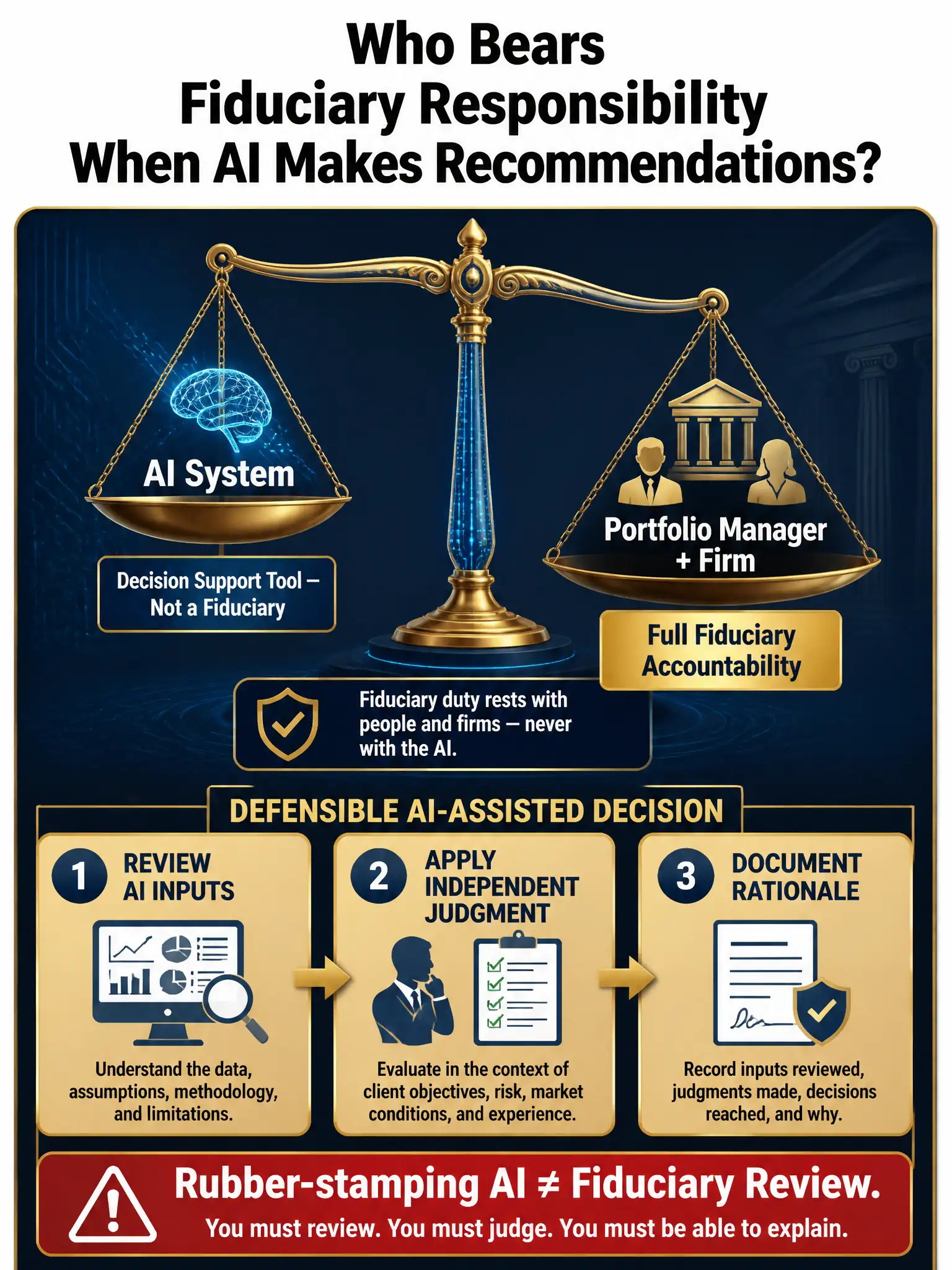
You can outsource analysis, but you can't outsource accountability. If you approve an AI recommendation without independent analysis, you're rubber-stamping, not reviewing. The portfolio manager and firm are fully on the hook because fiduciary duty can't be delegated to an AI system.
Full Explanation
Fiduciary duty in investment management is a personal and institutional obligation — it attaches to the licensed professional and the registered firm, not to the tools they use. Under the Investment Advisers Act of 1940, CFA Institute Standards, and comparable frameworks globally, a fiduciary must act in the client's best interest using their own professional judgment. AI systems are decision-support tools, not fiduciaries.
The portfolio manager in this scenario committed a fiduciary process failure by approving an AI recommendation without conducting independent analysis. Defensible AI-assisted decision processes require the human to: review the AI's inputs and assumptions, assess whether the recommendation aligns with client investment policy statements, apply professional judgment to market conditions, and document the rationale independently. Clicking 'approve' without performing these steps does not constitute a review — it constitutes delegation of judgment to a machine, which is not permitted under fiduciary law. Therefore, the correct answer is the one holding the portfolio manager and the firm responsible because fiduciary duty cannot be delegated to an AI system and the human decision-maker retains full accountability.
The AI-vendor answer is incorrect because AI vendors are not fiduciaries. Vendor contracts typically include explicit disclaimers that recommendations are for informational purposes only and do not constitute investment advice. Regulatory bodies will not pursue the vendor for fiduciary breach in this context.
The partial-responsibility answer is incorrect because it introduces a legally non-existent concept: AI systems cannot be co-decision-makers with fiduciary standing. There is no legal mechanism by which liability is shared with a software system. The entire responsibility remains with the human and institutional fiduciary.
The no-breach answer is incorrect because it mistakes procedure for substance. The existence of a review step does not satisfy fiduciary duty if the review consisted of accepting the AI recommendation uncritically. Regulators and courts examine the quality and independence of the judgment exercised, not merely whether a human clicked a button.