
A CIO at a $50B AUM asset management firm is evaluating whether to build a proprietary AI-driven portfolio optimization engine in-house or license a commercial solution from a third-party fintech vendor. The firm trades highly illiquid alternative assets with proprietary factor models that are core to its competitive edge. Which analysis framework and primary decision criterion should MOST drive this build-vs-buy decision?
Select an answer to reveal the explanation.
Short Explanation
Build-vs-buy isn't really a cost question — it's a 'what's your superpower?' question. If your proprietary factor models and illiquid-asset intelligence are the reason clients pay your fees, you don't hand that secret sauce to a vendor who also serves your competitors. Build what makes you unique, buy what everyone else can have.
Full Explanation
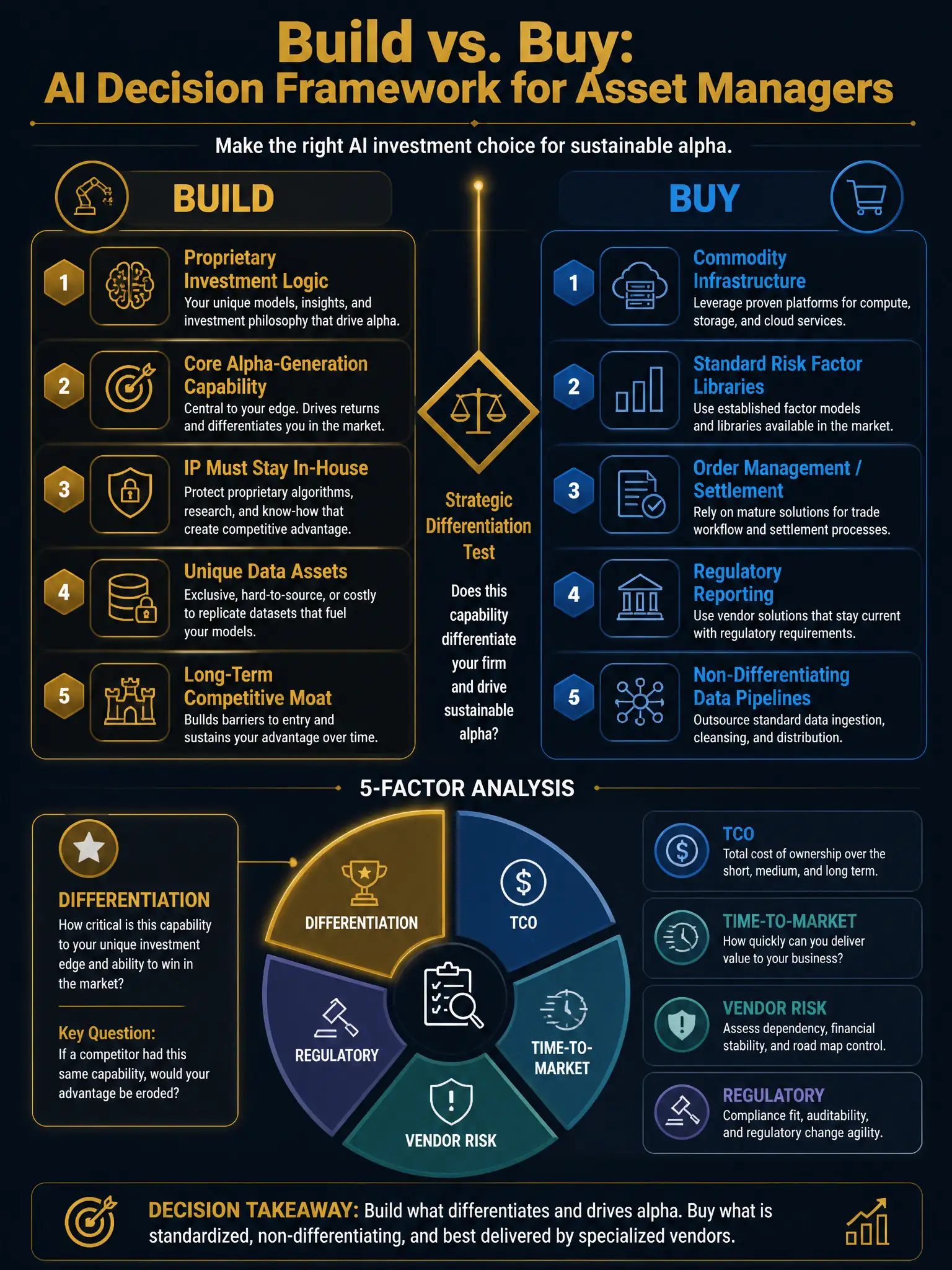
The build-vs-buy decision in financial AI architecture is one of the most consequential decisions the CIO makes, with implications spanning competitive positioning, regulatory risk, total cost, and organizational capability development. While multiple frameworks inform this decision, the Strategic Differentiation and Core Competency model (rooted in Prahalad and Hamel's resource-based view of the firm) is the primary analytical lens for asset management and investment firms.
The core principle: AI capabilities that encode the firm's proprietary investment thesis, factor models, or alpha-generation logic represent durable competitive advantages. Externalizing these to a vendor creates unacceptable risks: intellectual property exposure if the vendor's platform learns from the firm's data or is breached, and competitive commoditization if the same vendor sells equivalent capabilities to rival firms. For this $50B AUM firm trading illiquid alternatives with proprietary factors, the portfolio optimization engine is definitionally a core competency — it should be built.
Conversely, capabilities that are non-differentiating infrastructure (data normalization, order management system integration, regulatory reporting, standard risk factor libraries) are candidates for third-party procurement. Buying these reduces time-to-market and shifts operational risk to specialized vendors without sacrificing competitive advantage.
The Total Cost of Ownership analysis that prioritizes the lower 3-year licensing or development cost is an important input but an insufficient primary criterion. The proprietary AI engine may cost more to build than a vendor license over three years while still being the correct strategic choice because it protects the firm's alpha generation. Cost should be evaluated within the strategic framework, not used as the primary filter.
The vendor risk assessment that prioritizes minimizing third-party concentration risk is a legitimate secondary consideration in the broader vendor strategy, but minimizing concentration risk alone does not determine whether to build or buy a specific capability. An asset manager with 15 vendors is not necessarily better positioned than one with 5, if the 5 cover commodity capabilities.
The regulatory compliance mapping rule that builds only when no commercial vendor can demonstrate compliance and buys otherwise is an oversimplification. Many commercial AI vendors in financial services are highly compliance-capable, and regulatory status alone is rarely the determinative factor in the build-vs-buy decision. Furthermore, building in-house does not eliminate compliance obligations — the firm remains responsible for model validation, governance, and regulatory adherence regardless of who wrote the code.
Mature build-vs-buy frameworks evaluate strategic differentiation, total cost of ownership including hidden integration costs, time-to-market, vendor and concentration risk, and regulatory and IP considerations. Strategic differentiation is the primary filter; the others refine the decision once the strategic case is established.