
A systematic fund runs three alpha-generating models: (1) a momentum signal with IC of 0.08 and Sharpe of 1.1, (2) an NLP-based earnings sentiment signal with IC of 0.06 and Sharpe of 0.9, and (3) a satellite imagery-based supply chain signal with IC of 0.05 and Sharpe of 0.7. An analysis reveals the pairwise correlations between signal returns are: Momentum-NLP: 0.12, Momentum-Satellite: 0.05, NLP-Satellite: 0.08. What is the MOST important implication of the low inter-signal correlations for portfolio construction?
Select an answer to reveal the explanation.
Short Explanation and Infographic
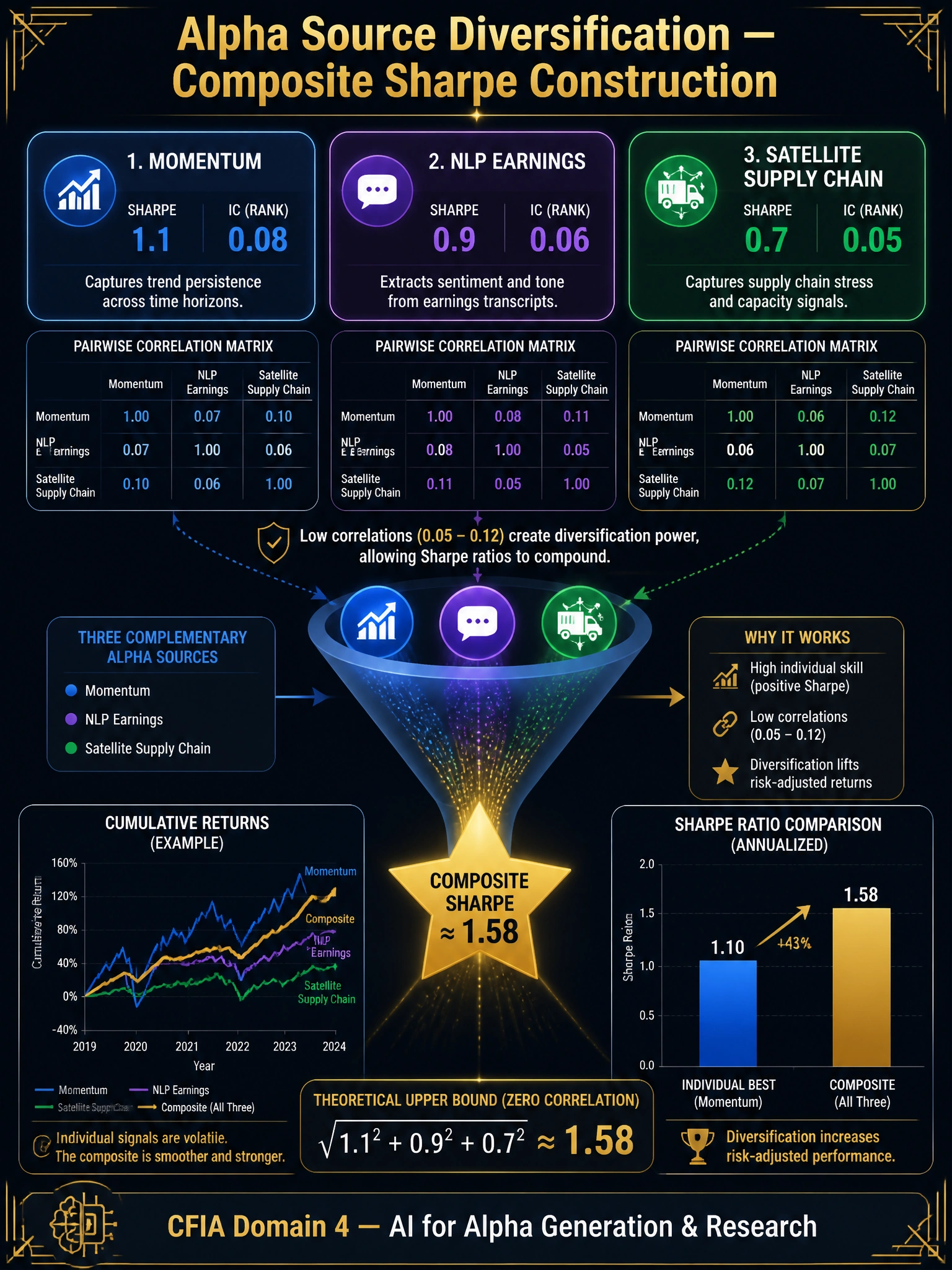
Diversification doesn't just apply to stocks — it applies to your alpha sources too. Three signals with low correlations are like three employees who rarely make mistakes at the same time. Even if each one is modestly skilled on its own, combining them smooths out the bad days and the composite ends up stronger than any individual. This is the fundamental power of alpha diversification: you can build a better Sharpe from weaker but uncorrelated ingredients than from a single strong but concentrated bet.
Full explanation below image
Full Explanation
The core insight from modern portfolio theory applied to alpha construction is that the composite signal Sharpe ratio of uncorrelated (or low-correlated) signals is approximately equal to the square root of the sum of the squared individual Sharpe ratios, assuming equal weighting and zero inter-signal correlation. For the three signals described: sqrt(1.1² + 0.9² + 0.7²) ≈ sqrt(1.21 + 0.81 + 0.49) ≈ sqrt(2.51) ≈ 1.58. Even if the realized pairwise correlations are slightly positive (0.05–0.12), the composite Sharpe would still materially exceed the best individual Sharpe of 1.1.
Option A (remove weak signals) misunderstands the role of low-IC signals in diversified composites. The satellite imagery signal with IC of 0.05 and Sharpe of 0.7 contributes meaningfully to the composite precisely because it is nearly uncorrelated with the other two signals. Removing it would reduce composite Sharpe.
Option C (maximize allocation to highest Sharpe signal) is the traditional intuition that diversification corrects. In an uncorrelated environment, equal-weighting or optimal (IC-weighted) blending outperforms concentration in the best single signal because the highest-Sharpe signal has high variance in realized outcomes, which the other signals offset.
Option D (signals will converge) is incorrect. Low correlation between signals derived from momentum patterns, language understanding, and geospatial imagery reflects genuinely distinct information sources with different market microstructure exposures. They are not measuring the same phenomenon; the low correlation is a feature, not a warning sign.
In practice, composite alpha construction at institutional systematic funds uses methods including equal risk contribution weighting, IC-weighted blending, and Markowitz optimization over signal returns to maximally exploit inter-signal diversification. The ongoing monitoring of pairwise correlations over rolling windows detects crowding events that can cause temporary correlation spikes.