
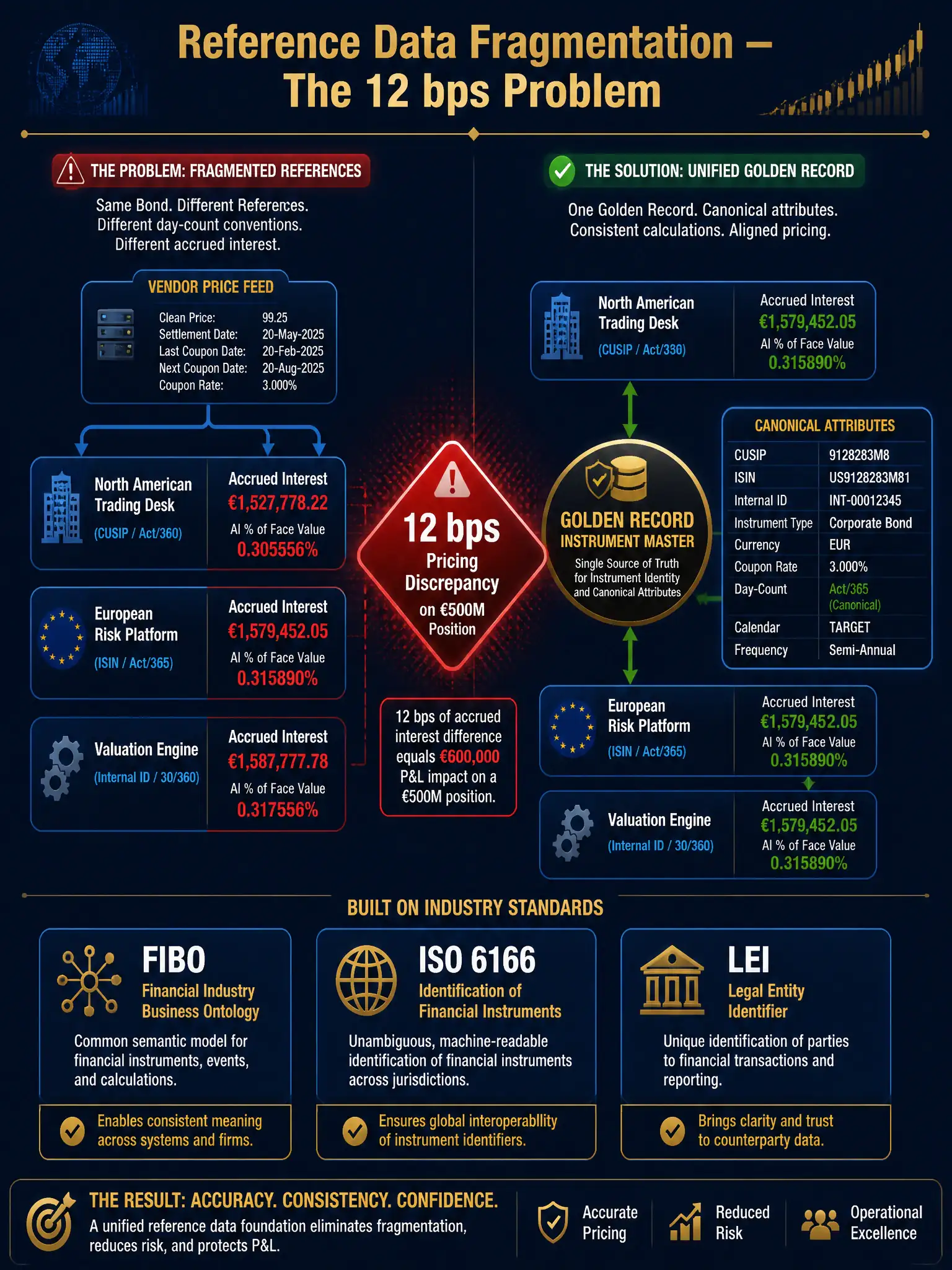
Following a cross-border merger, a global asset manager discovers that the same corporate bond is identified by three different identifiers across its systems: CUSIP in the North American trading desk system, ISIN in the European risk platform, and a proprietary internal code in the valuation engine. Each system also carries a different day-count convention for interest accrual — Actual/360, Actual/365, and 30/360, respectively. A reconciliation report flags a 12-basis-point pricing discrepancy on a €500M position. Tracing the discrepancy, the data team confirms all three systems are receiving the same vendor price feed but computing accrued interest differently. The root cause is BEST described as:
Select an answer to reveal the explanation.
Short Explanation
When three systems think they're talking about the same bond but each has its own 'ground truth' for day-count convention, you've got a reference-data mess. The fix is an instrument master Golden Record that maps CUSIP, ISIN, and the internal code to one canonical security with authoritative attributes. Without it, each system writes its own rules, and 12 bps suddenly costs real money.
Full Explanation
Reference data — descriptive, definitional attributes of financial instruments (identifiers, conventions, corporate actions, classification) — is foundational to every downstream calculation in an investment management operation. When reference data is fragmented across systems without a canonical source of truth, numerical errors in valuation, risk measurement, and regulatory reporting are inevitable.
The Golden Record concept in reference data management designates a single authoritative definition for each entity (instrument, counterparty, benchmark). For a fixed-income instrument, the Golden Record in the instrument master specifies: all recognized identifiers (CUSIP, ISIN, SEDOL, Bloomberg ID, internal code) and their bidirectional mapping; the canonical day-count convention, currency, coupon frequency, settlement convention, and maturity; and the authoritative source for any attributes that may differ by vendor.
In this scenario, the 12-bp discrepancy is directly attributable to three systems each applying a different day-count convention to the same price, producing three different accrued interest figures. Actual/360, Actual/365, and 30/360 produce meaningfully different accrued interest values on a €500M position, especially as the bond approaches a coupon date. Therefore, the root cause is best described as failure to maintain a Golden Record in a centralized instrument master with canonical identifier mapping and authoritative security attribute definitions.
Why the distractors fail: The systematic-error-in-the-vendor-pricing-feed explanation, which blames inconsistent yield curve stripping applied to the bond's cash flows, fails because all three systems receive the same vendor price feed, and the discrepancy is in accrued interest, not in the vendor's prices — the pricing feed is not the source of error. The incorrect-yield-curve-bootstrapping-in-the-European-risk-platform explanation, which blames a different rate basis than the North American system, fails because yield curve bootstrapping affects the discount rate applied to cash flows; the discrepancy here is in accrued interest computation, which depends on the day-count convention, not the rate basis. The absence-of-FIX-protocol-standardization explanation, which blames attribute divergence at the order-entry layer, fails because FIX protocol governs order execution message formats and is entirely unrelated to how systems store and apply static reference data attributes such as day-count conventions.
Industry standards for reference data management include FIBO (Financial Industry Business Ontology), ISO 6166 (ISIN), and the LEI (Legal Entity Identifier) framework, with operational implementations typically anchored in commercial MDM (Master Data Management) platforms such as those from Bloomberg, Refinitiv, or proprietary builds on data fabric architectures.