
A portfolio analyst at a macro hedge fund is using a large language model to analyze geopolitical risk in an earnings call transcript. She runs the following prompt: 'Summarize this earnings call.' The output is too general and misses three specific geopolitical risk disclosures embedded in management commentary. Her colleague suggests four prompt revisions. Which revised prompt best applies structured prompt engineering techniques to improve output specificity and reliability?
Select an answer to reveal the explanation.
Short Explanation and Infographic
A vague request gets a vague answer — you wouldn't tell a junior analyst to 'look into risks' and expect a structured risk memo. Option B applies four core prompt engineering techniques at once: a role assignment that primes the model's domain context, a precise extraction task, an explicit structured output schema, and a distinction between quantitative and qualitative disclosures. That's how you get reliable, auditable outputs. B is correct.
Full explanation below image
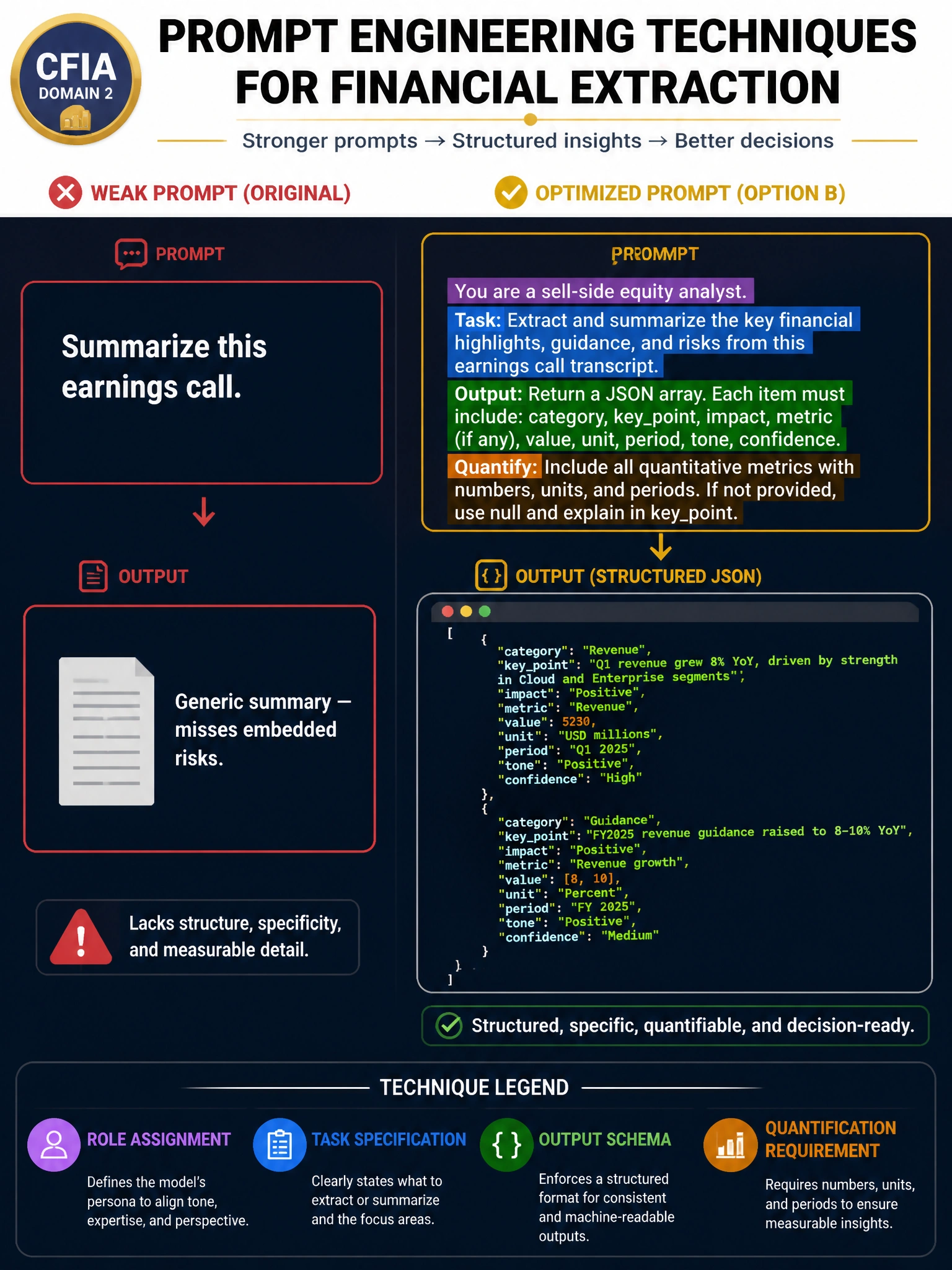
Full Explanation
Prompt engineering is a systematic discipline with documented techniques that materially improve output quality from large language models. For financial applications where precision, auditability, and structured output are required, several techniques are essential.
Option B demonstrates four in combination. First, persona assignment ('You are a senior macro analyst specializing in geopolitical risk assessment') primes the model to apply domain-appropriate reasoning and terminology rather than generic summarization behavior. Research has consistently shown that role assignment improves relevance and domain specificity in complex extraction tasks. Second, precise task specification ('Extract all geopolitical risk disclosures') eliminates the ambiguity in the original prompt ('summarize') that caused the model to prioritize general topics over embedded risk disclosures. Third, a structured output schema with explicit fields — quote, geography, financial impact, quantification type — transforms the task from open-ended generation into structured extraction, dramatically reducing variance in output format and content. Fourth, the JSON output requirement makes the output machine-readable and directly ingestible into downstream risk aggregation systems.
Option A adds emphasis ('Be thorough') but preserves the original vagueness. Research on instruction following in LLMs shows that intensity modifiers ('carefully,' 'be thorough') without structural constraints produce marginally better but still unfocused outputs. Option C is a modest improvement — it adds specificity to the summarization task — but it does not specify output format, does not assign a role, and the hedge 'if any are mentioned' signals to the model that geopolitical risks may not be important, potentially de-prioritizing them. Option D suffers from scope creep: by asking for geopolitical, supply chain, currency, and regulatory risks simultaneously without structured output requirements, the prompt diffuses the model's attention across four domains and produces a lengthy, disorganized report rather than a precise extraction. In prompt engineering, focused, constrained prompts with structured output schemas consistently outperform broad, open-ended prompts for extraction tasks.