
A sovereign wealth fund's AI transformation initiative is six months in. Adoption metrics show that the new AI-powered research platform is being used by only 22% of analysts despite mandatory training completion. Exit interviews with resistant analysts reveal three themes: (1) distrust of model outputs when they contradict their own views, (2) fear that AI performance attribution will undermine their compensation case, and (3) uncertainty about how to explain AI-influenced decisions to investment committees. Which change management intervention is most directly targeted at the root causes identified?
Select an answer to reveal the explanation.
Short Explanation and Infographic
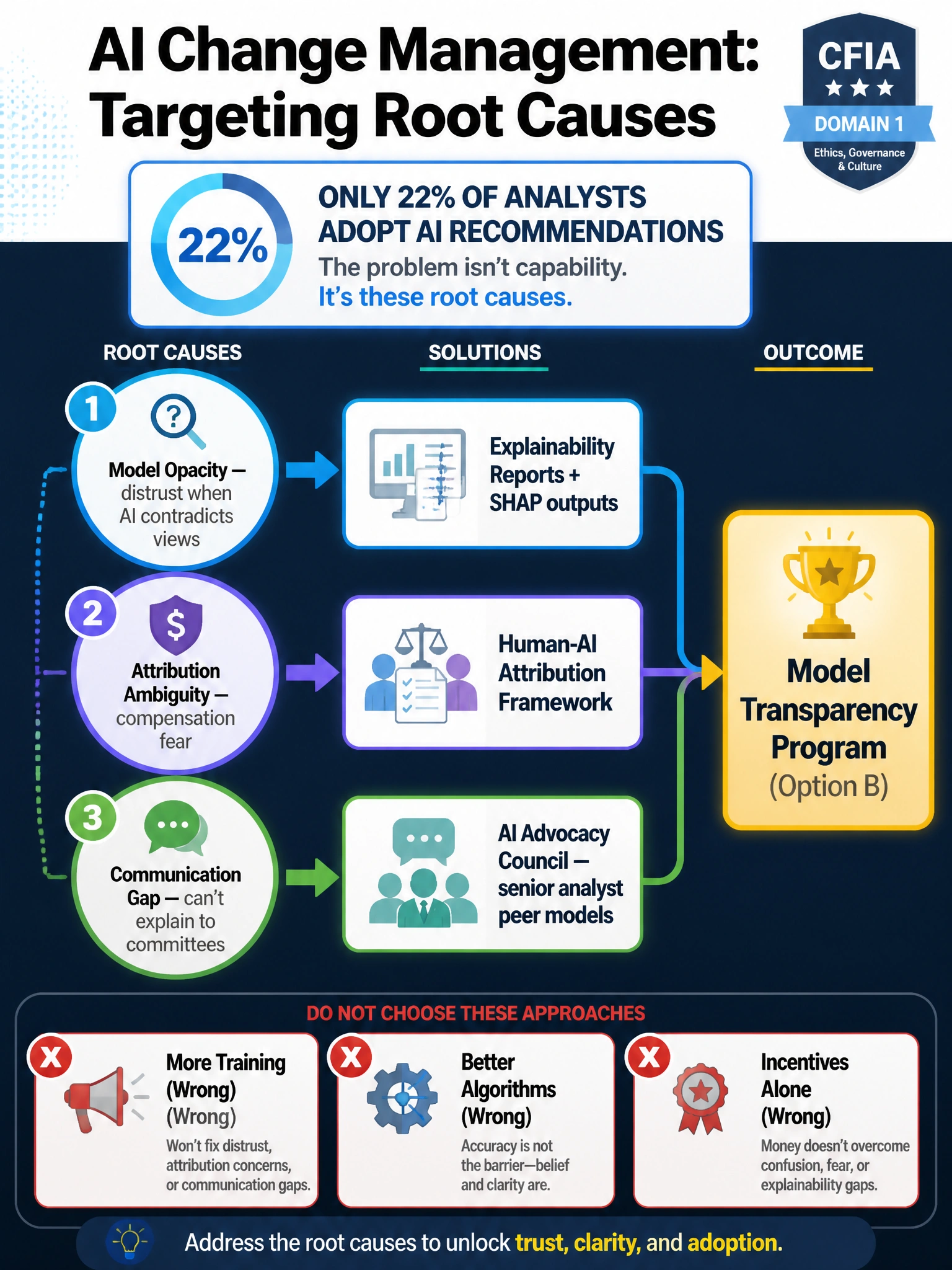
People don't resist change because they're lazy — they resist when they can't explain what's happening or when they feel their professional identity is threatened. All three root causes here are about trust and accountability, not capability. Option B addresses all three directly: explainability builds model trust, the attribution framework resolves the compensation fear, and peer advocacy normalizes platform use. That's the correct answer.
Full explanation below image
Full Explanation
Change management in AI transformation differs from traditional software rollout change management in a critical way: the resistance is often epistemological, not operational. Analysts who have spent a decade developing investment intuition feel cognitively threatened by a system that contradicts their views, especially when they cannot examine the reasoning behind those contradictions. This is not stubbornness — it is a rational response to opacity.
The three root causes identified in the exit interviews map precisely to three distinct change management levers. Root cause 1 (distrust of contradictory outputs) requires explainability — analysts need to see why the model disagrees with them, not just that it disagrees. Publishing SHAP values, attention patterns, or plain-language explanations of model reasoning allows analysts to engage with the AI as a peer whose reasoning can be examined and challenged, rather than as an oracle whose verdicts must be accepted or rejected wholesale.
Root cause 2 (compensation attribution fear) requires a formal human-AI performance attribution framework. Without one, credit for AI-influenced outperformance is ambiguous, and analysts rationally avoid using the tool to protect their track record. A framework that explicitly partitions credit — 'the AI identified the sector, the analyst identified the timing and sizing' — removes this zero-sum dynamic.
Root cause 3 (inability to explain to investment committees) is a communication and legitimacy problem, not a technical one. Senior analysts who publicly model confident, fluent AI platform use in committee settings create social permission for others to do the same.
Option A (mandating adoption as a KPI) treats the symptom and risks driving superficial compliance while deepening underlying resistance — a well-documented pattern in organizational change literature (Kotter, 8-step model). Option C (platform replacement) misdiagnoses the problem as a product failure when exit interview data clearly identifies a trust and accountability failure. Option D (pause for vendor review) is avoidance behavior that signals leadership uncertainty and likely accelerates resistance.