
The Chief People Officer of a $120B asset manager is building a five-year AI talent strategy. The firm currently employs 340 investment professionals with deep domain expertise but limited quantitative backgrounds, and has a small 12-person data science team. Competing for top ML engineers against tech firms is proving impossible given compensation constraints. Which talent strategy is most likely to produce durable AI capabilities at this firm?
Select an answer to reveal the explanation.
Short Explanation
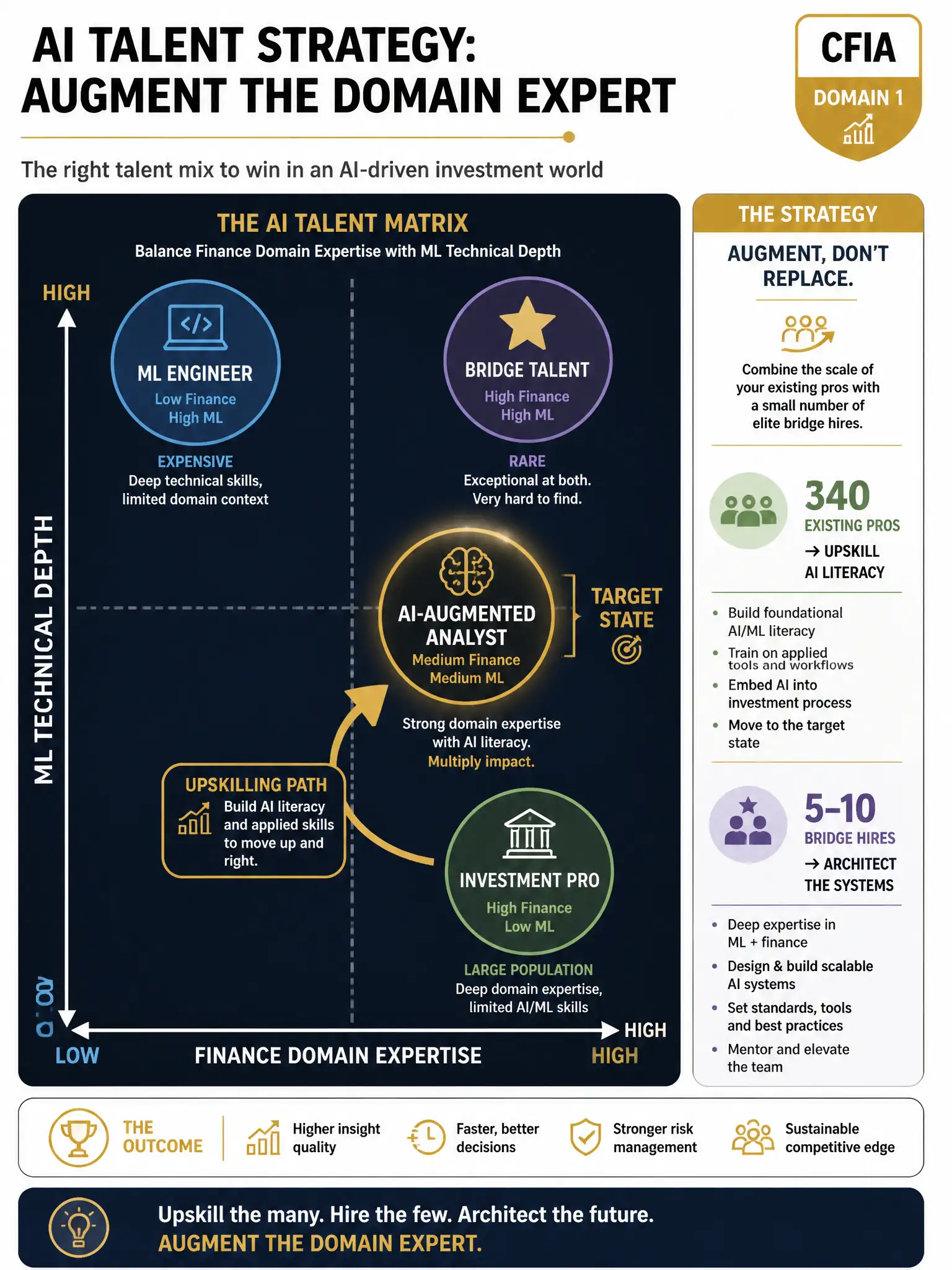
You can't out-pay Google for ML engineers, and you shouldn't try. Your real edge is the 340 investment professionals who already know what 'alpha' means. Upskill them as AI-augmented analysts, then hire only a few bridge talent who speak both finance and ML.
Full Explanation
Talent strategy for AI transformation in financial services has evolved significantly from the 2015-2020 'hire data scientists' playbook. The current consensus, supported by research from the MIT Sloan Management Review's AI in Business Consortium and practical evidence from firms like Bridgewater, Man Group, and Two Sigma, recognizes that the highest-leverage investment is upskilling domain experts rather than acquiring pure technical talent.
The core insight is that investment AI fails most often not because of insufficient model sophistication, but because models are built without adequate domain context, or because investment professionals cannot interpret and trust model outputs. The portfolio manager who understands what a transformer's attention weights mean in the context of earnings sentiment is more valuable than a senior ML engineer who has never read a 10-K. This 'AI-augmented analyst' archetype — someone who can frame the right problem for an AI system, evaluate its outputs critically, and know when to override — is the scarce resource in financial AI.
The durable strategy is to upskill the existing 340 investment professionals to become 'AI-augmented analysts' who can prompt, interpret, and validate AI outputs, while selectively hiring a small number of bridge talent who combine finance and ML expertise. It also correctly identifies 'bridge talent' as a selective complement. These are professionals with genuine depth in both finance and machine learning (often PhDs who did quantitative finance dissertations, or engineers who spent years at hedge funds). They are rare and expensive, but a firm needs only a handful to architect the AI systems that the upskilled generalists will use. This is a force-multiplier model, not a wholesale talent replacement.
The aggressive salary-matching strategy is wrong because the competition on compensation is unwinnable — a senior ML engineer at Google earns $400-600k+ in total comp that most asset managers cannot match, and those who could match it still lose on culture, compute access, and peer environment. The single-vendor outsourcing strategy is wrong because it creates dangerous dependency on a single vendor and eliminates the internal capability to evaluate, validate, and evolve AI systems — a critical governance failure. The top-academic-ML rotational hiring strategy is wrong because it inverts the correct talent sequencing; teaching ML engineers investment intuition is far harder and slower than teaching investment professionals AI literacy.