
A fundamental long/short equity fund with a 25-year track record is integrating AI into its investment process for the first time. The CIO wants to ensure AI augments rather than replaces the firm's qualitative edge. An external consultant proposes four integration sequences. Which sequence correctly follows the principle of 'embedding AI at the margin of the existing process before transforming the core'?
Select an answer to reveal the explanation.
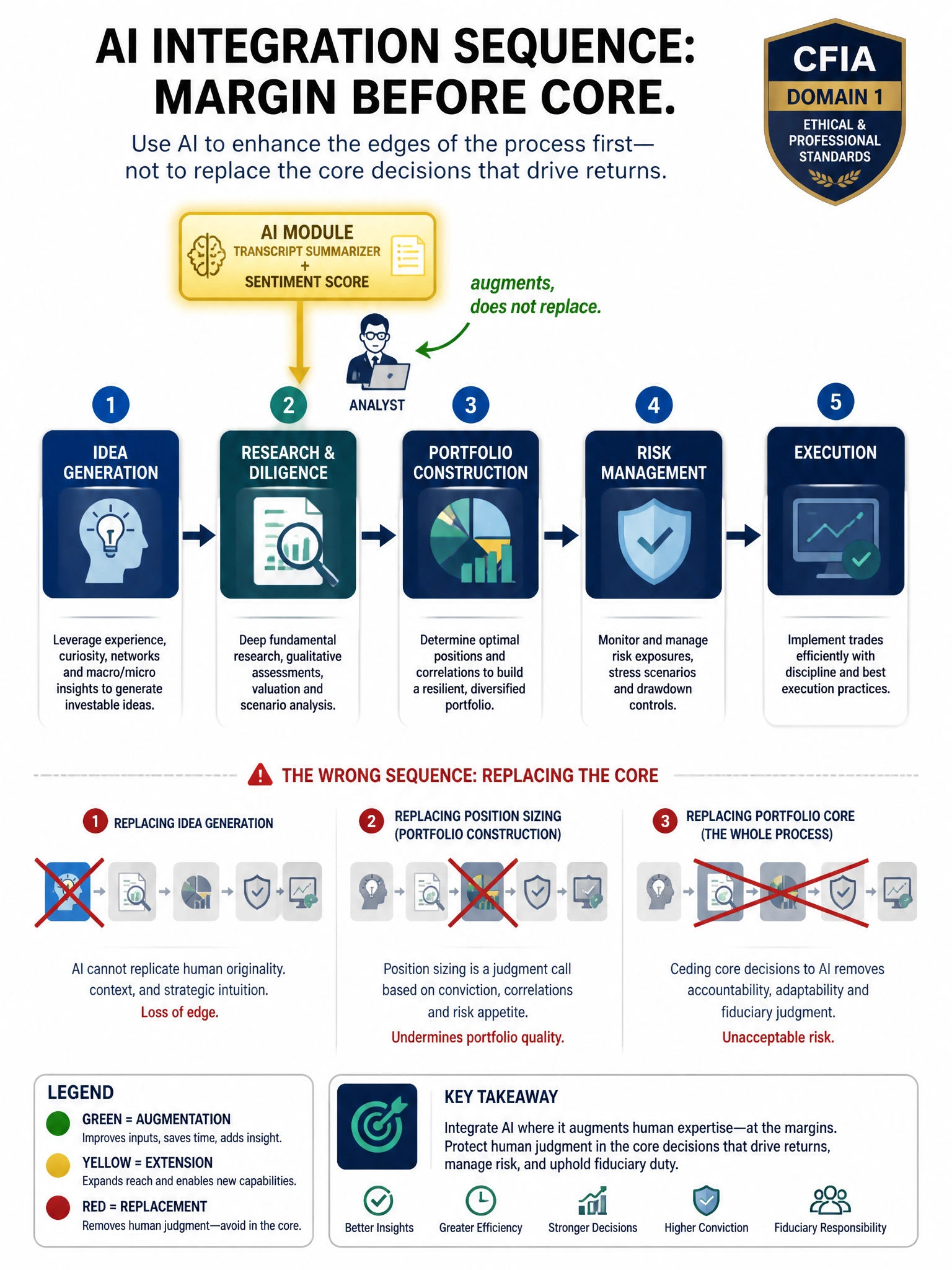
Short Explanation and Infographic
You wouldn't hand a new sous chef the keys to the restaurant on day one — you'd start them on prep work. Option B does exactly this: AI handles the tedious transcript processing while analysts retain full control over interpretation and thesis formation. This is how you build trust in AI outputs before letting the system touch higher-stakes decisions. B is correct.
Full explanation below image
Full Explanation
Investment process transformation theory distinguishes between process augmentation (AI improves how existing steps are executed), process extension (AI adds new capabilities that did not previously exist), and process replacement (AI takes over steps previously owned by humans). Best practice for firms with established qualitative edges is to sequence these deliberately: augmentation first, extension second, replacement only where clearly value-additive and after demonstrated track record.
Option B exemplifies augmentation at its cleanest. Earnings transcript summarization is a time-consuming, low-interpretation task — analysts currently spend 30-90 minutes per call reading and note-taking before forming views. An AI that compresses this to a structured pre-read summary saves time and reduces the risk that analysts miss key disclosures in lengthy transcripts. Critically, the analyst still performs all of the interpretive work: forming a thesis, stress-testing assumptions, and making the buy/sell recommendation. The AI has not touched the core of the process.
Option A is a core replacement disguised as augmentation — restricting the idea universe to AI-selected names fundamentally changes what the analyst team looks at and eliminates the bottom-up idea generation that is likely the source of the firm's qualitative edge. This is exactly what the CIO said to avoid. Option C replaces position sizing, another core discretionary function, with no track record justification. Option D installs a 'quantitative core' without establishing any foundation of trust or validation — this is a dramatic restructuring that contradicts the 'margin first' principle entirely.
The broader framework here draws from the McKinsey AI Transformation framework and the work of Andrew Lo and others on hybrid human-machine investment processes: establish AI credibility in low-stakes, measurable tasks before progressively extending its role into consequential decisions.