
Why does effective AI governance require ownership, policies, workflows and evidence to be defined together, rather than any one of them alone?
Select an answer to reveal the explanation.
Short Explanation
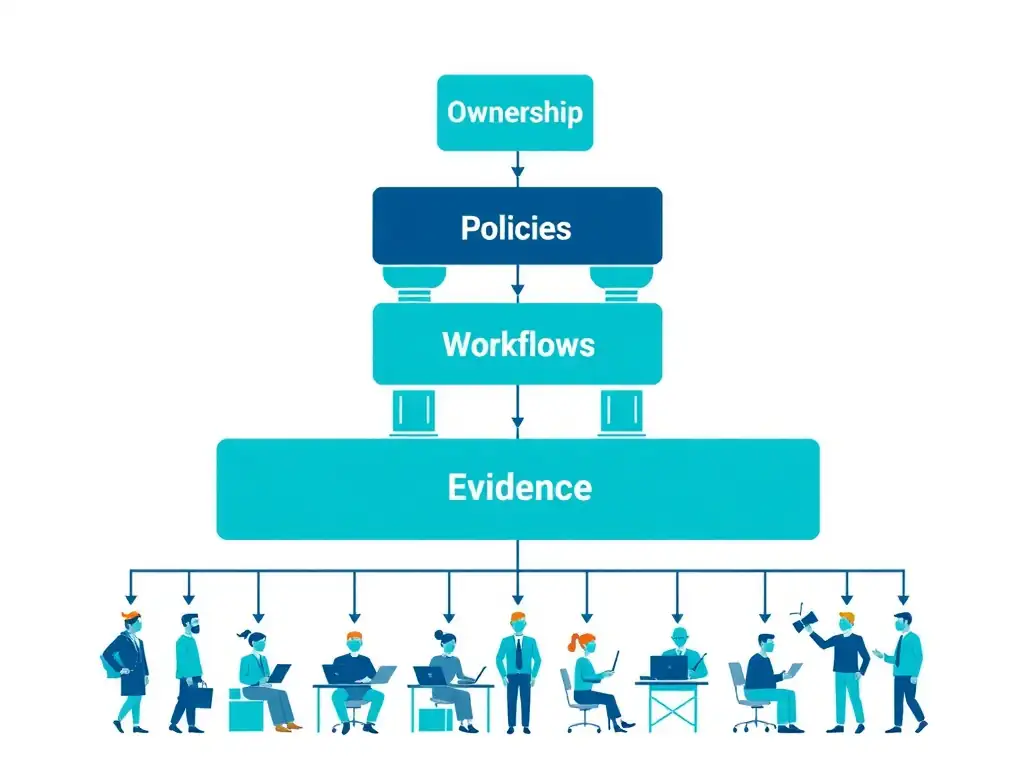
Take any one of the four away and you can see exactly what breaks - who's accountable, what the rule is, how it's applied, or whether it happened.
Full Explanation
The correct answer states that each element covers something the others do not: ownership assigns accountability, policy sets the rule, workflow operationalises it consistently, and evidence proves it happened. The four elements are complementary rather than redundant: without ownership nobody is accountable, without policy there is no rule, without workflow the rule is applied inconsistently, and without evidence nothing can be verified afterward. Regulators requiring exactly these four documents to be submitted as a single package is incorrect because there is no such fixed regulatory document-bundling requirement being described here. The idea that defining all four at once is faster than defining them one at a time is incorrect because speed of definition is not the reason all four matter; their distinct coverage is. The idea that only one of the four is actually necessary and the rest are optional best practice is incorrect because treating three of the four as optional reintroduces exactly the gaps governance is meant to close. For the exam, be ready to explain what each of the four elements uniquely provides.