
An organization wants business users to explore lakehouse data without writing SQL, while keeping every access subject to the same governance as engineered queries. Which approach is consistent with the platform's consumption model?
Select an answer to reveal the explanation.
Short Explanation
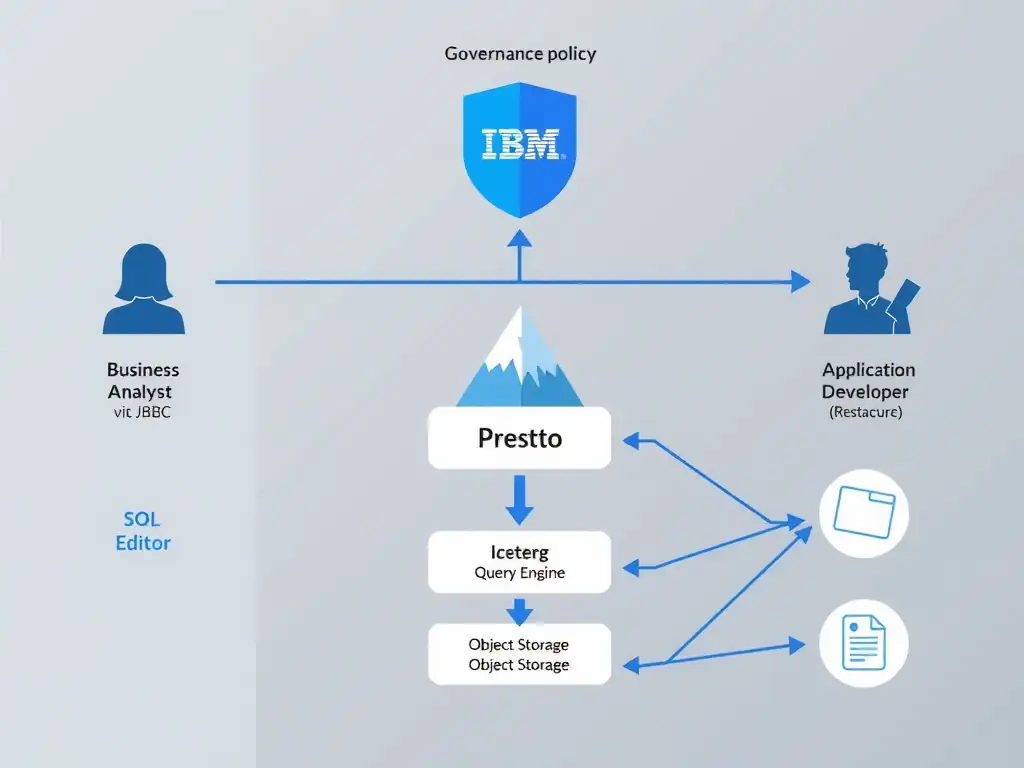
You don’t have to choose between self-service and governance. A BI or analytics tool writes the SQL for the user and sends it to the same engine, so the same policies apply to a drag-and-drop chart as to a hand-written query. Exports and side databases give up governance to get convenience.
Full Explanation
The correct approach is connecting a BI or analytics tool to an engine so its generated queries run under the same catalog policies. The tool generates SQL on the user's behalf and submits it over the engine's standard interface. Governance is unchanged because policies are evaluated at query time against the identity making the request, so a business user clicking through a visual builder is subject to exactly the controls an engineer is. Publishing a curated set of static exports for business users, refreshed on request, is incorrect because static exports are ungoverned copies. They also fail the stated requirement of exploration, since a user can only see what someone else chose to export. Granting business users a read-only bucket role so they can browse files without an engine is incorrect because bucket-level file access bypasses the catalog and its policies entirely. It is the least governed option on the list while being presented as the simplest. Building a separate summary database for business users with its own simplified permissions is incorrect because a parallel database with its own permission model creates a second source of truth and a second governance surface, and the two will drift in both data and policy. For the exam, tie self-service consumption to tools that query through the engine rather than to copies made for convenience.