
Which set of properties is the reason a lakehouse uses an open table format rather than plain files on object storage?
Select an answer to reveal the explanation.
Short Explanation
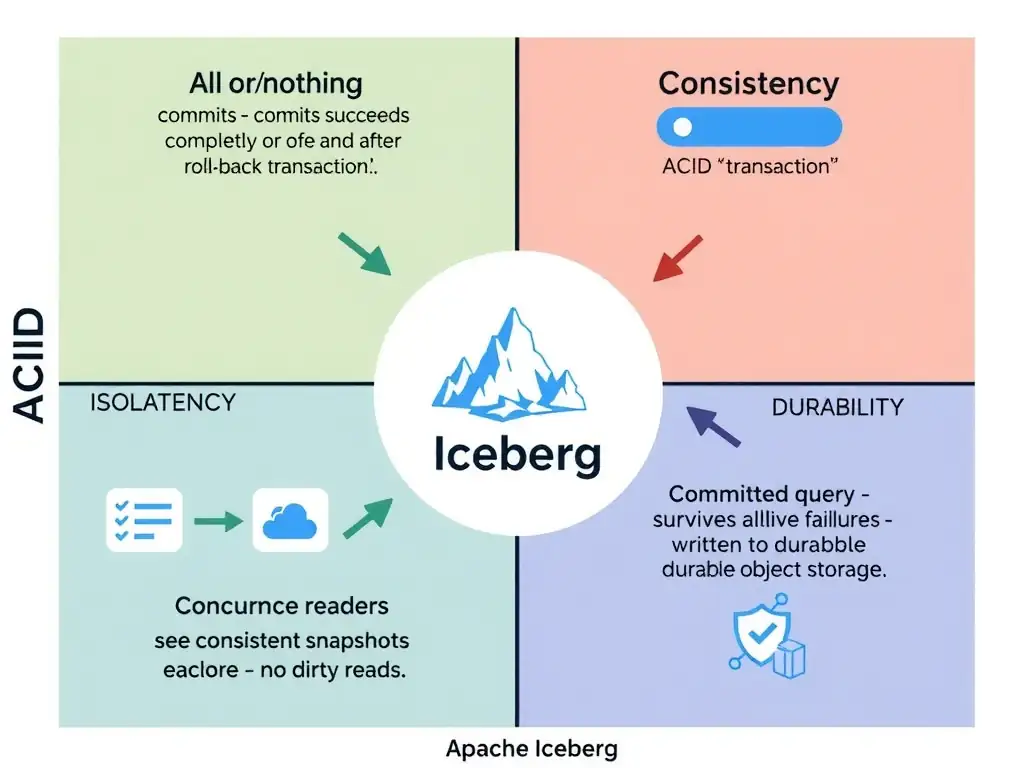
You need the set that gives you transactions, schema evolution, and concurrency. That's what an open table format adds over plain files. Everything else comes from other layers.
Full Explanation
The correct set is transactional consistency, schema evolution, and safe concurrent access across multiple engines. Open table formats exist to give data on object storage the guarantees relational systems provide: commits that are all-or-nothing, a definition that can change without rewriting history, and coordination so several engines can read and write the same table safely. The set listing compression, encryption at rest, and lifecycle expiry rules is incorrect because those are storage-layer capabilities available with or without a table format. The set listing network acceleration, request retry, and regional replication is incorrect because those are object-storage service characteristics, unrelated to table semantics. The set listing dashboard rendering, scheduled refresh, and export formatting is incorrect because those belong to consumption tools sitting above the lakehouse. For the exam, keep the three table-format properties together and do not confuse them with storage or business intelligence features.