
Why is increasing storage capacity before reading a query's error message an unsound response to a failure?
Select an answer to reveal the explanation.
Short Explanation
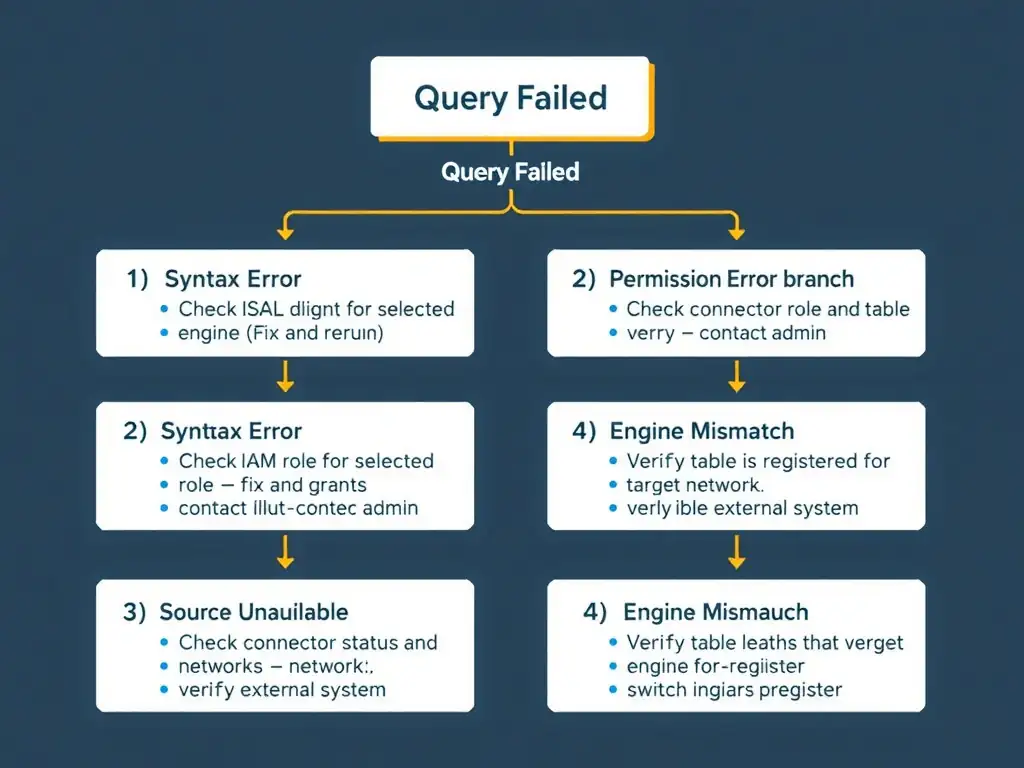
Read the error first. You're committing cost and change without evidence, and most query failures are a typo, a missing grant, or an unreachable source.
Full Explanation
The correct answer is the choice stating that increasing storage capacity commits cost and change without evidence, because most query failures—syntax, permissions, source availability—are unrelated to capacity. Acting before diagnosing spends money and alters the environment on a guess. The common causes of query failure—malformed SQL, missing entitlement, an unavailable source, the wrong engine—are all unaffected by storage capacity, so the change rarely helps and complicates later diagnosis. The claim that storage capacity cannot be increased once a lakehouse is in production is incorrect because capacity can be adjusted; the objection is that it is the wrong action here. The claim that adding capacity always invalidates existing table metadata is incorrect because adding capacity does not invalidate metadata. The claim that storage capacity affects only writes and can never be relevant to any failure is overstated: capacity genuinely can matter for write-path problems. The error is acting before reading the message, not the claim that storage is never relevant. For the exam, always read the error before changing infrastructure.