
What is the main drawback of running every workload on a single engine regardless of fit?
Select an answer to reveal the explanation.
Short Explanation
You can run everything on one engine, but you're making one compromise for every workload. Different jobs fight for the same resources, so the heaviest job sets everyone's experience. It's a fine starting point until the workloads diverge.
Full Explanation
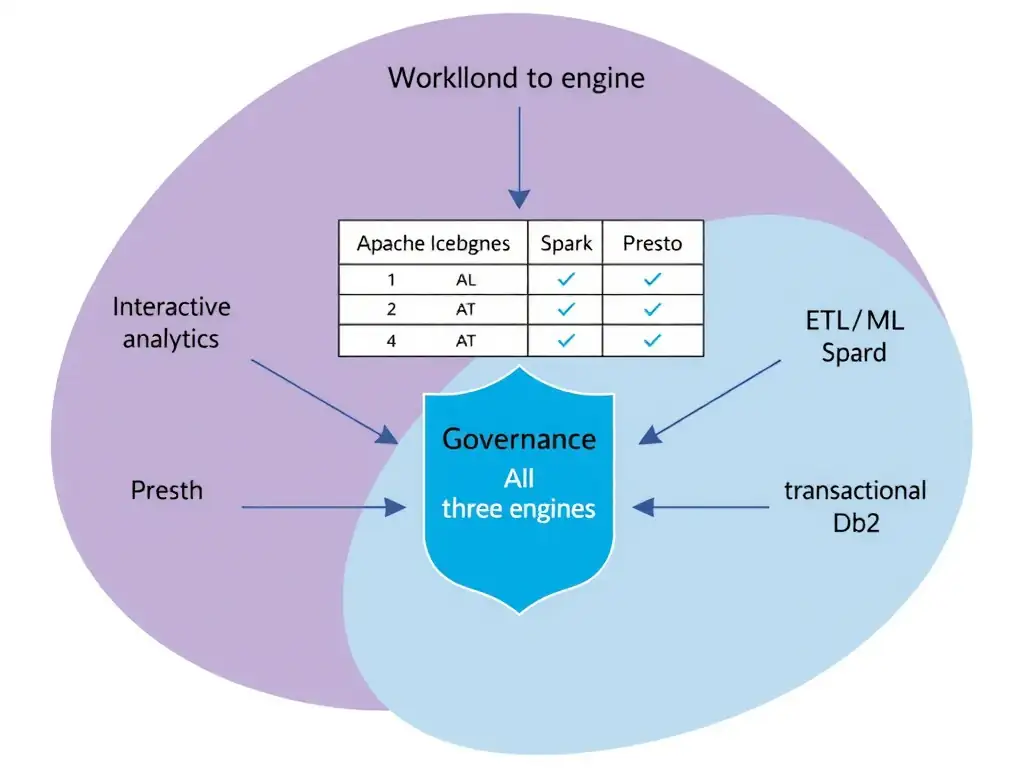
The correct answer is the one about workloads with different resource profiles contending with each other and the engine not being optimal for all of them at once. Interactive queries want low latency and small footprints; batch transformation wants throughput and large working sets. One engine must be sized for a compromise, and concurrent workloads compete for the same resources so a heavy job degrades everything else.
The catalog-access claim is incorrect because an engine can read multiple catalogs; catalog access is not the constraint.
The governance-only-with-multiple-engines claim is incorrect because governance is applied to the data and enforced regardless of engine count.
The unsupported-single-engine claim is incorrect because a single engine is perfectly supported and is often the right starting point. The issue is fit as workloads diversify.
For the exam, the objection to one-engine-for-everything is contention and sizing compromise.