
What does watsonx.data's REST API enable for application developers?
Select an answer to reveal the explanation.
Short Explanation
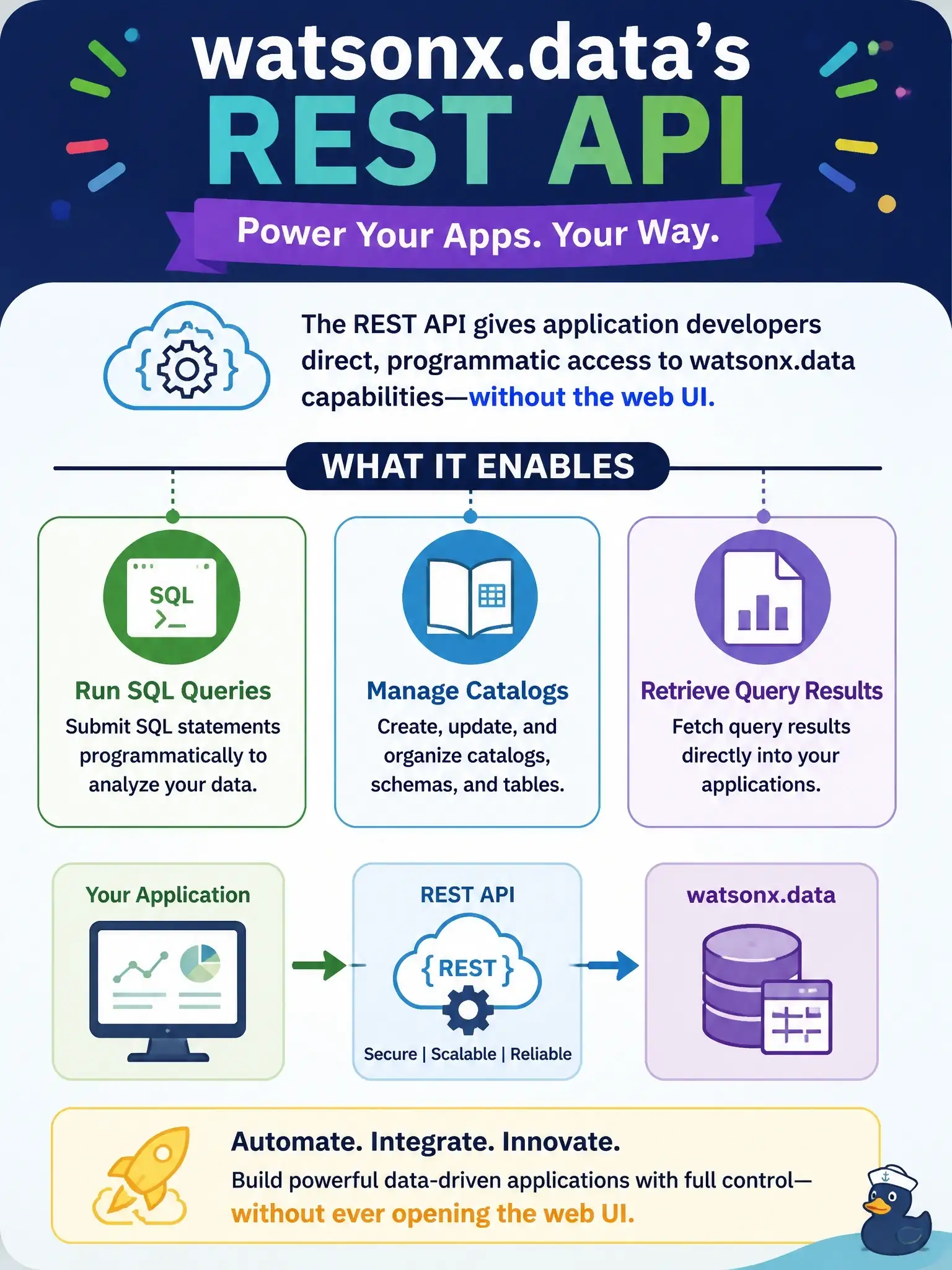
Think of the REST API as the back door for your code: everything you'd click in the console, you can script instead. You can register buckets, manage catalogs and schemas, work with engines, and send SQL to Presto and pull the results back, all without touching the web UI.
Full Explanation
The watsonx.data REST API exposes the platform's control and query surfaces to applications. Its reference covers bucket and database registrations, engines such as Presto, Prestissimo and Spark, catalogs, schemas and tables, ingestion jobs, and instance details, so developers can automate what administrators otherwise do in the console. For queries, the Presto engines accept SQL over HTTP through the statement endpoint, and results are retrieved by following the returned pages, so an application can submit SQL and read results programmatically. Direct binary reads of Parquet files are not part of this API; Parquet data in object storage is reached through a query engine and a catalog, and raw object access belongs to the storage provider's own API. Automated model training without code is a watsonx.ai concern, not a lakehouse API function. Real-time streaming of results over WebSocket connections is not how the API delivers results, which use standard paginated HTTP responses. On the exam, associate the API with automation of catalogs, engines and SQL execution. As an operational check, obtain a bearer token, call the catalogs listing endpoint, then submit a simple SELECT to a Presto engine and page through the results.