
What should be confirmed before rolling Instana out across an application estate?
Select an answer to reveal the explanation.
Short Explanation
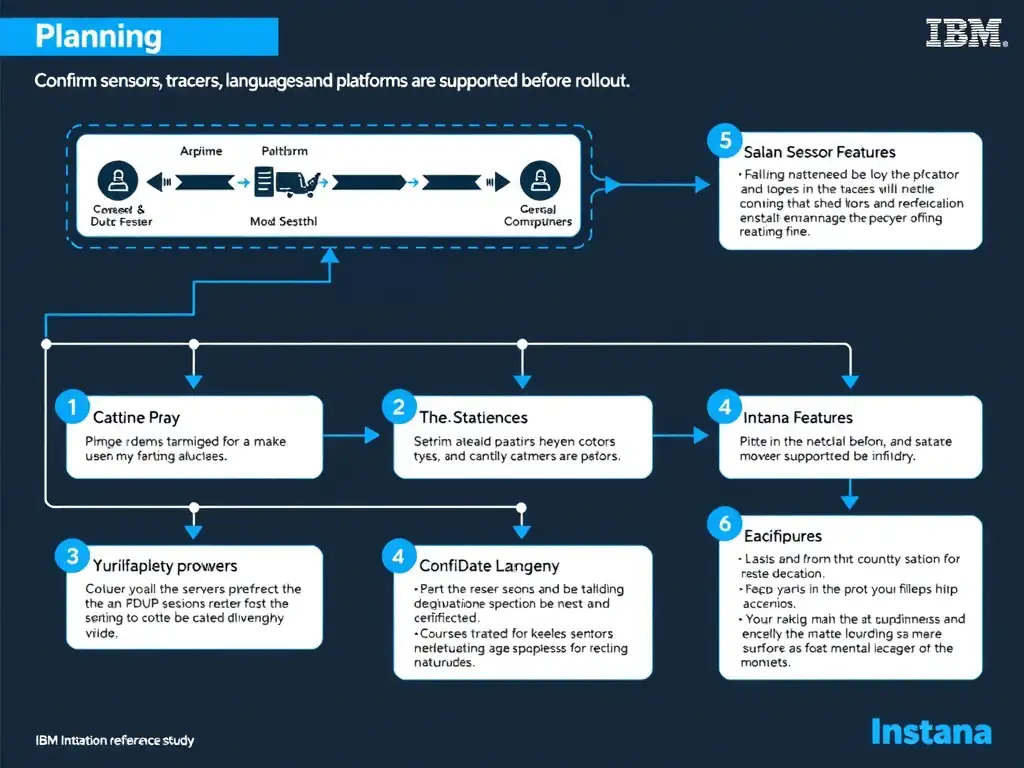
Check the support matrix first. You'll know which sensors and tracers exist for your languages, runtimes, and platforms before rollout. Finding an unsupported runtime during a demo is an expensive way to learn it.
Full Explanation
The correct answer is the confirmation that the required sensors and tracers exist for the languages, runtimes, and platforms in use, so gaps are known in advance rather than discovered afterwards. Instana publishes supported sensors, tracers, languages, and platforms. Checking that list against the estate before rollout turns potential surprises into known scope decisions.
The deploy-first approach, where nothing is confirmed in advance and services that fail to appear are investigated later, is incorrect because deploy-and-see wastes effort and surfaces gaps at the least convenient moment, often in front of stakeholders.
The CPU-only check, which assumes tracing is automatic for every library, is incorrect because automatic tracing depends on supported runtimes and instrumented libraries; it is not universal, and host capacity is a separate concern.
The approach of putting the most critical proof-of-concept workloads on unsupported runtimes to test the limits is incorrect because it guarantees the demonstration fails on the parts that matter most.
For the exam, treat support verification as a pre-rollout step.