
Validation of transformed business logic is assigned solely to the Java development team in the current plan, with no mainframe SME involvement. What is the concern?
Select an answer to reveal the explanation.
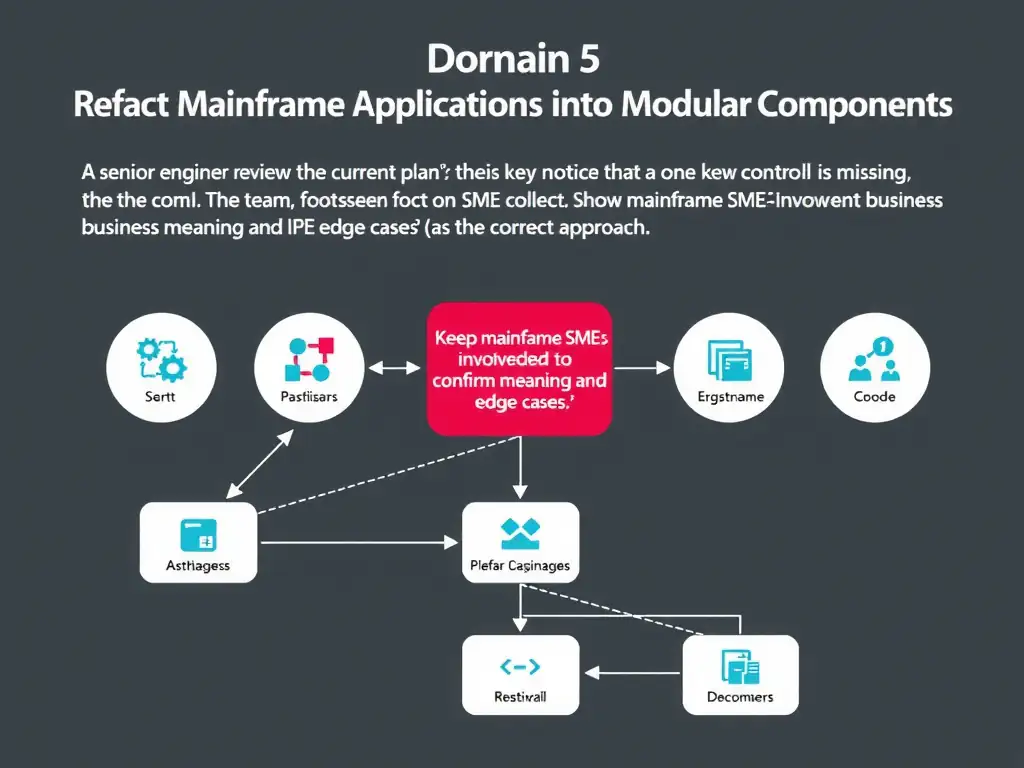
Short Explanation
You can trust the Java team to confirm the code does what it was written to do. But only mainframe SMEs can confirm it still does what the business originally meant.
Full Explanation
The correct concern is that Java developers can confirm the code behaves as written but may not know whether that behaviour matches the original business intent, which only mainframe SMEs can confirm. Technical correctness and business correctness are different questions, and validating the second requires people who understand what the legacy program was supposed to accomplish, which is the SMEs' domain.
The idea that Java developers are not qualified to write or review any Java code without SME supervision is incorrect and overstates the concern; Java developers are entirely capable of writing and reviewing Java code, and the gap is specifically business-intent validation.
The idea that Java development teams are prohibited from participating in validation activities is incorrect and describes no such restriction; Java teams are an appropriate part of validation, just not the whole of it.
The idea that the plan has correctly identified the right people and no further involvement is needed is incorrect because it ignores the stated gap, which is exactly the concern being raised.
For the exam, business-meaning validation requires SME involvement in addition to, not instead of, developer review.