
A validation plan only tests the happy path for transformed code. What is the main gap?
Select an answer to reveal the explanation.
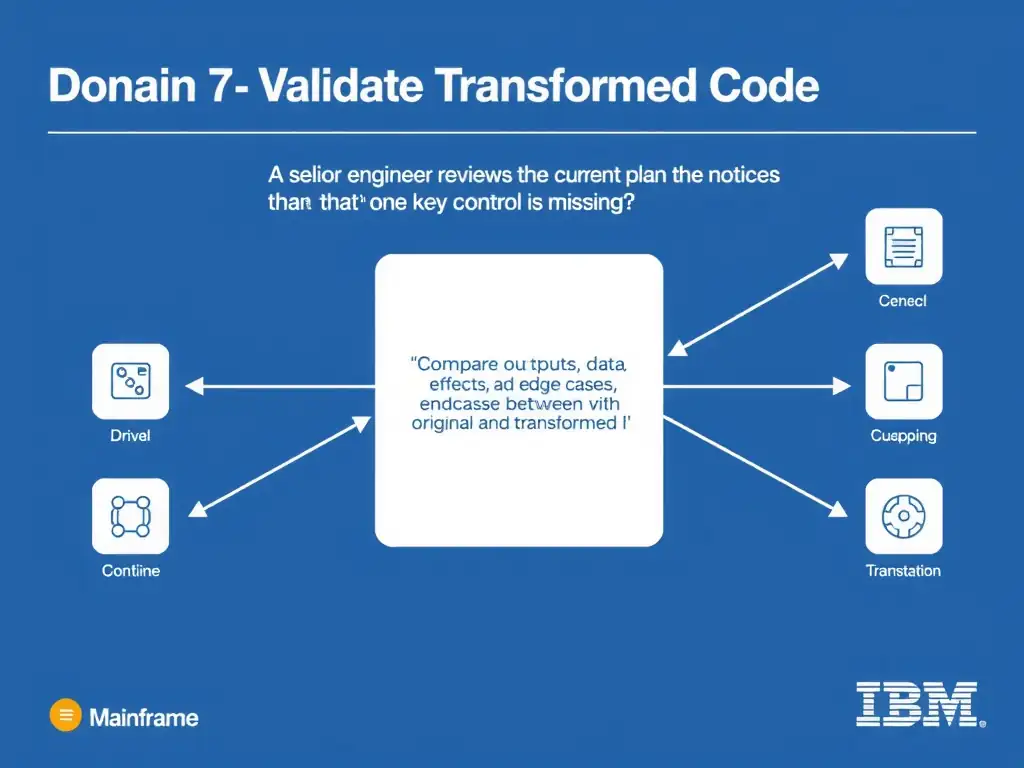
Short Explanation
The happy path is where COBOL and Java agree. The edges are where they quietly disagree, so you don't catch behavioural differences unless you test edge cases and boundary conditions.
Full Explanation
The correct answer is the statement that it misses edge cases and boundary conditions, which is where behavioural differences between COBOL and Java most often show up. Differences in numeric handling, rounding and boundary conditions between COBOL and Java typically show up at the edges, so a happy-path-only plan misses exactly the cases most likely to reveal a defect. The claim that it takes longer to run than a full test suite would is incorrect because a happy-path-only suite is actually faster, not slower, than a thorough one; speed is not the gap. The claim that it cannot be automated in a continuous integration pipeline is incorrect because happy-path tests can be automated just as easily as edge-case tests. The claim that it requires the original COBOL source to still be available is incorrect because both kinds of test need the same access to the original source. For the exam, flag happy-path-only coverage as an incomplete validation plan.