
What makes test data management particularly challenging when validating transformed COBOL-to-Java modules?
Select an answer to reveal the explanation.
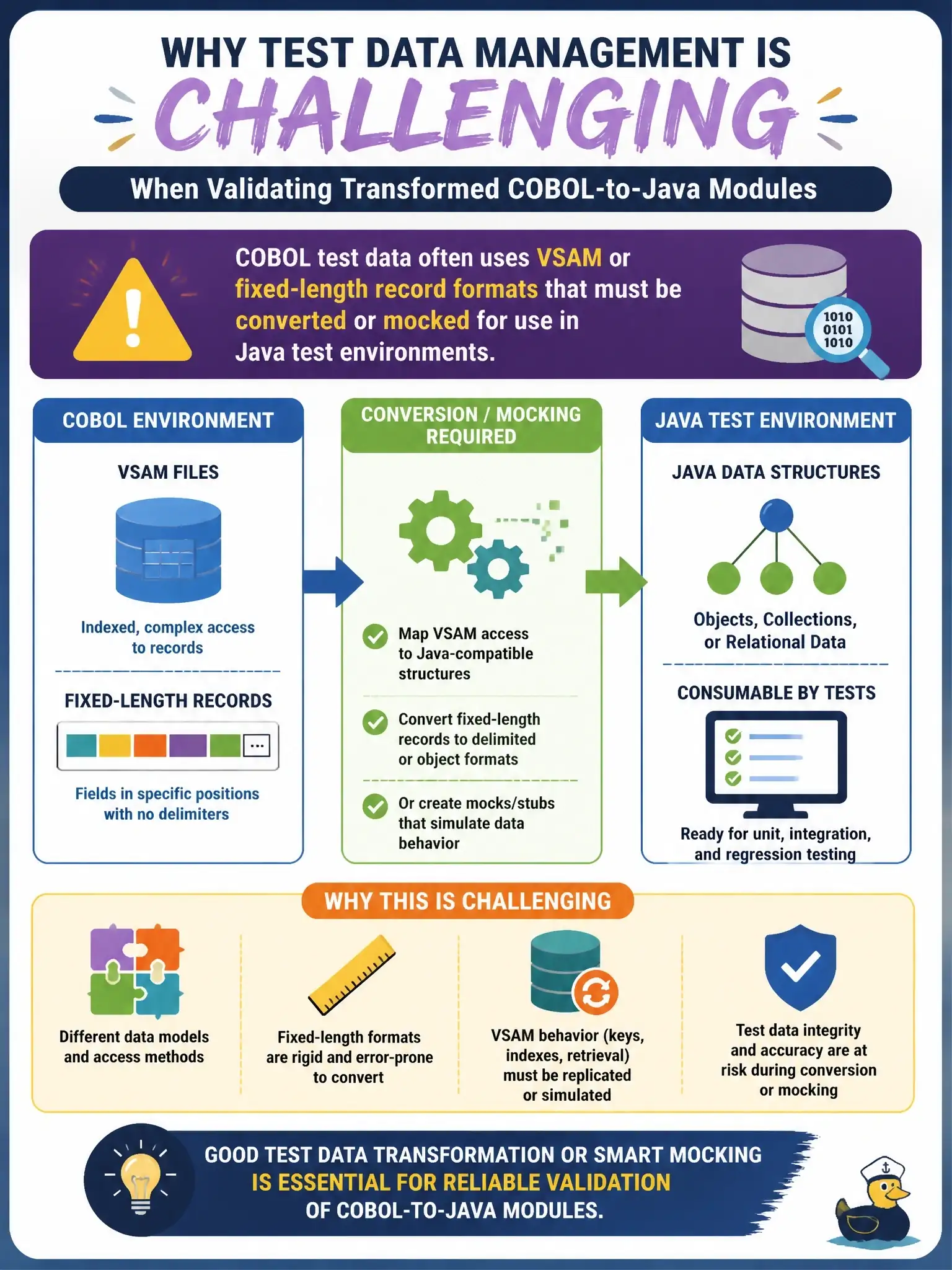
Short Explanation
Your COBOL test data lives in mainframe-shaped boxes, VSAM datasets and fixed-length records, and Java tests can't just open those boxes as-is. You have to capture, convert, or mock that data before JUnit can use it to prove the Java matches the COBOL.
Full Explanation
Validating a transformed module means proving that the Java produces the same results as the COBOL for the same inputs. That input data usually lives in VSAM datasets, sequential files with fixed-length records, and copybook-defined layouts with packed decimal fields, none of which a Java test harness consumes directly. IBM's Z Validation Assistant addresses this by running the COBOL program to capture test data, generating JUnit comparison tests, and supplying mock libraries so the Java methods can run against that data in isolation. The claim that Java cannot read EBCDIC at all is false: the JDK's extended encoding set includes EBCDIC code pages such as IBM037 and IBM1047, so encoding is a conversion detail rather than a hard blocker. No IBM quality council certifies test data before use; data preparation is the project team's responsibility. Test data management is not limited to Db2 either, because file, VSAM, and CICS resources all need representative data. On the exam, tie validation challenges to record formats, data capture, and mocking. As an operational check, confirm that captured test data files exist in the project's .validate folder and that the generated JUnit tests run against mocked resources.