
When a COBOL SECTION contains multiple paragraphs, how does wca4z structure the generated Java?
Select an answer to reveal the explanation.
Short Explanation
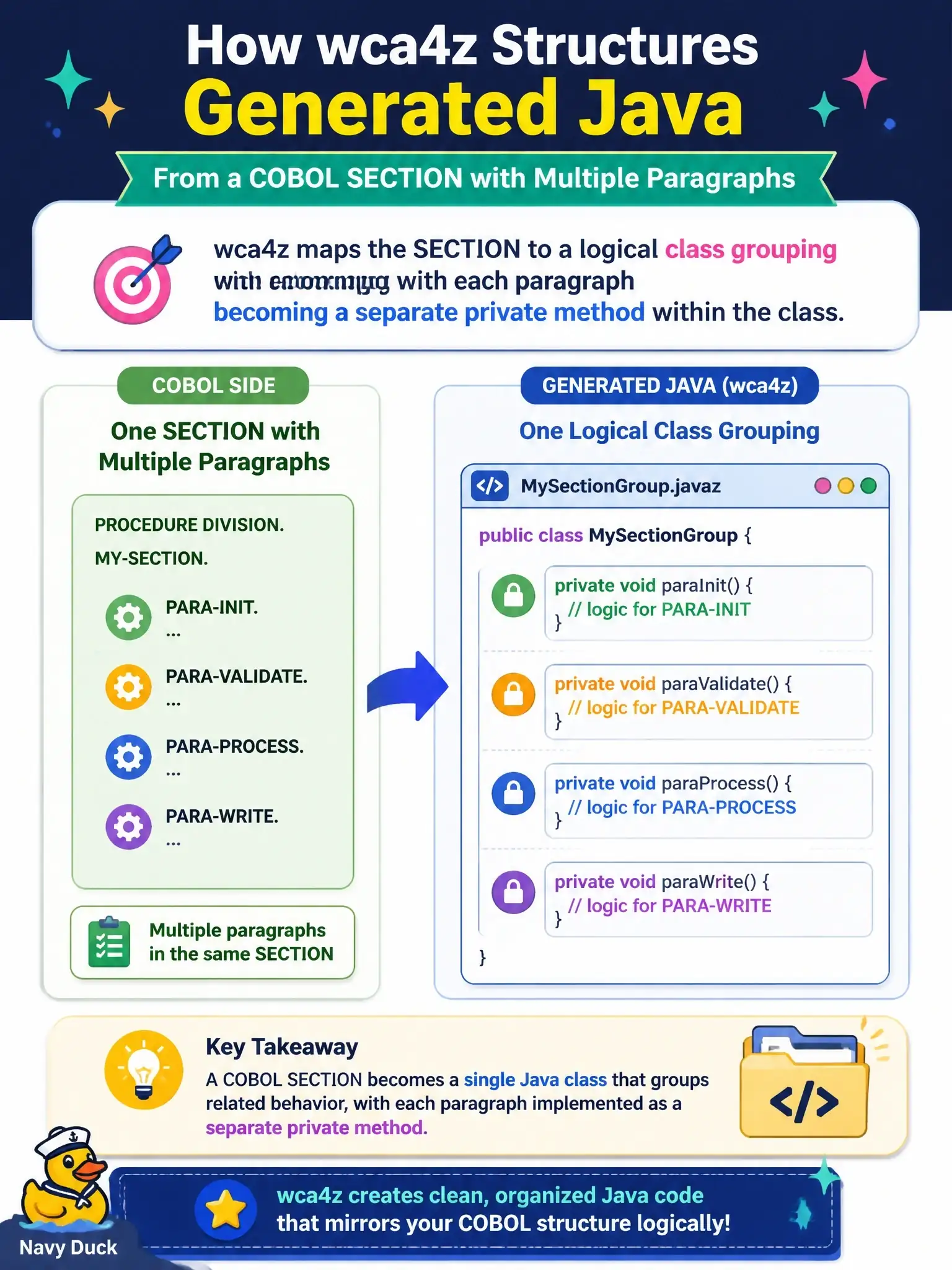
Think of a COBOL SECTION as a folder and its paragraphs as the files in it. In Java, wca4z keeps that folder as a grouping inside a class and turns each paragraph into its own method, so the structure you knew in COBOL is still there.
Full Explanation
Watsonx Code Assistant for Z builds Java classes from the COBOL data model and then converts the logic paragraph by paragraph into Java method signatures within the appropriate class. A SECTION is only a named group of paragraphs, so the natural result is a logical grouping in a class where each paragraph becomes its own method, usually private because it serves the class's own flow rather than outside callers. This keeps the COBOL hierarchy visible, lets each method be tested on its own, and matches the paragraph-to-method rule IBM describes. Turning the section into an abstract class with a concrete subclass per paragraph misuses inheritance; paragraphs are steps in one procedure, not specialized variants of a type. Making the section a package and each paragraph a top-level class would scatter tightly coupled logic across many files and break shared access to working storage. Inlining all paragraphs into one method would throw away the paragraph boundaries that PERFORM statements target. On the exam, remember that paragraphs map to methods. As an operational check, open the class design for a program with sections, confirm each paragraph appears as a method, and verify that PERFORM calls target the right ones.