
When wca4z transforms a COBOL program, which Java structural element typically corresponds to the COBOL PROCEDURE DIVISION?
Select an answer to reveal the explanation.
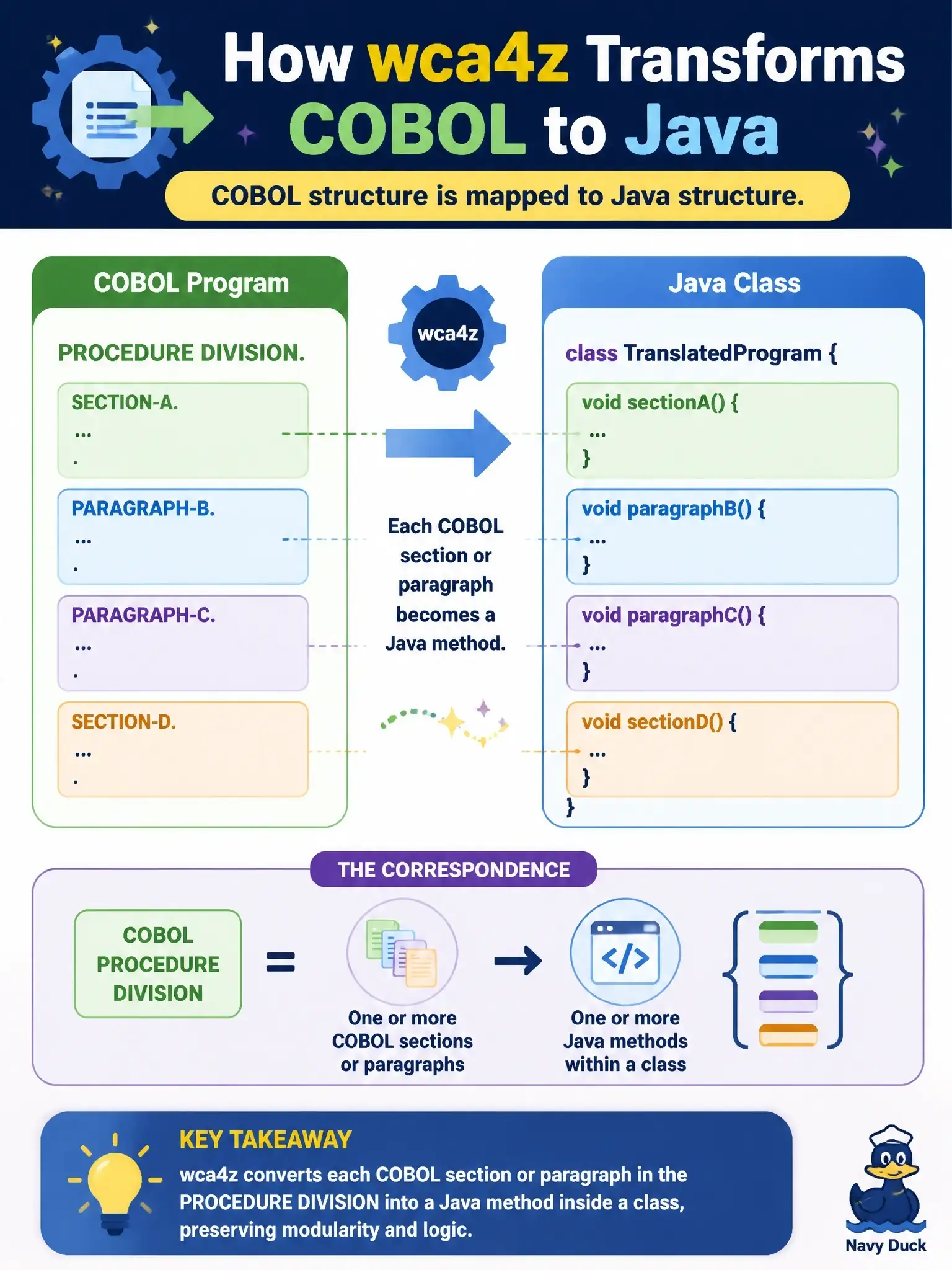
Short Explanation
Picture the PROCEDURE DIVISION as a to-do list broken into named chunks. When wca4z moves that list to Java, each chunk, meaning each paragraph or section, turns into a method inside a class, so the logic keeps its shape.
Full Explanation
IBM describes the COBOL-to-Java flow of watsonx Code Assistant for Z as two steps: first it generates Java classes from the COBOL data structures, then it converts the logic paragraph by paragraph into the appropriate Java method signature within the appropriate class. That means the executable part of a COBOL program, the PROCEDURE DIVISION, lands as one or more methods, while the DATA DIVISION drives the class and field design. Keeping paragraphs as methods preserves the original control flow, so a reviewer can trace each Java method back to the COBOL name shown beside it in the class design view. A Java annotation class is metadata about code; it holds no business logic and cannot execute statements. An interface that exposes every paragraph as an abstract method would contain no implementation at all, so nothing would actually run. An enum of PERFORM targets would only list names as constants and would lose the logic behind them. On the exam, remember the pairing: data structures shape classes, paragraphs become methods. As an operational check, open the generated class design, confirm that each COBOL paragraph you selected has a matching Java method, and review the generated method bodies against the source paragraph.